The graph shows the effect of auxin concentration on the elongation of cells in isolated root and shoot tissues of a plant species. One curve represents roots and the other represents shoots.
An intact seedling is placed horizontally in darkness. Due to gravity, auxin redistributes such that: - the upper tissue layer in both the root and the shoot has an auxin concentration of 10−4 arbitrary units - the lower tissue layer in both the root and the shoot has an auxin concentration of 1.0 arbitrary units Which row in the table correctly identifies the curve representing roots and predicts the resulting direction of curvature for the root and the shoot?
| | Curve representing roots | Direction of root curvature | Direction of shoot curvature | | :--- | :--- | :--- | :--- | | A | Curve P | downwards | upwards | | B | Curve P | downwards | downwards | | C | Curve P | upwards | upwards | | D | Curve P | upwards | downwards | | E | Curve Q | downwards | upwards | | F | Curve Q | downwards | downwards | | G | Curve Q | upwards | upwards | | H | Curve Q | upwards | downwards |
1. Curve Identification: Root cells are considerably more sensitive to auxin than shoot cells; they are stimulated by very low auxin concentrations and inhibited by the higher concentrations that promote shoot growth. Therefore, Curve P (peaking at 10−4 a.u. and inhibited at concentrations ≥10−2 a.u. ) represents roots, and Curve Q represents shoots.
2. Root Curvature: For the horizontal root, the upper tissue layer has an auxin concentration of 10−4 a.u. , giving +50% stimulation of cell elongation. The lower tissue layer has a concentration of 1.0 a.u. , giving −60% inhibition of elongation. Because the upper cells elongate faster than the lower cells, the root bends downwards.
3. Shoot Curvature: For the horizontal shoot, the upper tissue layer has an auxin concentration of 10−4 a.u. ( 0% stimulation). The lower tissue layer has a concentration of 1.0 a.u. , giving +80% stimulation of cell elongation. Because the lower cells elongate faster than the upper cells, the shoot bends upwards.
Hence, the correct row is A.
▸Question 2
Warm water at \pu38∘C is continuously discharged from an industrial cooling system into a cold, slow-flowing river.
Which of the following could occur in the river downstream of the discharge point?
1 An increase in the mass of dissolved oxygen held in a given volume of water at saturation.
2 An increase in the rate of aerobic cellular respiration per unit body mass in resident ectothermic organisms.
3 A reduction in the population size of fish species with high dissolved oxygen requirements.
A.
none of them
B.
1 only
C.
2 only
D.
3 only
E.
1 and 2 only
F.
1 and 3 only
G.
2 and 3 only
H.
1, 2 and 3
Answer and solution
Answer: G
1 is incorrect: The solubility of gases in liquids decreases as temperature increases. Therefore, warmer water holds a lower mass of dissolved oxygen per unit volume at saturation.
2 is correct: Ectothermic (poikilothermic) organisms do not maintain a constant body temperature metabolically; their internal temperature equilibrates with the surrounding water. Warmer body temperatures increase molecular kinetic energy and enzyme-catalysed reaction rates, increasing the rate of aerobic cellular respiration per unit body mass.
3 is correct: As water temperature increases, dissolved oxygen availability declines (due to lower solubility) while the metabolic oxygen demand of aquatic organisms rises. Fish species with high dissolved oxygen requirements experience hypoxia and respiratory stress, leading to increased mortality or migration and a reduction in their population size.
Hence, only statements 2 and 3 are correct.
▸Question 3
The diagram shows a circular recombinant plasmid constructed by inserting a foreign gene of interest into a bacterial plasmid vector.
The original, non-recombinant plasmid contained three functional genes: - gene A , coding for resistance to the antibiotic ampicillin - gene B , coding for resistance to the antibiotic tetracycline - gene C , coding for resistance to the antibiotic kanamycin
During the construction of the recombinant plasmid, the gene of interest was inserted into the coding region of gene B , as shown in the diagram.
Samples of bacteria containing only the recombinant plasmid and samples of bacteria containing only the original plasmid were separately inoculated onto four sets of agar plates: - Plate 1: agar containing ampicillin and kanamycin - Plate 2: agar containing ampicillin and tetracycline - Plate 3: agar containing tetracycline and kanamycin - Plate 4: nutrient agar containing no antibiotics
Which row in the table correctly identifies all the agar plates that will support the growth of each bacterial type?
| | Agar plates supporting growth of bacteria containing only the recombinant plasmid | Agar plates supporting growth of bacteria containing only the original plasmid | | :--- | :--- | :--- | | A | 1 and 4 only | 1, 2, 3, and 4 | | B | 1 and 4 only | 1, 2, and 3 only | | C | 4 only | 1, 2, 3, and 4 | | D | 4 only | 1, 2, and 3 only | | E | 1, 2, and 4 only | 1, 2, 3, and 4 | | F | 2 and 3 only | 1, 2, 3, and 4 | | G | 1 only | 1, 2, and 3 only | | H | 1, 2, 3, and 4 | 1, 2, 3, and 4 |
recombinant plasmid: 1 and 4 only; original plasmid: 1, 2, 3, and 4
B.
recombinant plasmid: 1 and 4 only; original plasmid: 1, 2, and 3 only
C.
recombinant plasmid: 4 only; original plasmid: 1, 2, 3, and 4
D.
recombinant plasmid: 4 only; original plasmid: 1, 2, and 3 only
E.
recombinant plasmid: 1, 2, and 4 only; original plasmid: 1, 2, 3, and 4
F.
recombinant plasmid: 2 and 3 only; original plasmid: 1, 2, 3, and 4
G.
recombinant plasmid: 1 only; original plasmid: 1, 2, and 3 only
H.
recombinant plasmid: 1, 2, 3, and 4; original plasmid: 1, 2, 3, and 4
Answer and solution
Answer: A
1. In the recombinant plasmid, the foreign gene of interest has been inserted directly into the coding sequence of gene B (insertional inactivation). This disrupts gene B , making it non-functional, so bacteria containing the recombinant plasmid are sensitive to tetracycline. However, gene A (ampicillin resistance) and gene C (kanamycin resistance) remain intact and functional.
- Plate 1 (ampicillin + kanamycin): The bacteria possess intact genes A and C , conferring resistance to both antibiotics, so they will grow. - Plate 2 (ampicillin + tetracycline): Tetracycline is present and gene B is disrupted, so the bacteria will not grow. - Plate 3 (tetracycline + kanamycin): Tetracycline is present and gene B is disrupted, so the bacteria will not grow. - Plate 4 (no antibiotics): There are no inhibitory substances, so the bacteria will grow.
Therefore, bacteria with only the recombinant plasmid grow on Plates 1 and 4 only.
2. In the original plasmid, genes A , B , and C are all intact. The bacteria are therefore resistant to ampicillin, tetracycline, and kanamycin, and can grow on all selective plates (Plates 1, 2, and 3) as well as the nutrient agar plate lacking antibiotics (Plate 4).
Therefore, the correct row is A.
▸Question 4
Two strips of plant tissue, P and Q, are prepared for an experiment. The cells in Strip P have a mean internal solute concentration of 0.6mol dm−3 . The cells in Strip Q have a mean internal solute concentration of 0.2mol dm−3 .
Both strips are submerged in a beaker containing a sucrose solution with a concentration of 0.4mol dm−3 .
Which option correctly predicts the initial change in turgor pressure for the cells in each strip?
A.
Strip P: Increases; Strip Q: Decreases
B.
Strip P: Increases; Strip Q: Increases
C.
Strip P: Decreases; Strip Q: Increases
D.
Strip P: Decreases; Strip Q: Decreases
Answer and solution
Answer: A
Water moves by osmosis from a region of higher water potential (lower solute concentration) to a region of lower water potential (higher solute concentration).
1. **Strip P ( 0.6mol dm−3 ) vs Solution ( 0.4mol dm−3 ): The cells in P have a higher solute concentration than the solution. Therefore, the water potential inside the cells is lower than the solution. Water moves into the cells. Turgor pressure increases**.
2. **Strip Q ( 0.2mol dm−3 ) vs Solution ( 0.4mol dm−3 ): The cells in Q have a lower solute concentration than the solution. Therefore, the water potential inside the cells is higher than the solution. Water moves out of the cells. Turgor pressure decreases**.
Thus, Strip P increases and Strip Q decreases.
▸Question 5
Which of the following statements about human cells is/are correct?
1 An osteocyte contains the same nuclear genes as a mesenchymal stem cell from the same individual.
2 A mature spermatozoon contains half the number of chromosomes found in a secondary spermatocyte.
3 When an adult stem cell divides asymmetrically, it produces one stem cell and one daughter cell that can undergo differentiation.
(Assume that no mutations have occurred.)
A.
none of them
B.
1 only
C.
2 only
D.
3 only
E.
1 and 2 only
F.
1 and 3 only
G.
2 and 3 only
H.
1, 2 and 3
Answer and solution
Answer: F
Statement 1 is correct: During development and cellular differentiation, cells become specialised through differential gene expression (transcribing specific subsets of genes while silencing others) rather than by losing genetic material. Both an osteocyte and a mesenchymal stem cell from the same individual carry the same full complement of nuclear genes.
Statement 2 is incorrect: A primary spermatocyte ( 2n=46 ) undergoes meiosis I to produce secondary spermatocytes. Because homologous chromosomes separate during meiosis I, each secondary spermatocyte is haploid with n=23 chromosomes (each composed of two sister chromatids). Meiosis II then separates sister chromatids to produce spermatids that mature into spermatozoa, which are also haploid with n=23 chromosomes (each composed of a single chromatid). Thus, a mature spermatozoon contains the same number of chromosomes (23) as a secondary spermatocyte (23), though it contains half the amount of DNA / chromatids.
Statement 3 is correct: Asymmetric division is a key mechanism of adult stem cells that allows self-renewal alongside tissue maintenance. One daughter cell remains an undifferentiated stem cell, while the other commits to a differentiation pathway.
Therefore, statements 1 and 3 only are correct.
▸Question 6
In a plant, tall height is controlled by a dominant allele T and dwarf height by a recessive allele t . A pure-breeding tall plant is crossed with a pure-breeding dwarf plant. Two offspring from this cross are then crossed.
What proportion of their offspring is expected to be dwarf?
A.
0
B.
81
C.
41
D.
21
E.
43
F.
1
Answer and solution
Answer: C
The first cross is TT×tt , so every offspring is Tt . Crossing two of these gives Tt×Tt , producing genotypes TT,Tt,Tt,tt . Only tt is dwarf, so the expected proportion is 1/4 , option C.
▸Question 7
The table shows the concentrations of substances in blood entering and leaving three different organs of a healthy adult who has been fasting for 24 hours:
Which row in the table below correctly identifies the three organs?
| | organ 1 | organ 2 | organ 3 | | :--- | :--- | :--- | :--- | | A | lungs | brain | liver | | B | lungs | liver | brain | | C | liver | lungs | brain | | D | liver | brain | lungs | | E | brain | lungs | liver | | F | brain | liver | lungs |
A.
organ 1: lungs, organ 2: brain, organ 3: liver
B.
organ 1: lungs, organ 2: liver, organ 3: brain
C.
organ 1: liver, organ 2: lungs, organ 3: brain
D.
organ 1: liver, organ 2: brain, organ 3: lungs
E.
organ 1: brain, organ 2: lungs, organ 3: liver
F.
organ 1: brain, organ 2: liver, organ 3: lungs
Answer and solution
Answer: B
To identify each organ, consider the metabolic activity of each during a 24-hour fast:
1. Organ 1: Oxygen concentration increases markedly from 40 to 95 arbitrary units, while glucose and urea concentrations remain unchanged. This corresponds to the lungs, where deoxygenated blood from the pulmonary artery is oxygenated before entering the pulmonary vein, with no significant net exchange of glucose or urea.
2. Organ 2: Oxygen concentration decreases from 95 to 70 arbitrary units due to aerobic respiration. Glucose concentration increases from 4.5 mmol dm−3 to 6.0 mmol dm−3 because during fasting, glycogenolysis and gluconeogenesis in the liver release glucose into the circulation. Urea concentration also increases from 5.0 mmol dm−3 to 5.8 mmol dm−3 because the liver synthesises urea via deamination of amino acids. Thus, Organ 2 is the liver.
3. Organ 3: Oxygen decreases from 95 to 70 arbitrary units and glucose decreases from 4.5 mmol dm−3 to 3.8 mmol dm−3 , reflecting continuous aerobic consumption of glucose as the primary fuel source. Urea concentration is unchanged because the brain neither synthesises nor excretes urea into blood. Thus, Organ 3 is the brain.
Therefore, row B is correct.
▸Question 8
Strips of plant epidermal tissue were placed into sucrose solutions of different concentrations. After reaching equilibrium, the percentage of plasmolysed cells was determined for each solution. Plasmolysis occurs when a plant cell loses water and its cytoplasm pulls away from the cell wall.
The graph shows the results obtained.
Which option correctly describes the effect of increasing the concentration of sucrose from 0.25 mol dm−3 to 0.40 mol dm−3 on the percentage of plasmolysed cells, and states the underlying cause?
A.
increases by 70% due to the net movement of water out of the cells
B.
increases by 70% due to the net movement of sucrose into the cells
C.
increases by 80% due to the net movement of water out of the cells
D.
increases by 80% due to the net movement of sucrose into the cells
E.
decreases by 70% due to the net movement of water into the cells
F.
decreases by 70% due to the net movement of sucrose out of the cells
G.
decreases by 80% due to the net movement of water into the cells
H.
decreases by 80% due to the net movement of sucrose out of the cells
Answer and solution
Answer: A
1. Reading the graph at a sucrose concentration of 0.25 mol dm−3 : The line segment between (0.20,0) and (0.30,20) is linear, so at 0.25 mol dm−3 , the percentage of plasmolysed cells is 10% .
2. Reading the graph at a sucrose concentration of 0.40 mol dm−3 : The percentage of plasmolysed cells is 80% .
3. The change in percentage of plasmolysed cells is: 80%−10%=+70% representing an increase of 70% .
4. Biological cause: Increasing the external sucrose concentration decreases the water potential of the surrounding solution. Water moves out of the plant cells down the water potential gradient by osmosis across the partially permeable cell surface membrane, causing protoplasts to shrink and plasmolyse. Sucrose does not freely enter the cells.
▸Question 9
The diagram shows part of the terrestrial nitrogen cycle involving four pools of nitrogen labeled P, Q, R, and S.
Which row correctly identifies boxes P, Q, R, and S?
| | Atmospheric \ceN2 | Ammonium ions in soil | Nitrate ions in soil | Organic nitrogen compounds in plants | | :--- | :---: | :---: | :---: | :---: | | A | P | R | S | Q | | B | P | S | R | Q | | C | Q | S | R | P | | D | Q | R | S | P | | E | S | R | Q | P | | F | S | Q | R | P | | G | Q | P | S | R | | H | S | P | R | Q |
Atmospheric \ceN2 : P; Ammonium ions in soil: R; Nitrate ions in soil: S; Organic nitrogen compounds in plants: Q
B.
Atmospheric \ceN2 : P; Ammonium ions in soil: S; Nitrate ions in soil: R; Organic nitrogen compounds in plants: Q
C.
Atmospheric \ceN2 : Q; Ammonium ions in soil: S; Nitrate ions in soil: R; Organic nitrogen compounds in plants: P
D.
Atmospheric \ceN2 : Q; Ammonium ions in soil: R; Nitrate ions in soil: S; Organic nitrogen compounds in plants: P
E.
Atmospheric \ceN2 : S; Ammonium ions in soil: R; Nitrate ions in soil: Q; Organic nitrogen compounds in plants: P
F.
Atmospheric \ceN2 : S; Ammonium ions in soil: Q; Nitrate ions in soil: R; Organic nitrogen compounds in plants: P
G.
Atmospheric \ceN2 : Q; Ammonium ions in soil: P; Nitrate ions in soil: S; Organic nitrogen compounds in plants: R
H.
Atmospheric \ceN2 : S; Ammonium ions in soil: P; Nitrate ions in soil: R; Organic nitrogen compounds in plants: Q
Answer and solution
Answer: D
To identify each pool, trace the biological processes represented by the directional arrows:
1. **Nitrification ( R→S ):** Nitrifying bacteria oxidize ammonium ions ( \ceNH4+ ) into nitrite and then nitrate ions ( \ceNO3− ). Thus, R is ammonium ions in soil and S is nitrate ions in soil. 2. **Outflows from nitrate ( S ): Nitrate ions (S) have two fates: - Denitrification ( S→Q ):** Denitrifying bacteria convert nitrate into atmospheric nitrogen gas ( \ceN2 ), so Q is atmospheric \ceN2 . - **Assimilation ( S→P ): Plant roots absorb nitrate ions to synthesize amino acids, proteins, and nucleic acids, so P is organic nitrogen compounds in plants. 3. Confirmation of other arrows:** - Q→R : Nitrogen fixation by free-living soil bacteria converts \ceN2 to \ceNH4+ . - Q→P : Nitrogen fixation by mutualistic bacteria (*Rhizobium*) in root nodules provides fixed nitrogen directly to the host plant. - P→R : Ammonification/decomposition of dead plant biomass and waste by saprobionts releases ammonium ions into the soil.
Matching the pools: - Atmospheric \ceN2 : Q - Ammonium ions in soil: R - Nitrate ions in soil: S - Organic nitrogen compounds in plants: P
This corresponds to row D.
▸Question 10
Four distinct biological specimens (W, X, Y, and Z) were analysed. The results of the analysis are shown in the table below:
| Sample | Genome type | Enclosed by a phospholipid bilayer | Contains ribosomes | Capable of synthesizing ATP | | :---: | :---: | :---: | :---: | :---: | | W | double-stranded DNA (circular) | yes | yes (70S) | yes | | X | single-stranded RNA | yes | no | no | | Y | double-stranded DNA (linear) | yes | yes (80S) | yes | | Z | double-stranded DNA (linear) | no | no | no |
A student made the following statements about these specimens:
1 Sample X could be an enveloped virus, such as the influenza virus.
2 Sample W must be a mitochondrion and cannot be a free-living bacterium.
3 An antibiotic that selectively inhibits 70S ribosomes would directly inhibit protein synthesis in Sample W, but not in the cytoplasm of Sample Y.
Which of these statements is/are correct?
A.
none of them
B.
1 only
C.
2 only
D.
3 only
E.
1 and 2 only
F.
1 and 3 only
G.
2 and 3 only
H.
1, 2 and 3
Answer and solution
Answer: F
Statement 1 is correct: Enveloped viruses (such as the influenza virus) have a single-stranded RNA genome enclosed within a host-derived phospholipid bilayer envelope. They lack ribosomes and do not possess independent ATP-synthesizing metabolic machinery.
Statement 2 is incorrect: Sample W contains circular double-stranded DNA, 70S ribosomes, a phospholipid bilayer membrane, and metabolic machinery to synthesize ATP. These are standard characteristics of free-living bacteria as well as mitochondria. Therefore, Sample W could be a bacterium; it does not have to be a mitochondrion.
Statement 3 is correct: Sample W contains 70S ribosomes, so an antibiotic targeting 70S ribosomes will directly inhibit its translation. Sample Y has 80S ribosomes in its cytoplasm, which are structurally distinct from 70S ribosomes and are not directly inhibited by 70S-specific antibiotics.
Therefore, only statements 1 and 3 are correct.
▸Question 11
A seed is collected from a plant belonging to a true-breeding line that consistently produces red flowers. The seed is planted and grows into a new plant. <p>This plant develops multiple branches, all of which bear red flowers, except for one single branch which exclusively bears white flowers, as shown in the diagram.</p><p>
What is the most likely genetic explanation for the white-flowered branch?</p>
A.
A somatic mutation occurred in a cell within the apical meristem of that specific branch.
B.
The parent plant was heterozygous, carrying a recessive allele for white flowers.
C.
The mutation for white flowers was present in the pollen grain that fertilised the parent flower.
D.
A localised deficiency of a specific mineral in the soil affected that branch.
E.
The mutation occurred in the zygote from which the entire plant grew.
Answer and solution
Answer: A
1. The plant is from a 'true-breeding' line for red flowers. This means its parents were homozygous for the allele for red flowers. This rules out Option B, as there would be no hidden recessive allele for white flowers.
2. If the mutation had occurred in a parental gamete (like the pollen in Option C) or in the zygote itself (Option E), the mutation would be present in every cell of the resulting plant. Consequently, all branches of the plant would be affected and would likely produce white flowers, not just a single branch.
3. The observation that only one branch has a different phenotype (a form of mosaicism) indicates that the genetic change happened after the initial development of the plant, in a localised group of cells.
4. In plants, branches grow from apical meristems, which are regions of active cell division (mitosis). If a mutation occurs in a single cell of a meristem, all cells subsequently produced from that mutated cell will carry the mutation. This lineage of cells forms the branch, so the entire branch will exhibit the new trait. This is known as a somatic mutation. Therefore, Option A is the most plausible explanation.
5. While environmental factors like soil minerals can sometimes influence flower colour (Option D), a complete and stable change from red to white on a single branch is a classic sign of a genetic event ('bud sport'), making the mutational explanation far more likely.
▸Question 12
In a species of mammal, coat pattern is determined by a single autosomal gene with two alleles, AD and a .
- Embryos with the homozygous genotype ADAD do not survive and die before birth. - Heterozygous individuals ( ADa ) have a striped coat. - Homozygous individuals ( aa ) have a solid-colour coat.
Two striped individuals are mated and produce a large number of live offspring.
Which of the following statements is/are correct?
1 The probability that any individual live-born offspring has a striped coat is 32 .
2 The ratio of allele AD to allele a among the live-born offspring is 1:2 .
3 If a striped live-born offspring is mated with a solid-colour individual, the probability of an embryo dying before birth is 41 .
A.
none of them
B.
1 only
C.
2 only
D.
3 only
E.
1 and 2 only
F.
1 and 3 only
G.
2 and 3 only
H.
1, 2 and 3
Answer and solution
Answer: E
Let the cross be ADa×ADa .
The zygote genotypes produced are: - 41ADAD (embryonic lethal, dies before birth) - 21ADa (live-born, striped) - 41aa (live-born, solid-colour)
Among the live-born offspring, the total surviving proportion is 21+41=43 .
- Statement 1 is correct: The fraction of live-born offspring with a striped coat is 3/41/2=32 .
- Statement 2 is correct: In a sample of 3 live offspring on average, 2 have genotype ADa and 1 has genotype aa . - Number of AD alleles = 2×1+1×0=2 - Number of a alleles = 2×1+1×2=4 - The ratio of AD:a=2:4=1:2 .
- Statement 3 is incorrect: A striped individual ( ADa ) mated with a solid-colour individual ( aa ) produces offspring with genotypes 21ADa and 21aa . Neither genotype is homozygous dominant ( ADAD ), so no embryos die before birth (probability is 0 , not 41 ).
Therefore, only statements 1 and 2 are correct.
▸Question 13
In honeybees (*Apis mellifera*), sex and fertility are determined by a single gene locus with multiple alleles ( A1,A2,A3 , etc.) via complementary sex determination:
- Haploid individuals develop from unfertilised eggs, possess only one allele at this locus (hemizygous), and develop into fertile males. - Diploid individuals develop from fertilised eggs: - if they are heterozygous at this locus, they develop into fertile females; - if they are homozygous at this locus, they develop into sterile males.
Which row in the table correctly shows the sex and fertility of the five honeybees with the given ploidy and genotypes?
| | Individual 1 (Haploid, A1 ) | Individual 2 (Diploid, A1A2 ) | Individual 3 (Diploid, A1A1 ) | Individual 4 (Diploid, A2A3 ) | Individual 5 (Diploid, A3A3 ) | |---|---|---|---|---|---| | A | fertile male | fertile female | fertile female | fertile female | fertile female | | B | fertile male | fertile female | fertile male | fertile female | fertile male | | C | fertile male | fertile female | sterile female | fertile female | sterile female | | D | fertile male | fertile female | sterile male | fertile female | fertile female | | E | fertile male | fertile female | sterile male | fertile female | sterile male | | F | fertile male | fertile female | sterile male | sterile female | sterile male | | G | sterile male | fertile female | sterile male | fertile female | sterile male | | H | sterile male | fertile female | fertile male | fertile female | fertile male |
Applying the rules given in the stem to each individual:
1. **Individual 1 (Haploid, A1 ): Has a single allele (hemizygous) resulting from an unfertilised haploid egg. According to the rule, haploids develop into fertile males. 2. Individual 2 (Diploid, A1A2 ):** Is diploid and possesses two distinct alleles ( A1eqA2 ), making it heterozygous. Heterozygous diploids develop into fertile females. 3. **Individual 3 (Diploid, A1A1 ):** Is diploid and possesses two identical alleles ( A1A1 ), making it homozygous. Homozygous diploids develop into sterile males. 4. **Individual 4 (Diploid, A2A3 ):** Is diploid and possesses two distinct alleles ( A2eqA3 ), making it heterozygous. Heterozygous diploids develop into fertile females. 5. **Individual 5 (Diploid, A3A3 ):** Is diploid and possesses two identical alleles ( A3A3 ), making it homozygous. Homozygous diploids develop into sterile males.
Matching across the columns gives: fertile male, fertile female, sterile male, fertile female, sterile male, which corresponds to row E.
▸Question 14
The diagram shows a simplified aquatic food web.Which of the following statements about this food web is/are correct?
1. In this food web, the herring are primary consumers. 2. Approximately 90% of the energy from the zooplankton is transferred to the herring. 3. Decomposers make mineral ions from dead organic matter available to the phytoplankton.
A.
none of them
B.
1 only
C.
2 only
D.
3 only
E.
1 and 2 only
F.
1 and 3 only
G.
2 and 3 only
H.
1, 2 and 3
Answer and solution
Answer: D
Statement 1 is incorrect. The producers are the phytoplankton. The zooplankton feed on the phytoplankton, so they are the primary consumers. The herring feed on the zooplankton, making them secondary consumers.
Statement 2 is incorrect. The transfer of energy between trophic levels is very inefficient. Typically, only about 10% of the energy from one trophic level is incorporated into the biomass of the next. Approximately 90% of the energy is lost, primarily as heat during respiration, or is not consumed or assimilated.
Statement 3 is correct. This describes the role of decomposers in nutrient cycling. They break down complex organic compounds in dead organisms and waste products into simple inorganic molecules (mineral ions). These ions are then available for uptake by producers (phytoplankton) to synthesise new organic matter.
▸Question 15
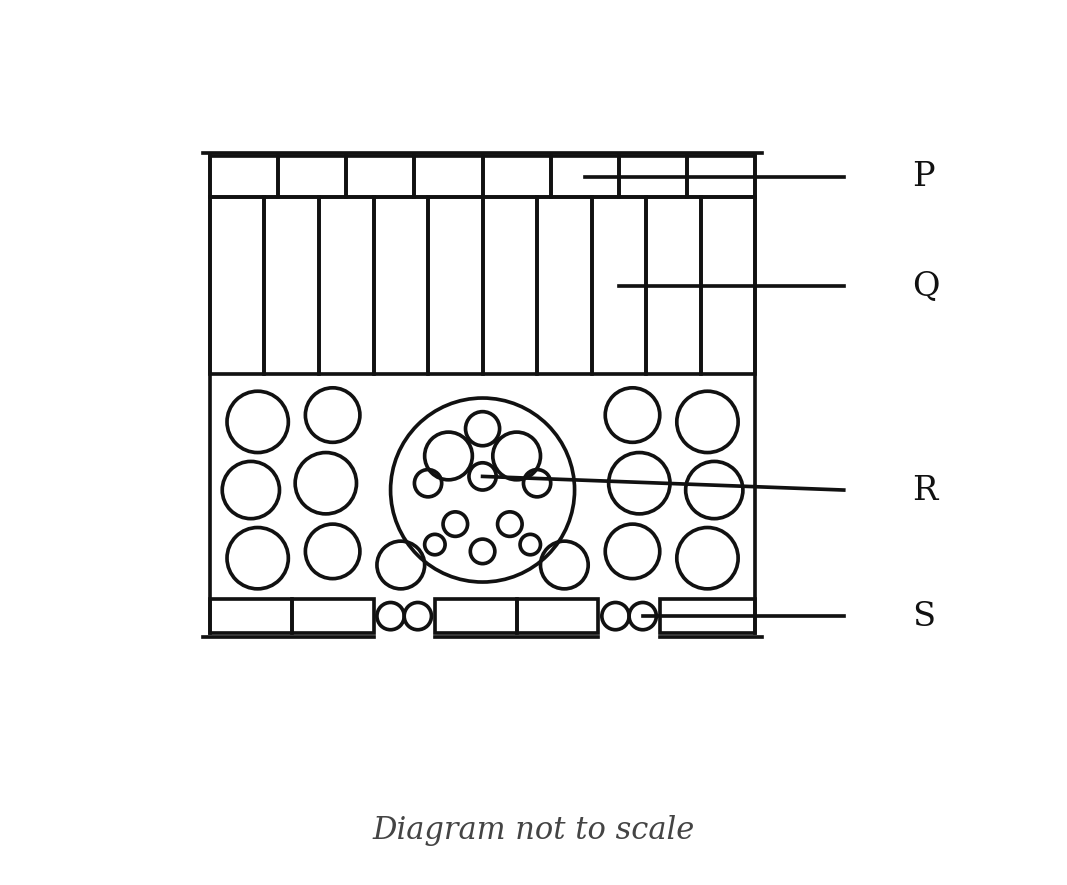
The diagram shows a transverse section through a dicotyledonous plant leaf with four distinct regions labelled P, Q, R, and S.
Which of the following statements is/are correct?
1 The entire leaf structure shown is classified as an organ.
2 Region P and region Q can each be classified as a tissue.
3 The mature xylem vessel elements in region R contain mitochondria to provide energy for the active transport of water.
A.
none of them
B.
1 only
C.
2 only
D.
3 only
E.
1 and 2 only
F.
1 and 3 only
G.
2 and 3 only
H.
1, 2 and 3
Answer and solution
Answer: E
Statement 1 is correct: In plants, leaves, stems, and roots are classified as organs because they are composed of several distinct tissues (including epidermal, ground/mesophyll, and vascular tissues) working together to carry out life processes.
Statement 2 is correct: A tissue is a collection of similar, specialised cells grouped together to carry out a specific function. Region P is the upper epidermal tissue (protecting underlying tissues and secreting the cuticle) and region Q is the palisade mesophyll tissue (specialised for photosynthesis).
Statement 3 is incorrect: Mature xylem vessel elements are dead, hollow cells that have lost their end walls and all protoplasmic contents, including the nucleus, cytoplasm, and mitochondria. Additionally, the movement of water through the xylem is a passive process driven by the cohesion-tension mechanism and transpiration pull, not active transport requiring ATP from xylem cells.
Therefore, only statements 1 and 2 are correct (E).
▸Question 16
Natural selection leads to evolutionary change in a population when a selection pressure acts upon heritable phenotypic variation, resulting in differential reproductive success.
In which of the following scenarios will the environmental factor described act as a selection pressure that results in evolution by natural selection for the specified trait?
1 A population of clonal bacteria with identical genomes is exposed to an increased temperature within their survival range, where heat-shock protein production increases equally in all individuals via phenotypic plasticity.
2 A population of field mice with heritable variation in fur colour is introduced to a light sandy habitat where predatory owls hunt by sight.
3 A population of an annual plant in which variation in seed size is determined entirely by local soil depth with no genetic basis, growing in a region experiencing an increased frequency of summer droughts.
4 A population of pathogenic bacteria containing a rare allele encoding a membrane efflux pump, exposed to therapeutic concentrations of an antibiotic that is expelled by this pump.
A.
1 and 2 only
B.
2 and 4 only
C.
3 and 4 only
D.
1, 2 and 4 only
E.
2, 3 and 4 only
F.
1, 2, 3 and 4
Answer and solution
Answer: B
Evolution by natural selection requires three fundamental conditions: 1. Phenotypic variation among individuals in the population. 2. A genetic (heritable) basis for this phenotypic variation. 3. Differential survival and reproductive success (fitness) linked to the phenotype as a result of a selection pressure.
Evaluating each scenario: - Statement 1: The bacteria are genetically identical and respond identically through phenotypic plasticity (acclimation). Because there is no genetic variation affecting survival or reproduction, no change in allele frequencies (evolution) can occur. Thus, statement 1 is incorrect. - Statement 2: Fur colour is heritable, and visual predation by owls on a sandy background provides a selection pressure favouring lighter-coloured morphs. Differential predation will alter allele frequencies across generations, leading to evolution by natural selection. Thus, statement 2 is correct. - Statement 3: The variation in seed size is purely environmental ( h2=0 ) with no genetic basis. Even if drought differentially kills plants with smaller seeds, the offspring in subsequent generations will not inherit altered seed size genetically, so no evolutionary change occurs. Thus, statement 3 is incorrect. - Statement 4: The rare efflux pump allele provides a heritable mechanism of resistance. Exposure to the antibiotic kills susceptible cells while allowing resistant cells to survive and reproduce, increasing the frequency of the resistance allele in the population (evolution by natural selection). Thus, statement 4 is correct.
Therefore, only statements 2 and 4 are correct (option B).
▸Question 17
Researchers investigated the function of Protein Q in mitochondria. They compared wild-type yeast cells with a mutant strain lacking Protein Q. The table below shows the results of three measurements: 1. The rate of pyruvate oxidation (respiration) in intact mitochondria. 2. The activity of Krebs cycle enzymes measured in lysed mitochondrial extracts. 3. The percentage of soluble matrix proteins found in the cytoplasm (outside the mitochondria). | Measurement | Wild-type | Mutant (lacking Protein Q) | | :--- | :--- | :--- | | Rate of pyruvate oxidation (arbitrary units) | 100 | 5 | | Activity of Krebs cycle enzymes in extracts (arbitrary units) | 100 | 98 | | Matrix proteins found in cytoplasm (%) | < 1 | 65 | Which conclusion regarding the role of Protein Q is best supported by these data?
A.
Protein Q is an enzyme that catalyses a rate-limiting step in the Krebs cycle.
B.
Protein Q is a transcription factor required for the expression of genes encoding respiratory enzymes.
C.
Protein Q is essential for maintaining the structural integrity of the mitochondrial membranes.
D.
Protein Q acts as a specific carrier protein for the active transport of pyruvate into the matrix.
E.
Protein Q is an inhibitor that prevents the breakdown of Krebs cycle enzymes in the cytoplasm.
Answer and solution
Answer: C
The data reveals a stark contrast. In intact mitochondria, the rate of pyruvate oxidation in the mutant is almost zero (5 units compared to 100). However, when the Krebs cycle enzymes are extracted and tested separately, their activity is near-normal (98 units compared to 100).
This immediately suggests that Protein Q is not itself a Krebs cycle enzyme, nor is it required for the synthesis of these enzymes. If it were, the activity in the extracts would also be very low. This rules out options A and B.
The decisive piece of evidence is the third measurement. In the mutant, 65% of the mitochondrial matrix proteins are found in the cytoplasm, compared to less than 1% in the wild-type. This indicates a massive failure of containment; the mitochondrial membranes are clearly compromised and leaking their contents.
The loss of pyruvate oxidation is therefore a secondary effect of this structural collapse. The primary function of Protein Q must be to maintain the integrity of the mitochondrial membranes.
▸Question 18
A diploid eukaryotic cell is homozygous for a gene encoding an enzyme.
The cell undergoes mitosis. During DNA replication prior to cell division, a single base substitution mutation occurs on one of the newly synthesised chromatids at this gene locus.
The cell successfully completes mitosis to produce two daughter cells: Cell 1 (which inherits the mutated chromatid) and Cell 2 (which inherits only non-mutated chromatids).
Assume no other mutations or chromosomal alterations occur.
Which of the following statements is/are correct?
1 The total number of gene loci in the nucleus is the same in both daughter cells.
2 Cell 1 has a greater number of different alleles for this gene than Cell 2.
3 Following DNA replication in the next cell cycle, the four chromatids carrying this gene in Cell 1 will all have identical base sequences.
A.
none of them
B.
1 only
C.
2 only
D.
3 only
E.
1 and 2 only
F.
1 and 3 only
G.
2 and 3 only
H.
1, 2 and 3
Answer and solution
Answer: E
Statement 1 is correct: A gene locus is the specific fixed position of a gene on a chromosome. A single base substitution alters the nucleotide sequence of an allele at that locus, but does not add, delete, or relocate any gene loci. Both daughter cells are diploid and possess the exact same number of gene loci.
Statement 2 is correct: The original parent cell was homozygous (genotype A1A1 ). During replication, one chromatid mutated to form allele A2 . Following normal mitotic chromatid segregation, Cell 1 receives one A1 chromatid and one A2 chromatid (genotype A1A2 , heterozygous), whereas Cell 2 receives two A1 chromatids (genotype A1A1 , homozygous). Therefore, Cell 1 possesses two different alleles for this gene, whereas Cell 2 possesses only one type of allele.
Statement 3 is incorrect: Cell 1 is heterozygous ( A1A2 ). Following DNA replication in the subsequent cell cycle, the chromosome carrying A1 forms two identical sister chromatids carrying allele A1 , and the homologous chromosome carrying A2 forms two identical sister chromatids carrying allele A2 . Because allele A1 and allele A2 differ by a base substitution, the four chromatids carrying this gene do not all have identical base sequences.
▸Question 19
The graph shows the initial rate of an enzyme-catalysed reaction plotted against substrate concentration under three different experimental conditions: P, Q, and R.
In each experiment, the total concentration of enzyme present was identical. - In experiment P, no inhibitor was added. - In experiment Q, a constant concentration of substance X was added. - In experiment R, a constant concentration of substance Y was added.
Which of the following statements is/are correct?
1 Substance X acts as a competitive inhibitor of the enzyme.
2 Increasing the substrate concentration can overcome the inhibitory effect of substance Y.
3 At a substrate concentration of 4 arbitrary units , a smaller proportion of enzyme molecules are bound to substrate in experiment Q than in experiment P.
A.
none of them
B.
1 only
C.
2 only
D.
3 only
E.
1 and 2 only
F.
1 and 3 only
G.
2 and 3 only
H.
1, 2 and 3
Answer and solution
Answer: F
Statement 1 is correct: In experiment Q, the reaction achieves the same maximum rate ( Vmax=100 arbitrary units ) as the uninhibited reaction P at higher substrate concentrations. This shows that the inhibition is surmountable by increasing substrate concentration, which is the defining feature of competitive inhibition.
Statement 2 is incorrect: In experiment R, the maximum rate of reaction plateaus at a lower level ( Vmax=50 arbitrary units ) and cannot reach the Vmax of experiment P regardless of how high the substrate concentration is increased. This is characteristic of non-competitive inhibition.
Statement 3 is correct: The initial rate of reaction is directly proportional to the concentration of enzyme-substrate complexes ( v=kcat[ES] ). Because the total enzyme concentration is identical in all experiments, the proportion of enzyme molecules bound to substrate is proportional to the reaction rate. At a substrate concentration of 4 arbitrary units , the rate in Q (approximately 60 arbitrary units ) is significantly lower than in P (approximately 95 arbitrary units ), meaning a smaller fraction of enzyme active sites are occupied by substrate in Q than in P.
Therefore, statements 1 and 3 only are correct.
▸Question 20
The graph shows the partial pressure of oxygen ( p\ceO2 ) in water and in blood measured along the length of a secondary lamella in the gill of a bony fish.
Water flows across the lamella from distance 0% to 100% . Blood flows through the lamellar capillary in the opposite direction, from distance 100% to 0% .
Which of the following statements is/are correct?
1 Along the entire length of the lamella, net diffusion of oxygen occurs from the water into the blood.
2 Under the same flow conditions and entering partial pressures, if blood flowed in the same direction as water (concurrent flow), the maximum theoretical p\ceO2 the blood could reach is 10.0 kPa .
3 The partial pressure gradient driving the diffusion of oxygen across the lamella is greatest at distance 0% .
A.
none of them
B.
1 only
C.
2 only
D.
3 only
E.
1 and 2 only
F.
1 and 3 only
G.
2 and 3 only
H.
1, 2 and 3
Answer and solution
Answer: E
1 is correct: At every point along the lamella from 0% to 100% , the partial pressure of oxygen in the water is greater than that in the blood ( 18.0>16.0 kPa at 0% , 11.0>9.0 kPa at 50% , and 4.0>2.0 kPa at 100% ). Therefore, net diffusion of oxygen occurs from water into blood along the entire length.
2 is correct: In concurrent flow, water enters at 0% with p\ceO2=18.0 kPa and deoxygenated blood enters at 0% with p\ceO2=2.0 kPa . Because the two lines have equal and opposite slopes (water loses 14.0 kPa while blood gains 14.0 kPa ), the effective gas capacities of the two streams are equal. Net diffusion would cease once equilibrium is reached between the two fluids: pequilibrium=218.0+2.0=10.0 kPa . Thus, the maximum theoretical p\ceO2 the blood could reach is 10.0 kPa .
3 is incorrect: The partial pressure gradient at any distance is given by the difference Δp\ceO2=p\ceO2(water)−p\ceO2(blood) . At 0% , Δp\ceO2=18.0−16.0=2.0 kPa ; at 100% , Δp\ceO2=4.0−2.0=2.0 kPa . Because both profiles are linear and parallel, the gradient is constant ( 2.0 kPa ) throughout the entire exchange surface, not greatest at 0% .
▸Question 21
A single-stranded RNA virus replicates inside host cells by first synthesising a complementary negative-sense RNA strand to form a double-stranded RNA intermediate.
The percentage of bases in the positive-sense single-stranded viral RNA genome was determined:
1 In the complementary negative-sense RNA strand, 18% of the bases are adenine.
2 In the double-stranded RNA intermediate, 22% of the bases are cytosine.
3 In the double-stranded RNA intermediate, 50% of the bases are purines.
A.
1 only
B.
2 only
C.
3 only
D.
1 and 2 only
E.
1 and 3 only
F.
2 and 3 only
G.
1, 2 and 3
H.
none of them
Answer and solution
Answer: E
First, calculate the percentage of cytosine ( w ) in the positive-sense single strand: w=100%−(32%+18%+28%)=100%−78%=22% .
Now evaluate each statement:
1. Correct. Adenine in the complementary negative-sense strand pairs with uracil from the positive-sense strand. Therefore, the percentage of adenine in the negative-sense strand equals the percentage of uracil in the positive-sense strand, which is 18% .
2. Incorrect. In the double-stranded RNA intermediate, the total number of cytosine bases is the sum of cytosine bases in the positive strand ( 22% ) and cytosine bases in the negative strand (which equals guanine in the positive strand, 28% ). The percentage of cytosine in the double-stranded RNA intermediate is 222%+28%=25% , not 22% .
3. Correct. In double-stranded RNA, adenine pairs with uracil ( %A=%U ) and guanine pairs with cytosine ( %G=%C ). The purines are adenine and guanine. Since every base pair consists of one purine and one pyrimidine, purines must make up exactly 50% of the total bases in double-stranded RNA ( %A+%G=25%+25%=50% ).
Therefore, statements 1 and 3 only are correct.
▸Question 22
A double-stranded DNA molecule is 400 base pairs long and 32% of its bases are cytosine.
One strand of this DNA molecule is transcribed to produce a single-stranded mRNA molecule that is 400 nucleotides long.
In this mRNA molecule: - 22% of the bases are guanine - 18% of the bases are uracil
Which of the following statements is/are correct?
1 The mRNA molecule contains 168 cytosine bases.
2 There are 1056 hydrogen bonds between the base pairs in the double-stranded DNA molecule.
3 Adenine makes up 36% of the bases in the mRNA molecule.
A.
none of them
B.
1 only
C.
2 only
D.
3 only
E.
1 and 2 only
F.
1 and 3 only
G.
2 and 3 only
H.
1, 2 and 3
Answer and solution
Answer: E
1. Analysis of the double-stranded DNA (dsDNA): - Total number of base pairs =400⟹ total number of bases =800 . - Cytosine (C)=32%⟹0.32×800=256 bases . - By Chargaff's rules for dsDNA, Guanine (G)=256 bases . - Total G-C pairs =256 . - Total A-T bases =800−(256+256)=288 bases⟹144 Adenine (A) and 144 Thymine (T) bases. - Total A-T pairs =144 .
2. Statement 2 is correct: - Each G-C base pair is held together by 3 hydrogen bonds: 256×3=768 . - Each A-T base pair is held together by 2 hydrogen bonds: 144×2=288 . - Total hydrogen bonds =768+288=1056 .
3. **Analysis of the mRNA transcript ( 400 nucleotides):** - G in mRNA=22% of 400=88 bases . - U in mRNA=18% of 400=72 bases . - The mRNA is transcribed from the template strand, so: - Cytosine in template strand =G in mRNA=88 . - Adenine in template strand =U in mRNA=72 .
4. Statement 1 is correct: - In the dsDNA, the sum of cytosines in the template strand and guanines in the template strand equals the total number of C (or G ) bases in one strand =256 . - Guanine in template strand =256−88=168 . - Cytosine in mRNA is complementary to guanine in the template strand ⟹C in mRNA=168 .
5. Statement 3 is incorrect: - Thymine in template strand =Total A in dsDNA−A in template strand=144−72=72 . - Adenine in mRNA is complementary to thymine in the template strand ⟹A in mRNA=72 . - Percentage of A in mRNA=40072×100%=18% (not 36% ).
Therefore, only statements 1 and 2 are correct.
▸Question 23
Three separate cultures of cells (Culture 1, Culture 2, and Culture 3) were established. At time t=0 h , each culture contained 100 stem cells and no specialised (differentiated) cells.
All stem cells in each culture divided synchronously every 24 hours according to a specific mode of division: - Culture 1: each stem cell divides asymmetrically to produce one stem cell and one specialised cell. - Culture 2: each stem cell divides symmetrically to produce two stem cells. - Culture 3: each stem cell divides symmetrically to produce two specialised cells.
Specialised cells do not divide further, and no cells die during the 96-hour period.
The graph shows the total number of cells (stem cells plus specialised cells) over time for the three cultures, represented by curves X, Y, and Z.
Which row in the table correctly matches each culture to its corresponding curve on the graph, and gives the percentage of cells in Culture 1 that are stem cells at t=96 h ?
| | Culture 1 | Culture 2 | Culture 3 | Percentage of stem cells in Culture 1 at t=96 h | | :--- | :--- | :--- | :--- | :--- | | A | Curve Y | Curve X | Curve Z | 20% | | B | Curve Y | Curve X | Curve Z | 25% | | C | Curve Y | Curve Z | Curve X | 20% | | D | Curve Y | Curve Z | Curve X | 50% | | E | Curve X | Curve Y | Curve Z | 20% | | F | Curve X | Curve Y | Curve Z | 25% | | G | Curve Z | Curve X | Curve Y | 20% | | H | Curve Z | Curve Y | Curve X | 50% |
To match the cultures to the curves, we track the cell counts after each 24-hour cycle:
1. Culture 2 (symmetric self-renewal): - At t=0 h : 100 stem cells, 0 specialised cells (Total = 100). - At t=24 h : 200 stem cells (Total = 200). - At t=48 h : 400 stem cells (Total = 400). - At t=72 h : 800 stem cells (Total = 800). - At t=96 h : 1600 stem cells (Total = 1600). This exponential growth corresponds to Curve X.
2. Culture 1 (asymmetric division): - Each round of division maintains 100 stem cells while adding 100 specialised cells. - At t=0 h : 100 stem cells, 0 specialised cells (Total = 100). - At t=24 h : 100 stem cells, 100 specialised cells (Total = 200). - At t=48 h : 100 stem cells, 200 specialised cells (Total = 300). - At t=72 h : 100 stem cells, 300 specialised cells (Total = 400). - At t=96 h : 100 stem cells, 400 specialised cells (Total = 500). This steady linear increase of 100 cells per 24 hours corresponds to Curve Y.
3. Culture 3 (symmetric differentiation): - At t=0 h : 100 stem cells, 0 specialised cells (Total = 100). - At t=24 h : 0 stem cells, 200 specialised cells (Total = 200). - Since specialised cells do not divide further, the total cell count remains at 200 for all subsequent time points. This corresponds to Curve Z.
4. **Percentage of stem cells in Culture 1 at t=96 h :** Percentage=total cellsstem cells×100%=500100×100%=20% Thus, the correct row is A.
▸Question 24
An experiment was carried out to investigate the effect of light intensity on the net rate of carbon dioxide ( \ceCO2 ) uptake by a plant leaf at a constant temperature of 20∘C and constant atmospheric \ceCO2 concentration. The graph shows the results obtained.
A student considered the graph and made the following conclusions:
1 Between light intensities 0 and P , no photosynthesis takes place.
2 At light intensity P , the rate of photosynthesis is equal to the rate of cellular respiration.
3 Between light intensities P and Q , light intensity is limiting the rate of photosynthesis.
Which of the student's conclusions is/are correct?
A.
none of them
B.
1 only
C.
2 only
D.
3 only
E.
1 and 2 only
F.
1 and 3 only
G.
2 and 3 only
H.
1, 2 and 3
Answer and solution
Answer: G
1 is incorrect: At a light intensity of 0 , the net rate of \ceCO2 uptake is negative because the leaf is releasing \ceCO2 through cellular respiration. As light intensity increases from 0 to P , the net rate of \ceCO2 uptake increases towards zero. This demonstrates that \ceCO2 is being consumed by photosynthesis; photosynthesis is occurring, but its rate is less than the rate of respiration.
2 is correct: At light intensity P (the light compensation point), the net exchange of \ceCO2 is zero. This occurs when the rate of \ceCO2 uptake by photosynthesis exactly equals the rate of \ceCO2 release by cellular respiration.
3 is correct: Between P and Q , increasing light intensity causes an increase in the net rate of \ceCO2 uptake (and thus the rate of photosynthesis). Because increasing light intensity increases the rate while other factors are held constant, light intensity is the factor limiting the rate of photosynthesis in this region.
▸Question 25
A linear double-stranded DNA fragment contains 1500 base pairs and has a total of 3600 hydrogen bonds between its complementary nitrogenous bases.
Which of the following statements is/are correct?
1 Guanine accounts for 40% of the total nitrogenous bases in this DNA fragment.
2 There are 900 thymine bases in this DNA fragment.
3 There are 2998 phosphodiester bonds in the sugar–phosphate backbones of this DNA fragment.
A.
none of them
B.
1 only
C.
2 only
D.
3 only
E.
1 and 2 only
F.
1 and 3 only
G.
2 and 3 only
H.
1, 2 and 3
Answer and solution
Answer: G
Let nAT be the number of A–T base pairs and nGC be the number of G–C base pairs.
1. Total base pairs: nAT+nGC=1500 2. Hydrogen bonds: each A–T pair has 2 hydrogen bonds and each G–C pair has 3 hydrogen bonds: 2nAT+3nGC=3600 Substituting nAT=1500−nGC : 2(1500−nGC)+3nGC=36003000+nGC=3600⟹nGC=600nAT=1500−600=900 - Statement 1 is incorrect: There are 600 guanine bases out of a total of 1500×2=3000 bases. The percentage of guanine is 3000600×100%=20% . (40% is the combined percentage of G + C bases, or the percentage relative only to base pairs). - Statement 2 is correct: Each A–T base pair contains one thymine base, so there are 900 thymine bases. - Statement 3 is correct: The fragment is linear and double-stranded. Each strand consists of 1500 nucleotides linked by 1500−1=1499 phosphodiester bonds. Across both strands, the total number of phosphodiester bonds is 2×1499=2998 .
Therefore, statements 2 and 3 only are correct.
▸Question 26
Which of the following could be found inside a healthy pancreatic beta cell of an adult human?
1 circular DNA
2 gene for rhodopsin
3 cellulose
A.
none of them
B.
1 only
C.
2 only
D.
3 only
E.
1 and 2 only
F.
1 and 3 only
G.
2 and 3 only
H.
1, 2 and 3
Answer and solution
Answer: E
1 is correct: Pancreatic beta cells contain mitochondria, and mitochondria possess their own circular DNA molecules (mtDNA).
2 is correct: All nucleated somatic cells in an organism contain a complete copy of the nuclear genome. Although rhodopsin is only expressed in retinal photoreceptor cells, the rhodopsin gene is still present in the DNA of all other nucleated human cells, including pancreatic beta cells.
3 is incorrect: Cellulose is a structural polysaccharide synthesized by plants and some algae, not animals. Human cells do not synthesize or contain cellulose.
Therefore, 1 and 2 only are correct.
▸Question 27
In a diploid organism, Process X produces cells required for growth and tissue repair, resulting in daughter cells that are genetically identical to the parent cell. Process Y produces cells required for sexual reproduction, resulting in daughter cells with half the number of chromosomes of the parent cell.
Which of the following statements correctly describes a difference in the chromosomal events between Process X and Process Y?
A.
DNA replication occurs prior to the start of Process X, but not prior to the start of Process Y.
B.
Sister chromatids separate and move to opposite poles in Process X, but not in Process Y.
C.
Homologous chromosomes pair up to form bivalents in Process Y, but not in Process X.
D.
Spindle fibres attach to the centromeres of chromosomes in Process Y, but not in Process X.
E.
Chromosomes condense and become visible in Process X, but not in Process Y.
Answer and solution
Answer: C
Process X describes mitosis (produces genetically identical, diploid cells). Process Y describes meiosis (produces haploid gametes).
We must identify an event that is unique to one process: 1. Homologous pairing (synapsis): In meiosis (Process Y), homologous chromosomes pair up to allow for crossing over and independent assortment. In mitosis (Process X), homologous chromosomes behave independently. This is the correct difference. 2. DNA replication: Occurs during Interphase (S-phase) before *both* mitosis and meiosis. 3. Sister chromatid separation: Occurs during anaphase of mitosis and anaphase II of meiosis. It is common to both. 4. Spindle attachment and condensation: These are universal features of nuclear division.