A curve has the equation y2=kx for some constant k>0 . The point P(a,b) , where a>0 and b>0 , lies on the curve. The point Q ,
which also lies on the curve, has an x -coordinate of 9a and a positive y -coordinate. What is the y -coordinate of Q in terms of b ?
A.
3b
B.
9b
C.
81b
D.
3b
E.
9b
F.
3b2
Answer and solution
Answer: A
The point P(a,b) lies on the curve y2=kx . Substituting its coordinates into the equation gives:
b2=ka
This is our first relationship.
The point Q has coordinates (9a,yQ) , where yQ>0 . Since Q also lies on the curve, its coordinates must also satisfy the equation:
yQ2=k(9a)
We can rearrange this equation as:
yQ2=9(ka)
Now, we can substitute the expression for ka from our first relationship, ka=b2 , into this equation for Q :
yQ2=9(b2)
Taking the square root of both sides gives:
yQ=±9b2=±3b
The problem states that the y -coordinate of Q is positive, so we take the positive root.
yQ=3b
Therefore, the correct option is A.
▸Question 2
Which one of the following is a simplification of x−32x−9−x2x2+3x−1 for all values of x for which the expression is defined?
A.
2+x−39
B.
2−x−39
C.
2+x−33
D.
2−x−33
E.
1+x−33
F.
1−x−33
Answer and solution
Answer: A
First, simplify the second fraction by factoring the numerator and denominator: 9−x2x2+3x=(3−x)(3+x)x(x+3)=3−xx=−x−3x Substitute this back into the original expression: x−32x−(−x−3x)−1=x−32x+x−3x−1=x−33x−1 Combine the terms over a common denominator: x−33x−(x−3)=x−32x+3 Express this in mixed form: x−32x+3=x−32(x−3)+9=2+x−39 Thus, the correct option is A.
▸Question 3
Find the value of x that satisfies the equation:
4x−31×2x+31=16x2−9x−2
A.
−25
B.
75
C.
25
D.
4
E.
5
F.
11
Answer and solution
Answer: F
First, write all bases as powers of 2 : 4=22 and 16=24 .
Substitute these into the equation:
(22)x−31×2x+31=(24)x2−9x−2
Simplify the exponents:
2x−32×2x+31=2x2−94(x−2)
Use the index law am×an=am+n on the left-hand side:
2x−32+x+31=2x2−94x−8
Since the bases are equal, we can equate the exponents:
x−32+x+31=x2−94x−8
Notice that the common denominator for the left-hand side is (x−3)(x+3)=x2−9 . Combine the fractions:
x2−92(x+3)+1(x−3)=x2−94x−8
Multiply both sides by x2−9 (assuming xeq±3 ):
2(x+3)+(x−3)=4x−8
Expand the brackets:
2x+6+x−3=4x−8
Simplify the left-hand side:
3x+3=4x−8
Rearrange to solve for x :
x=11
Therefore the correct answer is F.
▸Question 4
A material is composed of a mixture of two types of spherical particles, type A and type B.
The ratio of the number of particles of type A to the number of particles of type B is 4:1 .
The total volume occupied by all particles of type A is half the total volume occupied by all particles of type B.
What is the ratio of the radius of a single particle of type A to the radius of a single particle of type B?
A.
81
B.
42
C.
21
D.
32
E.
2
F.
8
Answer and solution
Answer: C
Let NA and NB be the number of particles of type A and B, respectively. Let VA and VB be the total volumes occupied by particles of type A and B. Let rA and rB be the radii of single particles of type A and B. Let vA and vB be the volumes of single particles of type A and B.
From the problem statement, we are given: 1. The ratio of the number of particles: NBNA=14=4 . 2. The ratio of the total volumes: VA=21VB , which means VBVA=21 .
The total volume for each type is the number of particles multiplied by the volume of a single particle: VA=NA×vAVB=NB×vB We can write the ratio of total volumes in terms of these:
VBVA=NB×vBNA×vA=(NBNA)×(vBvA)
We want to find the ratio of the volumes of single particles, vBvA . We can rearrange the equation above:
vBvA=NA/NBVA/VB
Substituting the given values:
vBvA=41/2=81
The volume of a sphere is given by the formula v=34πr3 . Therefore, the volume of a particle is proportional to the cube of its radius ( v∝r3 ).
The ratio of the volumes of single particles is related to the ratio of their radii as follows:
vBvA=34πrB334πrA3=rB3rA3=(rBrA)3
We have found that vBvA=81 , so:
(rBrA)3=81
To find the ratio of the radii, we take the cube root of both sides:
rBrA=381=21
Thus, the ratio of the radius of a particle of type A to that of type B is 21 . Therefore the correct answer is C.
▸Question 5
A point P lies on the hypotenuse AB of a right-angled triangle ABC . The perpendicular distance from P to the leg AC is equal to the perpendicular distance from P to the leg BC . Given that AP=3 and PB=4 , what is this distance?
A.
12/7
B.
12/5
C.
2.5
D.
2√3
E.
7√2 / 4
Answer and solution
Answer: B
Let the triangle be ABC , with the right angle at C . Let the required distance be s . Let the feet of the perpendiculars from P to AC and BC be D and E respectively. The quadrilateral CDPE is a square of side length s .
This construction forms two smaller right-angled triangles, △ADP and △PEB . Since PD is parallel to BC , these two triangles are similar.
We can set up a ratio of corresponding sides using the given lengths of the hypotenuse segments, AP=3 and PB=4 :
PEAD=PBAPandEBDP=PBAP
Since DP=PE=s , we can find expressions for the other segments of the legs: AD=s⋅PBAP=s⋅43=43s . EB=s⋅APPB=s⋅34=34s .
The full lengths of the legs of △ABC are therefore: AC=AD+DC=43s+s=47sBC=EB+EC=34s+s=37s The hypotenuse AB=AP+PB=3+4=7 . Applying Pythagoras' theorem to △ABC :
(AC)2+(BC)2=(AB)2
(47s)2+(37s)2=72
Dividing the entire equation by 72=49 simplifies the calculation significantly:
16s2+9s2=1
s2(161+91)=1
s2(1449+16)=1
s2(14425)=1
This gives s2=25144 , and since s must be a positive length, s=512 .
▸Question 6
A solid cuboid has side lengths 2a , 2b , and 2c , where a , b , and c are integers such that a>b>c>0 .
The following process is applied repeatedly to a single piece.
- Cut that piece in half by a plane perpendicular to its longest edge. If two or more edges share the longest length, choose exactly one of them. - Keep exactly one of the two resulting pieces and discard the other. - Continue with the kept piece.
The process stops as soon as the kept piece is a cube.
Let N be the total number of cuts required, and let S be the side length of the final cube.
Which pair of expressions for N and S is correct?
A.
N=a−b,S=2b
B.
N=a−c,S=2c
C.
N=a+b−c,S=2c
D.
N=a+b−2c,S=2c
E.
N=a+b−2c,S=23c
Answer and solution
Answer: D
The process stops when the cuboid becomes a cube. Since the side lengths can only decrease, all three side lengths must become equal to the smallest initial side length, 2c . Therefore, the side length of the final cube is S=2c .
To find the total number of cuts, N , we can consider the number of halvings required for each dimension to reach the final length 2c .
1. The side with initial length 2a must be reduced to 2c . Each cut along this dimension reduces the exponent by 1. Thus, the number of cuts required for this dimension is a−c .
2. The side with initial length 2b must be reduced to 2c . Similarly, the number of cuts required for this dimension is b−c .
3. The side with initial length 2c is always the shortest (or equal shortest) and is therefore never cut. The number of cuts for this dimension is 0.
The total number of cuts N is the sum of the cuts for each dimension. N=(a−c)+(b−c)+0=a+b−2c Thus, the correct expressions are N=a+b−2c and S=2c .
▸Question 7
A tank initially contains V litres of water. Water flows into the tank at a rate of x litres per minute for a duration of h hours. Water flows out of the tank at a rate of y litres per hour for a duration of m minutes. Which of the following expressions gives the final volume of water in the tank, in litres?
A.
V+hx−my
B.
V+60hx−60my
C.
V+60hx−60my
D.
V+60hx−60my
E.
V+60hx−60my
F.
V−60hx+60my
Answer and solution
Answer: D
To calculate the volume change, we must match the time units of the rates and durations.
For the inflow, the rate is given in litres per minute, so we convert the duration of h hours into minutes:
Volume added=x×(60h)=60hx
For the outflow, the rate is given in litres per hour, so we convert the duration of m minutes into hours:
Volume removed=y×(60m)=60my
The final volume is the initial volume plus the inflow minus the outflow:
V+60hx−60my
▸Question 8
The points A(2,6) and B(6,−2) lie on a straight line. Point P lies on this line such that the distance AP is three times the distance PB . Given that P does not lie between A and B , what are the coordinates of P ?
A.
(0,10)
B.
(3,4)
C.
(5,0)
D.
(8,−6)
E.
(14,−18)
Answer and solution
Answer: D
Since P lies on the line through A and B but not between them, it must be on the extension of the segment AB . Given AP=3PB , the point P is further from A than from B . This implies the order of points is A , then B , then P .
We can express the distance AP as AB+BP . Substituting the given ratio:
AB+BP=3BP⟹AB=2BP⟹BP=21AB
We calculate the vector AB :
AB=(6−2−2−6)=(4−8)
Therefore, BP=21(4−8)=(2−4) . Adding this to the position vector of B gives the coordinates of P :
OP=OB+BP=(6−2)+(2−4)=(8−6)
Thus, P is at (8,−6) .
▸Question 9
A passcode of length 5 is formed by selecting distinct digits from the set {1,2,3,4,5,6} .
The digit 6 must be included in the passcode, but it cannot be the first or the last digit.
How many such passcodes can be formed?
A.
120
B.
240
C.
360
D.
480
E.
600
F.
720
Answer and solution
Answer: C
The digit 6 is required but restricted to the internal positions (2nd, 3rd, or 4th). This gives 3 possible positions for the digit 6.
Once 6 is placed, there are 4 remaining positions to fill. We must choose and arrange 4 digits from the remaining 5 available digits ( {1,2,3,4,5} ).
The number of ways to arrange these remaining digits is:
5P4=5×4×3×2=120
To find the total number of valid passcodes, we multiply the number of valid positions for 6 by the arrangements of the other digits:
3×120=360
▸Question 10
A particle undergoes two successive displacements. The first displacement has magnitude d and is on a bearing of 030∘ . The second displacement has magnitude 63 and is on a bearing of 300∘ . Given that the final position of the particle is due north of its initial position, what is the value of d ?
A.
6
B.
9
C.
63
D.
18
E.
123
Answer and solution
Answer: D
For the final position to be due north, the net horizontal displacement must be zero. We resolve each displacement horizontally.
The first displacement has magnitude d on a bearing of 030∘ . The horizontal (East) component is:
dsin30∘=2d
The second displacement has magnitude 63 on a bearing of 300∘ , which is 60∘ West of North. The horizontal (West) component is:
63sin60∘=63(23)=9
Equating the East and West components:
2d=9⟹d=18
▸Question 11
A composite object is formed from two materials, X and Y. The density of material X is 2000kg m−3 . The density of material Y is 8.0g cm−3 . The volume of material X is twice the volume of material Y. What is the density of the composite object?
A.
1600kg m−3
B.
4000kg m−3
C.
5000kg m−3
D.
6000kg m−3
Answer and solution
Answer: B
We first observe that the densities are given in different units. Since 1g cm−3=1000kg m−3 , the density of material Y is:
ρY=8.0×1000=8000kg m−3
Let the volume of material Y be V . The volume of material X is 2V , giving a total volume of 3V . We calculate the total mass by summing the mass of each component:
mtotal=(2000×2V)+(8000×V)=4000V+8000V=12000V
The density of the composite object is the total mass divided by the total volume:
ρ=3V12000V=4000kg m−3
▸Question 12
A solid cylinder has base radius r and height h . A solid cube has side length 2r . The total surface area of the cylinder is equal to the total surface area of the cube. Which of the following expressions gives h in terms of r ?
A.
h=(π8−1)r
B.
h=π8r
C.
h=(π12−1)r
D.
h=π12r
E.
h=(π12+1)r
Answer and solution
Answer: C
The total surface area of the cylinder is the sum of the areas of its two circular bases and its curved surface: Acylinder=2πr2+2πrh .
The cube has six faces, each with an area of (2r)2=4r2 . Its total surface area is Acube=6×4r2=24r2 .
We are given that these areas are equal, so we can set up an equation:
2πr2+2πrh=24r2
To solve for h , we can first divide the entire equation by 2πr (since req0 ):
r+h=2πr24r2=π12r
Now, we rearrange to make h the subject and factor out r :
h=π12r−r=(π12−1)r
▸Question 13
Three fair, six-sided dice are rolled. Let pS be the probability that the sum of the scores is 5. Let pP be the probability that the product of the scores is 6. What is the value of pP−pS ?
A.
0
B.
2161
C.
1081
D.
721
E.
361
Answer and solution
Answer: D
The total number of possible outcomes for three dice is 63=216 .
First, we find the number of outcomes where the sum of the scores is 5. The possible sets of numbers are \{1, 1, 3\} and \{1, 2, 2\}. - The set \{1, 1, 3\} can be rolled in 2!3!=3 distinct ways. - The set \{1, 2, 2\} can also be rolled in 2!3!=3 distinct ways. This gives a total of 3+3=6 successful outcomes, so pS=2166 .
Next, we find the number of outcomes where the product of the scores is 6. The possible sets of numbers are \{1, 1, 6\} and \{1, 2, 3\}. - The set \{1, 1, 6\} can be rolled in 2!3!=3 distinct ways. - The set \{1, 2, 3\} can be rolled in 3!=6 distinct ways. This gives a total of 3+6=9 successful outcomes, so pP=2169 .
The required difference is:
pP−pS=2169−2166=2163=721
▸Question 14
Two regular polygons, P and Q, are such that the exterior angle of P is three times the exterior angle of Q.
The sum of an interior angle of P and an interior angle of Q is 300∘ .
What is the number of sides of polygon Q?
A.
6
B.
8
C.
12
D.
24
E.
30
F.
48
Answer and solution
Answer: D
Let the exterior angles of polygons P and Q be eP and eQ respectively. Let their interior angles be iP and iQ .
From the problem statement, we have two conditions: 1) The exterior angle of P is three times the exterior angle of Q: eP=3eQ . 2) The sum of their interior angles is 300∘ : iP+iQ=300 .
For any regular polygon, the interior and exterior angles sum to 180∘ . So, iP=180−eP and iQ=180−eQ .
Substitute these into the second condition:
(180−eP)+(180−eQ)=300
360−(eP+eQ)=300
eP+eQ=60
Now we have a simple system of two linear equations:
eP=3eQ
eP+eQ=60
Substitute the first equation into the second:
(3eQ)+eQ=60
4eQ=60
eQ=15∘
The number of sides of a regular polygon, n , is given by the formula n=e360 , where e is the exterior angle in degrees.
For polygon Q, the number of sides nQ is:
nQ=eQ360=15360=24
Thus, polygon Q has 24 sides.
▸Question 15
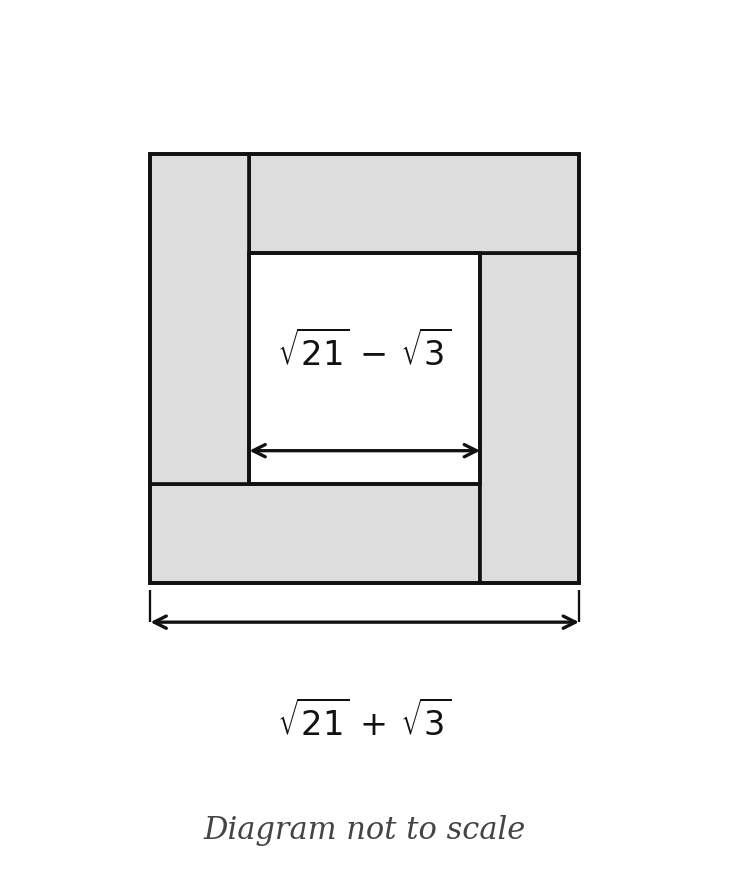
A large square with side length 21+3 contains four identical shaded rectangles arranged around a central unshaded square of side length 21−3 , as shown in the diagram.
What is the total area of the shaded region?
A.
37
B.
67
C.
123
D.
127
E.
24
F.
247
G.
48
Answer and solution
Answer: D
The total area of the four shaded rectangles is equal to the area of the outer square minus the area of the central unshaded square: Shaded Area=(21+3)2−(21−3)2 Using the identity (u+v)2−(u−v)2=4uv : Shaded Area=4(21)(3)=463=49×7=127 Alternatively, if each rectangle has length x and width y , then x+y=21+3 and x−y=21−3 . Adding and subtracting gives x=21 and y=3 . The total shaded area is 4xy=4(21)(3)=127 .
▸Question 16
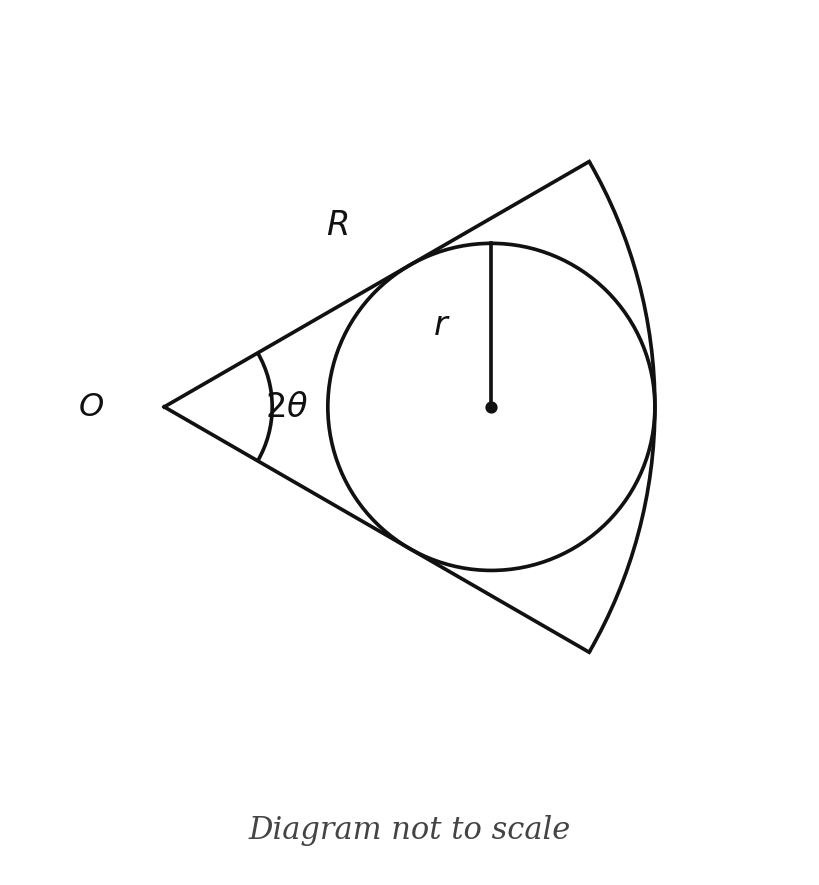
The diagram shows a circle of radius r inscribed inside a sector of a circle of radius R .
The central angle of the sector is 2θ , where 0<θ<2π . The inscribed circle is tangent to both straight edges of the sector and to the circular arc.
Which of the following is an expression for r in terms of R and heta ?
A.
1+sinθRsinθ
B.
1−sinθRsinθ
C.
1+cosθRcosθ
D.
1−cosθRcosθ
E.
1+tanθRtanθ
F.
1+sinθR
Answer and solution
Answer: A
Let O be the vertex of the sector and C be the centre of the inscribed circle.
By symmetry, the line OC bisects the central angle of the sector, so the angle between OC and each straight boundary is θ .
The inscribed circle is tangent to the circular arc of radius R , so the distance from O to the contact point on the arc is R . Therefore, the distance from O to the centre of the inscribed circle is: OC=R−r Let T be the point where the inscribed circle touches one of the straight edges of the sector. The line segment CT is perpendicular to the straight edge and has length CT=r .
In the right-angled triangle △OTC : sinθ=OCCT=R−rr Rearranging to solve for r : r=(R−r)sinθr+rsinθ=Rsinθr(1+sinθ)=Rsinθr=1+sinθRsinθ Hence, the correct option is A.
▸Question 17
The pressure of a gas sample is increased by 25%. The final pressure is 120 kPa.
What was the initial pressure?
A.
90 kPa
B.
95 kPa
C.
96 kPa
D.
100 kPa
E.
150 kPa
Answer and solution
Answer: C
Let P be the initial pressure. A 25% increase corresponds to a multiplier of 1.25 or 45 . We have:
45P=120
Isolating P yields:
P=120×54=24×4=96kPa
We could also observe that an increase of 41 is reversed by a decrease of 51 from the final value ( 120−24=96 ).
▸Question 18
A list consists of 6 distinct numbers. A new number is added to the list, creating a new list with 7 numbers.
The mean of the new list is identical to the mean of the original list.
Which one of the following statements must be true?
A.
The range is unchanged.
B.
The median is unchanged.
C.
The range increases.
D.
The median is now equal to the mean.
E.
The median increases.
F.
The median decreases.
Answer and solution
Answer: A
Let the original list of 6 numbers be x1,x2,…,x6 . Let their sum be S=i=1∑6xi . The mean of the original list is μ=6S .
Let the new number added to the list be y . The new list has 7 numbers, and their sum is S+y . The mean of the new list is 7S+y .
We are given that the means are identical:
7S+y=6S
6(S+y)=7S
6S+6y=7S
6y=S
y=6S
This shows that the number added, y , must be equal to the mean of the original list, μ .
Now, let's consider the range. The range of a list is the difference between its maximum and minimum values. Let the minimum and maximum values of the original list be xmin and xmax , respectively. The original range is R1=xmax−xmin .
The mean of a set of numbers must lie between (or be equal to) the minimum and maximum values of that set. Since the numbers are distinct, the mean must be strictly between the minimum and maximum. So, xmin<μ<xmax .
The new number added is y=μ . So, we know that xmin<y<xmax .
When this new number y is added to the list, the original minimum value xmin is still the minimum value of the new list. Similarly, the original maximum value xmax is still the maximum value of the new list.
Therefore, the new range is R2=xmax−xmin=R1 . The range must be unchanged.
Let's check the other options with a counterexample. Consider the original list of 6 distinct numbers: {0,1,8,9,10,16} .
- The sum is 0+1+8+9+10+16=44 . This is not great for no-calc. Let's pick better numbers. Consider the list {0,1,2,9,10,14} . - The sum is S=0+1+2+9+10+14=36 . - The mean is μ=36/6=6 . So the number added is y=6 . - The original sorted list is {0,1,2,9,10,14} . The original median is the average of the two middle terms: M1=22+9=5.5 . - The new sorted list is {0,1,2,6,9,10,14} . The new median is the 4th term: M2=6 . - The original range is 14−0=14 . The new range is 14−0=14 . The range is unchanged.
- Comparing medians: M2=6 and M1=5.5 . The median has increased. This single example shows that 'The median is unchanged' (B) and 'The median decreases' (F) are not `must be true` statements. - Is the new median equal to the mean? Yes, in this case M2=6 and μ=6 . But is this always true?
Let's try another list: {0,1,8,9,10,14} . - The sum is S=0+1+8+9+10+14=42 . - The mean is μ=42/6=7 . So the number added is y=7 . - The original median is M1=28+9=8.5 . - The new sorted list is {0,1,7,8,9,10,14} . The new median is the 4th term: M2=8 . - In this case, the median has decreased ( 8<8.5 ). This shows 'The median increases' (E) is not a `must be true` statement. - Also, the new median ( M2=8 ) is not equal to the mean ( μ=7 ). This shows 'The median is now equal to the mean' (D) is not a `must be true` statement.
Only statement A, 'The range is unchanged', must be true.
▸Question 19
Given that p and q are real numbers such that
p+q=1
and
8p×27q=12
what is the value of p ?
A.
31
B.
194
C.
21
D.
1915
E.
32
Answer and solution
Answer: E
We are given two equations:
p+q=1
8p×27q=12
From the first equation, we can express q in terms of p : q=1−p .
Substitute this into the second equation:
8p×271−p=12
To solve this, we should express the numbers 8, 27, and 12 as powers of their prime factors, which are 2 and 3. 8=2327=3312=4×3=22×31 Substituting these into the equation gives:
(23)p×(33)1−p=22×31
Using the index law (am)n=amn , we get:
23p×33(1−p)=22×31
For this equality to hold, the powers of each unique prime base on the left-hand side must equal the corresponding powers on the right-hand side.
Equating the powers of base 2:
3p=2
p=32
As a check, we can also equate the powers of base 3:
3(1−p)=1
1−p=31
p=1−31=32
Both methods give the same result. Therefore, the value of p is 32 .
▸Question 20
Sets of non-zero integers are classified as Type A or Type B.
- In a Type A set, 100% of the integers are even. - In a Type B set, 50% of the integers are odd.
In any set of either type, 50% of the integers are positive. An integer's sign is independent of its parity.
Two disjoint sets, S1 and S2 , have equal size. An integer is chosen at random from the union S1∪S2 .
What is the probability that the integer is odd and positive in Case 1, and what is this probability in Case 2?
- Case 1: Both S1 and S2 are Type B. - Case 2: One of S1,S2 is Type A and the other is Type B.
A.
Case 1: 41 , Case 2: 81
B.
Case 1: 81 , Case 2: 41
C.
Case 1: 21 , Case 2: 41
D.
Case 1: 41 , Case 2: 83
E.
Case 1: 81 , Case 2: 0
F.
Case 1: 41 , Case 2: 41
Answer and solution
Answer: A
Let O be the event that a chosen integer is odd, and Pos be the event that it is positive. Since sign is independent of parity, the desired probability is P(O∩Pos)=P(O)×P(Pos) .
We are given that in any set, 50% of the integers are positive. This property holds for the union S1∪S2 . Thus, P(Pos)=21 .
The problem reduces to finding the probability P(O) of choosing an odd integer from the union S1∪S2 in each case.
Let the size of S1 be N , and the size of S2 be N . The size of the union S1∪S2 is 2N .
**Case 1: Both S1 and S2 are Type B.**
- A Type B set has 50% odd integers. - Number of odd integers in S1 is 0.5N . - Number of odd integers in S2 is 0.5N . - Total number of odd integers in S1∪S2 is 0.5N+0.5N=N . - The probability of choosing an odd integer is P(O)=2NN=21 . - Therefore, the probability of being odd and positive is P(O∩Pos)=P(O)×P(Pos)=21×21=41 .
Case 2: One set is Type A and the other is Type B.
- A Type A set has 0% odd integers (100% even). - Let S1 be Type A and S2 be Type B. - Number of odd integers in S1 is 0×N=0 . - Number of odd integers in S2 is 0.5N . - Total number of odd integers in S1∪S2 is 0+0.5N=0.5N . - The probability of choosing an odd integer is P(O)=2N0.5N=41 . - Therefore, the probability of being odd and positive is P(O∩Pos)=P(O)×P(Pos)=41×21=81 .
So, the probabilities are 41 for Case 1 and 81 for Case 2.
▸Question 21
Element Q has three isotopes. The lightest isotope has a relative mass of 20. The isotope with the middle mass is 20% heavier than the lightest, and the heaviest isotope is 30% heavier than the lightest.
The relative abundance of the middle-mass isotope is equal to the sum of the relative abundances of the other two. The relative abundance of the lightest isotope is twice that of the heaviest isotope.
What is the relative atomic mass of Q?
A.
22.0
B.
22.5
C.
23.0
D.
23.5
E.
24.0
Answer and solution
Answer: C
First, we establish the relative masses of the three isotopes. The lightest is given as 20. The middle isotope is 20% heavier: 20×1.2=24 . The heaviest is 30% heavier: 20×1.3=26 .
Let the relative abundances be p1,p2,p3 for the lightest, middle, and heaviest isotopes respectively. We know that their sum must be 1: p1+p2+p3=1 .
We are told that p2=p1+p3 . Substituting this into the sum gives (p1+p3)+p2=1 , which simplifies to p2+p2=1 . This immediately tells us that p2=0.5 .
The remaining 50% of the abundance is shared between the lightest and heaviest isotopes, so p1+p3=0.5 . The final condition is that the lightest isotope is twice as abundant as the heaviest: p1=2p3 .
Substituting this into the previous equation: 2p3+p3=0.5⟹3p3=0.5 , which gives p3=61 . It follows that p1=2×61=31 .
The abundances are p1=31 , p2=21 , and p3=61 .
The relative atomic mass is the weighted average of the isotopic masses:
Ar=(20×31)+(24×21)+(26×61)
Ar=320+12+313=333+12=11+12=23.0
▸Question 22
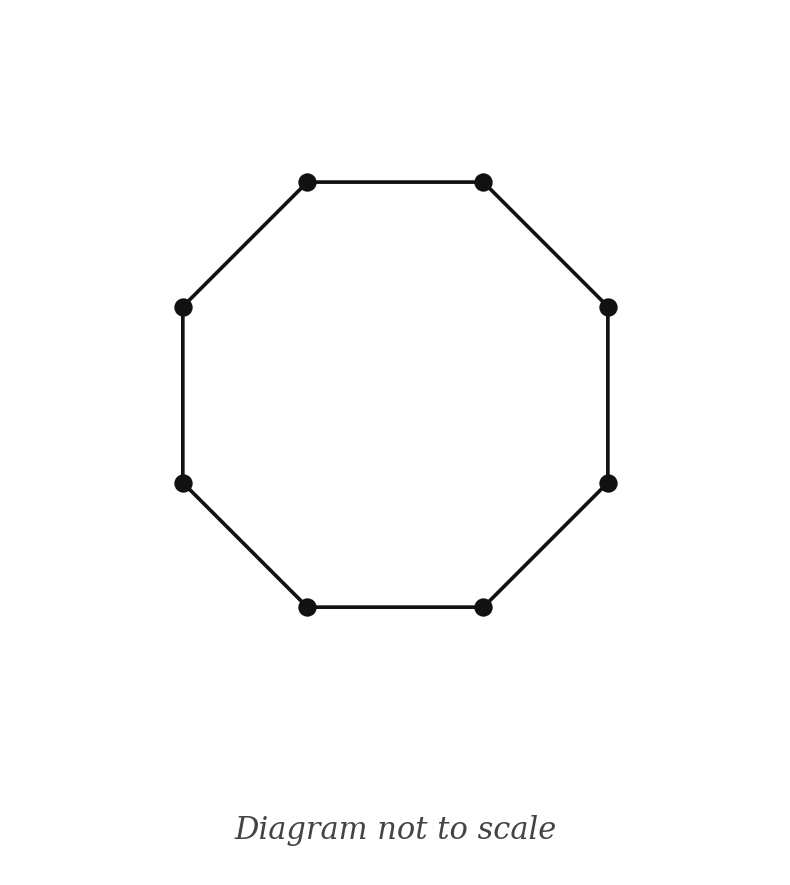
Three distinct vertices are chosen at random from the eight vertices of a regular octagon.
What is the probability that the triangle formed by these three vertices is right-angled?
A.
141
B.
71
C.
72
D.
73
E.
74
F.
76
Answer and solution
Answer: D
The total number of ways to choose 3 distinct vertices from the 8 vertices of a regular octagon is: (38)=3×2×18×7×6=56 All vertices of a regular octagon lie on its circumscribed circle. By Thales's theorem, an inscribed triangle is right-angled if and only if one of its sides is a diameter of the circle (i.e. connects two diametrically opposite vertices).
A regular octagon has 28=4 pairs of opposite vertices (diameters).
For each diameter, any of the remaining 8−2=6 vertices can be chosen as the third vertex to form a right-angled triangle.
Since a triangle has only 3 vertices, it can contain at most one diameter, so each right-angled triangle is counted exactly once.
The number of right-angled triangles is: 4×6=24 Therefore, the probability is: P=5624=73
▸Question 23
A fluid containing a dissolved substance flows through a cylindrical pipe. Between point A and point B, the pipe's radius is halved, the fluid's speed triples, and the substance's concentration decreases by 20%.
What is the percentage change in the mass of the substance flowing past a point per second, from A to B?
A.
130% increase
B.
50% increase
C.
20% increase
D.
25% decrease
E.
40% decrease
F.
60% decrease
Answer and solution
Answer: E
Let m˙s be the mass of the substance flowing past a point per second. This is the product of the substance's concentration C (mass per volume), the fluid's speed v , and the pipe's cross-sectional area A .
m˙s=C×v×A
Since the pipe is cylindrical with radius r , the area is A=πr2 .
m˙s=C⋅v⋅(πr2)
We want to find the ratio of the mass flow rate at point B to that at point A, which we can call the overall scale factor.
Let's determine the scale factor for each term based on the problem statement: 1. The radius is halved: rB=21rA⟹rArB=21 . 2. The fluid's speed triples: vB=3vA⟹vAvB=3 . 3. The concentration decreases by 20%: CB=(1−0.20)CA=0.8CA⟹CACB=0.8 .
Now, we substitute these scale factors into the equation for the ratio of mass flow rates:
m˙s,Am˙s,B=(0.8)⋅(3)⋅(21)2
m˙s,Am˙s,B=0.8⋅3⋅41=2.4⋅41=0.6
This means the mass flow rate at B is 60% of the mass flow rate at A. To find the percentage change, we calculate:
Percentage Change=(Old ValueNew Value−1)×100%
Percentage Change=(0.6−1)×100%=−0.4×100%=−40%
A negative sign indicates a decrease. Therefore, there is a 40% decrease in the mass of the substance flowing past a point per second.
▸Question 24
An empty rectangular tank is being filled with water from a cylindrical pipe. The tank's internal dimensions are 5x m, 2x m, and y m. The pipe's internal diameter is 2x cm. The water flows at a constant speed of 21y km/h.
For positive constants x and y , find the time in hours required to fill the tank.
A.
π2
B.
π20
C.
π50
D.
π200
E.
π200000
F.
50π1
Answer and solution
Answer: D
The problem asks for the time in hours, so we should work with units of metres (m) for length and hours (h) for time.
First, calculate the volume of the rectangular tank in m3 .
Next, calculate the volumetric flow rate of the water in m3/h . The flow rate is the cross-sectional area of the pipe multiplied by the speed of the water.
1. **Pipe's cross-sectional area ( A ):** The internal diameter is given as 2x cm. The radius is half the diameter. Radius, r=22x=x cm. To be consistent with the tank's volume units, we convert the radius to metres: r=x cm=100x m. The area is A=πr2 .
A=π(100x)2=10000πx2 m2
2. **Water speed ( v ):** The speed is given as 21y km/h. To be consistent, we convert this to m/h. Since 1 km = 1000 m:
Finally, calculate the time required to fill the tank.
Time=RVtank=20πx2y m3/h10x2y m3
The variables x2y cancel out:
Time=20π10=π10×20=π200 hours
▸Question 25
The graph of a quadratic polynomial y=P(x) is translated by the vector 3−2 to give the graph of y=Q(x) .
The polynomial Q(x) has roots at x=2 and x=6 .
Given that the graph of y=P(x) touches the x -axis exactly once, what is the y -intercept of the graph of y=P(x) ?
A.
−249
B.
−1
C.
−21
D.
21
E.
6
F.
249
Answer and solution
Answer: D
Since Q(x) is a quadratic with roots at x=2 and x=6 , it can be written as:
Q(x)=a(x−2)(x−6)
where a is a non-zero constant.
The graph of y=P(x) is translated by the vector 3−2 to obtain y=Q(x) . This means that the coordinates transform as (x,y)→(x+3,y−2) , yielding the relation Q(x)=P(x−3)−2 .
Rearranging this to find P(x) gives P(x)=Q(x+3)+2 . Substituting our expression for Q(x) :
P(x)=a((x+3)−2)((x+3)−6)+2
P(x)=a(x+1)(x−3)+2=a(x2−2x−3)+2=ax2−2ax−3a+2
We are given that the graph of y=P(x) touches the x -axis exactly once, meaning the quadratic equation P(x)=0 has a repeated root. Therefore, its discriminant must be zero:
Δ=(−2a)2−4(a)(−3a+2)=0
4a2+12a2−8a=0
16a2−8a=0
Factoring gives 8a(2a−1)=0 . Since P(x) is a quadratic, aeq0 , so we must have a=21 .
The y -intercept of y=P(x) is given by P(0) :
P(0)=−3a+2=−3(21)+2=21
Therefore the correct answer is D.
▸Question 26
The quantities x , y , P , Q and R in a physical system are related by the equation: y=x−RPx+Q Which expression gives x in terms of y , P , Q and R ?
A.
x=P−yyR+Q
B.
x=y−PQ+R
C.
x=y−PyR−Q
D.
x=y−PyR+Q
E.
x=y+PyR+Q
Answer and solution
Answer: D
We want to rearrange the equation y=x−RPx+Q to make x the subject.
First, multiply both sides by the denominator (x−R) :
y(x−R)=Px+Q
Expanding the left-hand side gives yx−yR=Px+Q . To isolate x , we gather all terms containing x on one side and the remaining terms on the other:
yx−Px=yR+Q
Next, we factor out x from the left-hand side:
x(y−P)=yR+Q
Finally, dividing by (y−P) gives the expression for x :
x=y−PyR+Q
▸Question 27
Which one of the following is a simplification of (32−23)2 ?
A.
6
B.
30
C.
6−126
D.
12−126
E.
30−66
F.
30−126
G.
30+126
H.
62−43
Answer and solution
Answer: F
Expanding the expression using (a−b)2=a2−2ab+b2 :
1. First term squared: (32)2=32×(2)2=9×2=18 2. Cross-term: −2(32)(23)=−2×6×2×3=−126 3. Second term squared: (23)2=22×(3)2=4×3=12 Combining these terms: (32−23)2=18−126+12=30−126 Therefore, the correct option is F.