The point P on the curve y=x3−3x has x -coordinate 2 . The tangent at P meets the y -axis at R , and the normal at P meets the x -axis at Q . What is the area of triangle OQR , where O is the origin?
A.
80
B.
128
C.
144
D.
160
E.
180
F.
320
Answer and solution
Answer: D
At x=2 , P=(2,2) . The tangent gradient is 3(2)2−3=9 , so the tangent is y=9x−16 and R=(0,−16) . The normal has gradient −1/9 , so y−2=−91(x−2) . Setting y=0 gives Q=(20,0) . Therefore the area is 21(20)(16)=160 .
▸Question 2
Find the number of solutions to the equation log2(sinx)+log2(3sinx)=1+log2(1−cosx) for 0≤x≤2π .
A.
0
B.
1
C.
2
D.
3
E.
4
F.
5
Answer and solution
Answer: B
Step 1:
Identify Domain Constraints
For the logarithms to be defined, their arguments must be strictly positive. 1. sinx>0 2. 1−cosx>0⟹cosx<1 The condition sinx>0 means that any solution must be in the interval (0,π) . The condition cosx<1 excludes x=0 and x=2π from the given interval 0≤x≤2π .
Step 2:
Simplify the Logarithmic Equation
Using the logarithm laws logaM+logaN=loga(MN) and 1=log2(2) , we can rewrite the equation: log2((sinx)(3sinx))=log2(2)+log2(1−cosx)log2(3sin2x)=log2(2(1−cosx)) Equating the arguments of the logarithms gives: 3sin2x=2(1−cosx) Step 3:
Form a Quadratic Equation in cosx Using the Pythagorean identity sin2x=1−cos2x , we substitute to get an equation solely in terms of cosx : 3(1−cos2x)=2−2cosx3−3cos2x=2−2cosx Rearranging gives a standard quadratic form: 3cos2x−2cosx−1=0 Step 4:
Solve the Quadratic Equation
Let c=cosx . The equation is 3c2−2c−1=0 . We can factor this quadratic: (3c+1)(c−1)=0 This gives two possible values for cosx : cosx=−31orcosx=1 Step 5:
Verify Solutions Against Domain Constraints
We must check these potential solutions against the domain constraints identified in the first step.
Case 1: cosx=1 This occurs at x=0 and x=2π in the given interval. However, our domain requires cosx<1 . Therefore, these are not valid solutions.
Case 2: cosx=−31 In the interval 0≤x≤2π , there are two angles for which cosx=−31 : one in the second quadrant ( x1∈(π/2,π) ) and one in the third quadrant ( x2∈(π,3π/2) ). We must check these against the other domain constraint, sinx>0 . - For the solution x1 in the second quadrant, sinx1>0 . This is a valid solution. - For the solution x2 in the third quadrant, sinx2<0 . This is not a valid solution.
Thus, only one of the potential solutions is valid.
Step 6:
Conclusion
There is exactly one value of x in the interval 0≤x≤2π that satisfies the original equation.
▸Question 3
P, Q and R are regular polygons.
Q has twice as many sides as P.
R has three times as many sides as Q.
An interior angle of R is 25∘ larger than an interior angle of P.
How much larger is an interior angle of Q than an interior angle of P, in degrees?
A.
5
B.
831
C.
10
D.
1221
E.
15
F.
1632
G.
20
Answer and solution
Answer: E
Let n be the number of sides of polygon P.
The exterior angle of a regular k -sided polygon is k360∘ , and its interior angle is 180∘−k360∘ .
- Polygon P has n sides, so its exterior angle is EP=n360∘ . - Polygon Q has 2n sides, so its exterior angle is EQ=2n360∘=21EP . - Polygon R has 3×2n=6n sides, so its exterior angle is ER=6n360∘=61EP .
The difference between the interior angles of R and P equals the difference between their exterior angles: IR−IP=EP−ER=EP−61EP=65EP We are given that IR−IP=25∘ : 65EP=25∘⟹EP=25∘×56=30∘ Then the exterior angle of Q is: EQ=21EP=15∘ The difference between the interior angle of Q and the interior angle of P is: IQ−IP=EP−EQ=30∘−15∘=15∘
▸Question 4
The function f(x)=2x−x2 is defined for 0≤x≤k , where k>2 . Let I be the definite integral ∫0kf(x)dx . Let A be the area of the region bounded by the curve y=f(x) and the x -axis for 0≤x≤k . Given that A=3I , what is the value of k ?
A.
2
B.
3
C.
1+2
D.
1+3
E.
2+3
Answer and solution
Answer: D
The function f(x)=2x−x2=x(2−x) has roots at x=0 and x=2 . Since k>2 , the curve lies above the axis for 0<x<2 and below the axis for 2<x<k .
We first calculate the area of the positive region:
∫02(2x−x2)dx=[x2−3x3]02=4−38=34
Let N be the area of the region below the axis (where N>0 ). We can express the definite integral I and the total geometric area A as:
I=34−NandA=34+N
Adding these equations eliminates N , giving A+I=38 . We are given A=3I , so:
3I+I=38⟹4I=38⟹I=32
We now equate this value to the integral formula in terms of k :
∫0k(2x−x2)dx=[x2−3x3]0k=k2−3k3
Setting k2−3k3=32 leads to the cubic equation k3−3k2+2=0 . By inspection, k=1 is a root. We factorise the cubic:
(k−1)(k2−2k−2)=0
The roots are k=1 and k=22±4−4(1)(−2)=1±3 . Since we require k>2 , the only valid solution is k=1+3 .
▸Question 5
Two vertices of a regular hexagon are at the points (1,1) and (3,5) .
What is the sum of the areas of all possible regular hexagons with these points as vertices?
A.
2953
B.
2753
C.
21053
D.
403
E.
2353
F.
12953
Answer and solution
Answer: A
Let the two points be P(1,1) and Q(3,5) . The square of the distance, d2 , between them is:
d2=(3−1)2+(5−1)2=22+42=4+16=20
A regular hexagon with side length s is composed of 6 equilateral triangles of side length s . The area of one such triangle is 21s2sin(60∘)=43s2 . Therefore, the area of the hexagon is A=6×43s2=233s2 .
There are three distinct geometric relationships for two vertices on a regular hexagon, leading to three possible hexagon sizes.
Case 1: The points are adjacent vertices. The distance between them is the side length, s1 . So, s12=d2=20 . The area of this hexagon is A1=233s12=233(20)=303 .
Case 2: The points are opposite vertices. The distance between them is the long diagonal, which has length 2s2 . So, (2s2)2=d2 , which means 4s22=20 , and s22=5 . The area of this hexagon is A2=233s22=233(5)=2153 .
Case 3: The points are separated by one vertex. The distance between them is the short diagonal, which has length s33 . So, (s33)2=d2 , which means 3s32=20 , and s32=320 . The area of this hexagon is A3=233s32=233(320)=103 .
The sum of the areas of all possible hexagons is A1+A2+A3 .
The straight line XY is tangent at point A to a circle with centre O .
Points B and C lie on the circumference of the circle such that AB=BC .
Angle YAB=65∘ .
What is the size of angle OCA ?
A.
25∘
B.
35∘
C.
40∘
D.
45∘
E.
50∘
F.
65∘
G.
75∘
H.
80∘
Answer and solution
Answer: C
We can solve for ∠OCA using circle theorems in two steps:
1. **Find ∠BAC and ∠ABC :** - By the alternate segment theorem, the angle subtended by chord AB at the circumference in the alternate segment is ∠ACB=∠YAB=65∘ . - Since AB=BC , triangle ABC is isosceles, so ∠BAC=∠BCA=65∘ . - Therefore, ∠ABC=180∘−2(65∘)=50∘ .
2. **Find ∠OCA : - Method 1 (via angle at centre):** The angle subtended by chord AC at the centre is ∠AOC=2×∠ABC=2×50∘=100∘ . Since OA=OC (both are radii), triangle OAC is isosceles, so ∠OCA=2180∘−100∘=40∘ . - Method 2 (via radius perpendicular to tangent): The radius OA is perpendicular to tangent XY , so ∠OAY=90∘ . Thus, ∠OAB=90∘−65∘=25∘ . Then ∠OAC=∠BAC−∠OAB=65∘−25∘=40∘ . Since OA=OC , ∠OCA=∠OAC=40∘ .
Hence, the correct option is C.
▸Question 7
The first term of an arithmetic sequence is 1 and its second term is 61 .
A geometric sequence has its first term equal to the third term of the arithmetic sequence, and its common ratio equal to the sum of the first three terms of the arithmetic sequence.
Find the sum to infinity of the geometric sequence.
A.
−34
B.
2
C.
31
D.
−94
E.
−35
F.
−43
Answer and solution
Answer: A
Let the arithmetic sequence be denoted by un .
We are given the first two terms: u1=1u2=61 The common difference, d , is the difference between consecutive terms:
d=u2−u1=61−1=−65
We need the third term, u3 , of the arithmetic sequence:
u3=u2+d=61+(−65)=−64=−32
We also need the sum of the first three terms, S3 :
Now, let the geometric sequence have first term a and common ratio r .
According to the problem statement: - The first term a is equal to u3 . So, a=−32 . - The common ratio r is equal to S3 . So, r=21 .
Since ∣r∣=∣21∣<1 , the sum to infinity of the geometric sequence exists. The formula for the sum to infinity is S∞=1−ra .
Substituting the values of a and r :
S∞=1−21−32=21−32=−32×2=−34
Therefore, the correct answer is −34 .
▸Question 8
The constant k is defined by k=∫02(3x2+1)dx . A geometric series has first term k and common ratio 1/3 .
What is its sum to infinity?
A.
10
B.
12
C.
15
D.
18
E.
20
F.
30
Answer and solution
Answer: C
k=[x3+x]02=8+2=10 . The sum to infinity is 10/(1−1/3)=10/(2/3)=15 . The correct option is C.
▸Question 9
What is the maximum value of the expression sin2x+3cosx for real values of x ?
A.
1
B.
3
C.
13/4
D.
4
E.
5
Answer and solution
Answer: B
We can express the function entirely in terms of cosx using the identity sin2x=1−cos2x . Let the expression be y .
y=(1−cos2x)+3cosx=−cos2x+3cosx+1
Let u=cosx . Since x is a real number, the possible values for u are in the interval [−1,1] . We need to find the maximum value of the quadratic function f(u)=−u2+3u+1 on this restricted domain.
The parabola f(u) opens downwards, and its vertex is at u=−2(−1)3=1.5 .
Since the vertex is outside the domain [−1,1] , the maximum value on this interval must occur at an endpoint. As the vertex is to the right of the interval, the function is strictly increasing on [−1,1] . The maximum value therefore occurs at u=1 .
Substituting u=1 into the expression gives:
f(1)=−(1)2+3(1)+1=−1+3+1=3
The maximum value is 3.
▸Question 10
A particle moves along a straight line such that its displacement x in metres from a fixed origin at time t in seconds is given by: x=5cos(3t) What is the total distance traveled by the particle between t=0 and t=65π ?
A.
5
B.
15
C.
20
D.
25
E.
30
Answer and solution
Answer: D
The particle's motion is described by x=5cos(3t) . This is simple harmonic motion with amplitude A=5 and angular frequency ω=3 .
The period of one full oscillation is T=ω2π=32π seconds.
The time interval is from t=0 to t=65π . The duration of this interval is 65π . To find how many oscillations this corresponds to, we can divide the duration by the period:
2π/35π/6=65π×2π3=1215=45
So the particle completes 141 oscillations.
In one full oscillation, the particle travels a distance of 4A=4×5=20 m.
The particle starts at its maximum positive displacement, x(0)=5cos(0)=5 . After one full oscillation, it returns to this position. The remaining quarter of an oscillation takes the particle from this extreme position ( x=5 ) to the equilibrium position ( x=0 ). The distance covered in this segment is the amplitude, A=5 m.
The total distance travelled is the sum of these parts: 20+5=25 m.
▸Question 11
How many real solutions does the equation sin(2x)=tan(x) have in the interval 0≤x≤2π ?
A.
3
B.
4
C.
5
D.
6
E.
7
Answer and solution
Answer: E
We use the identities sin(2x)≡2sin(x)cos(x) and tan(x)≡cos(x)sin(x) . The equation becomes:
2sin(x)cos(x)=cos(x)sin(x)
Multiplying by cos(x) (valid since cos(x)eq0 ) and rearranging yields:
sin(x)(2cos2(x)−1)=0
This gives two cases:
1. sin(x)=0 . In the interval 0≤x≤2π , the solutions are 0,π,2π (3 solutions).
Given that P(X+Y=6)=121 , what is the value of P(X+Y=3) ?
A.
121
B.
81
C.
61
D.
245
E.
41
F.
125
Answer and solution
Answer: D
Since the sum of probabilities for the distribution of Y must equal 1: P(Y=1)+P(Y=2)+P(Y=3)=1⟹2p+q=1 Because X and Y both take values from {1,2,3} , the only pair of values that gives X+Y=6 is X=3 and Y=3 . Since X and Y are independent: P(X+Y=6)=P(X=3)×P(Y=3)=61×q=6q We are given P(X+Y=6)=121 , so: 6q=121⟹q=21 Substituting q=21 into 2p+q=1 gives: 2p=1−21=21⟹p=41 The event X+Y=3 occurs when (X,Y)=(1,2) or (X,Y)=(2,1) : - P(X=1,Y=2)=P(X=1)×P(Y=2)=21×41=81 - P(X=2,Y=1)=P(X=2)×P(Y=1)=31×41=121 Adding these probabilities: P(X+Y=3)=81+121=243+242=245
▸Question 13
The shape S shown in the diagram is reflected in the line y=x , and the resulting image is then reflected in the line y=2−x .
Which single transformation is equivalent to this sequence of two reflections?
A.
A translation by the vector (22)
B.
A translation by the vector (−2−2)
C.
A reflection in the line x=1
D.
A reflection in the line y=1
E.
A rotation of 90∘ clockwise about the point (1,1)
F.
A rotation of 90∘ anticlockwise about the point (1,1)
G.
A rotation of 180∘ about the origin (0,0)
H.
A rotation of 180∘ about the point (1,1)
Answer and solution
Answer: H
There are two effective methods to determine the equivalent single transformation:
Method 1: Geometric reasoning The composition of reflections in two intersecting lines L1 and L2 meeting at point P with an angle θ between them is equivalent to a rotation about P through an angle 2θ . - The lines y=x and y=2−x intersect at the point (1,1) because 1=2−1 . - The gradients of the two lines are m1=1 and m2=−1 . Since m1m2=−1 , the two lines are perpendicular (the angle between them is θ=90∘ ). - Therefore, the composite transformation is a rotation through 2×90∘=180∘ about the point of intersection (1,1) .
Method 2: Coordinate mapping Let (x,y) be an arbitrary point on shape S : 1. Reflecting (x,y) in the line y=x gives (y,x) . 2. Reflecting a point (u,v) in the line x+y=2 gives (2−v,2−u) . Applying this to (u,v)=(y,x) yields: (x′,y′)=(2−x,2−y) A rotation of 180∘ about a centre (a,b) maps (x,y)→(2a−x,2b−y) . Matching coefficients gives 2a=2⟹a=1 and 2b=2⟹b=1 , confirming a rotation of 180∘ about (1,1) .
▸Question 14
The area of the region enclosed by the curve y=3x2+1 , the x -axis, and the lines x=0 and x=2 , is A . The area of the region enclosed by the line y=mx , the x -axis, and the lines x=0 and x=2 , is 10% of A .
What is the value of m ?
A.
41
B.
52
C.
21
D.
1
E.
1013
F.
29
Answer and solution
Answer: C
First, we calculate the area A under the curve y=3x2+1 from x=0 to x=2 .
A=∫02(3x2+1)dx
A=[x3+x]02
A=(23+2)−(03+0)=8+2=10
The area of the region under the line y=mx is given as 10% of A . Let's call this area AL .
AL=0.10×A=0.10×10=1
Now, we calculate the area AL by integrating y=mx from x=0 to x=2 . This area can also be seen as a triangle with base 2 and height 2m .
AL=∫02mxdx
AL=[2mx2]02
AL=2m(22)−2m(02)=24m=2m
We are given that AL=1 . Therefore, we can set up the equation:
2m=1
m=21
The correct option is C.
▸Question 15
What is the term independent of x in the expansion of (2x2−x1)6 ?
A.
-160
B.
-60
C.
15
D.
30
E.
60
F.
240
Answer and solution
Answer: E
The general term in the expansion of (2x2−x1)6 is given by:
(r6)(2x2)6−r(−x−1)r
To find the term independent of x , we need the total power of x to be zero. The power of x in the general term is 2(6−r)−r=12−3r .
Setting this power to zero gives:
12−3r=0⟹r=4
We now calculate the coefficient for the term with r=4 :
(46)(2)6−4(−1)4=(26)×22×1=26×5×4=15×4=60
The term independent of x is 60.
▸Question 16
The table shows summary statistics for the scores achieved by students in three different classes, X, Y, and Z.
| Class | Number of students | Mean score | Range of scores | | :--- | :---: | :---: | :---: | | X | 15 | 18 | 8 | | Y | 25 | 24 | 14 | | Z | 10 | 30 | 11 |
The results for all three classes are combined into a single dataset.
What can be deduced about the mean and range of the combined dataset?
A.
mean=23.4 , range≤11
B.
mean=23.4 , 11<range<14
C.
mean=23.4 , range≥14
D.
mean=23.4 , range≥33
E.
mean=24.0 , range≤11
F.
mean=24.0 , 11<range<14
G.
mean=24.0 , range≥14
H.
mean=24.0 , range≥33
Answer and solution
Answer: C
To find the mean of the combined dataset, calculate the total sum of all scores divided by the total number of students: Total students=15+25+10=50Total sum of scores=(15×18)+(25×24)+(10×30)=270+600+300=1170Combined mean=501170=23.4 For the range, let S=X∪Y∪Z be the combined dataset. The range is given by range(S)=max(S)−min(S) . Since class Y is a subset of S , the maximum of S must be at least the maximum of Y, and the minimum of S must be at most the minimum of Y: max(S)≥max(Y)andmin(S)≤min(Y) Subtracting these gives: range(S)=max(S)−min(S)≥max(Y)−min(Y)=14 Therefore, mean=23.4 and range≥14 .
▸Question 17
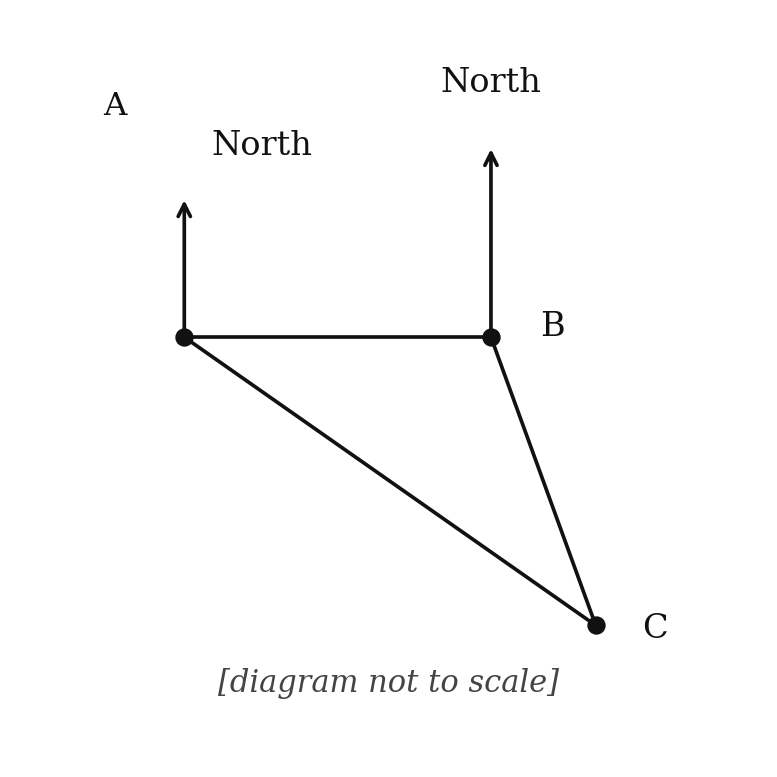
Three buoys, A , B , and C , are floating in the sea as shown in the diagram.
Buoy B is due East of buoy A . The distance from A to B is equal to the distance from B to C . Buoy C is on a bearing of 160∘ from buoy B .
What is the bearing of buoy A from buoy C ?
A.
015∘
B.
125∘
C.
285∘
D.
305∘
E.
325∘
F.
340∘
Answer and solution
Answer: D
1. Buoy B is due East of buoy A , so the bearing of B from A is 090∘ , and the bearing of A from B is 270∘ (due West). 2. Buoy C is on a bearing of 160∘ from B . The interior angle ∠ABC is therefore: ∠ABC=270∘−160∘=110∘ 3. Since the distance AB=BC , triangle ABC is isosceles with ∠BAC=∠BCA : ∠BAC=∠BCA=2180∘−110∘=35∘ 4. The bearing of C from A is: 090∘+∠BAC=090∘+35∘=125∘ 5. The bearing of A from C is the reverse bearing: 125∘+180∘=305∘ (Alternatively, the bearing of B from C is 160∘+180∘=340∘ . Since A lies anti-clockwise from line CB by ∠BCA=35∘ , the bearing is 340∘−35∘=305∘ .)
▸Question 18
A dataset of 25 integer values is summarised in the frequency table below:
| Value | Frequency | | :---: | :---: | | 2 | p | | 4 | q | | 6 | 7 | | 8 | r | | 10 | 2 |
where p , q , and r are positive integers.
The dataset has: - a mean of 5.44 - a median of 6 - a unique mode of 4 What is the value of p ?
A.
1
B.
2
C.
3
D.
4
E.
5
F.
7
Answer and solution
Answer: C
1. Total Frequency: p+q+7+r+2=25⟹p+q+r=16 2. Mean Equation: ∑fx=2p+4q+6(7)+8r+10(2)=2p+4q+8r+62Mean=252p+4q+8r+62=5.442p+4q+8r+62=136⟹2p+4q+8r=74⟹p+2q+4r=37 3. **Eliminating p **: (p+2q+4r)−(p+q+r)=37−16⟹q+3r=21⟹q=21−3r=3(7−r)p=16−q−r=16−(21−3r)−r=2r−5 Since p,q,r are positive integers ( p≥1,q≥1,r≥1 ): - p=2r−5≥1⟹r≥3 - q=21−3r≥1⟹r≤6 The candidate integer triples (p,q,r) are: - r=3⟹(p,q,r)=(1,12,3) - r=4⟹(p,q,r)=(3,9,4) - r=5⟹(p,q,r)=(5,6,5) - r=6⟹(p,q,r)=(7,3,6) 4. Unique Mode Condition: The unique mode is 4 , so its frequency q must be strictly greater than all other frequencies, in particular q>7 (the frequency of 6 ). - This eliminates r=5 (where q=6 ) and r=6 (where q=3 ).
5. Median Condition: For 25 ordered values, the median is the 225+1=13th value. - If (p,q,r)=(1,12,3) : Cumulative frequency of value 2 is 1 ; cumulative frequency of value 4 is 1+12=13 . The 13th value is 4 , which gives a median of 4 (contradicts the given median of 6 ). - If (p,q,r)=(3,9,4) : Cumulative frequency of value 2 is 3 ; cumulative frequency of value 4 is 3+9=12 ; cumulative frequency of value 6 is 12+7=19 . The 13th value falls in the group with value 6 , so the median is indeed 6 .
Thus, the only valid solution is (p,q,r)=(3,9,4) , so p=3 .
▸Question 19
A real number x satisfies the equation
e2x+e−2xe2x−e−2x=31
What is the value of x ?
A.
41ln2
B.
21ln2
C.
−41ln2
D.
−21ln2
E.
0
F.
ln2
Answer and solution
Answer: A
The given equation is:
e2x+e−2xe2x−e−2x=31
To eliminate the negative exponent, we multiply the numerator and the denominator of the left-hand side by e2x :
e2x(e2x+e−2x)e2x(e2x−e−2x)=31
e4x+e0e4x−e0=31
Since e0=1 , this simplifies to:
e4x+1e4x−1=31
Now, we cross-multiply to solve for e4x :
3(e4x−1)=1(e4x+1)
3e4x−3=e4x+1
Group the terms involving e4x on one side and the constant terms on the other:
3e4x−e4x=1+3
2e4x=4
e4x=2
To find x , we take the natural logarithm of both sides:
ln(e4x)=ln(2)
4x=ln(2)
Finally, we solve for x :
x=41ln(2)
Thus, the correct option is A.
▸Question 20
A container is constructed in the shape of a cuboid with a square base of side length x and height h . The container is open at the top. The total surface area of the container is fixed at a constant value S . Given that the volume of the container is maximised, which of the following equations correctly relates h and x ?
A.
h=41x
B.
h=21x
C.
h=x
D.
h=2x
E.
h=4x
Answer and solution
Answer: B
The surface area S of the open-topped container consists of the square base and four vertical sides:
S=x2+4xh
The volume is V=x2h . We can use the surface area equation to express h in terms of x and the constant S :
h=4xS−x2
Substituting this into the volume formula gives V as a function of x alone:
V(x)=x2(4xS−x2)=41(Sx−x3)
To find the value of x that maximises the volume, we differentiate V(x) and set the derivative to zero:
dxdV=41(S−3x2)
Setting dxdV=0 gives the condition for maximum volume: S−3x2=0 , which means S=3x2 .
Finally, we substitute this relationship back into our expression for h :
h=4xS−x2=4x3x2−x2=4x2x2=2x
Thus, the relationship is h=21x .
▸Question 21
Find the coefficient of x2 in the expansion of
(x2−1x3−x+x3+2x2+x+2−2x3−4x2−2x−4)5
A.
−80
B.
−40
C.
−20
D.
20
E.
40
F.
80
Answer and solution
Answer: A
Let the expression inside the large brackets be E(x) . We simplify each fraction separately.
The first fraction is:
x2−1x3−x=x2−1x(x2−1)=x
For the second fraction, let the numerator be N(x) and the denominator be D(x) . N(x)=−2x3−4x2−2x−4=−2(x3+2x2+x+2) . D(x)=x3+2x2+x+2 .
We can factor the denominator by grouping or by using the factor theorem. By grouping: D(x)=x2(x+2)+1(x+2)=(x2+1)(x+2) . Alternatively, using the factor theorem, we can test integer factors of 2. For x=−2 , D(−2)=(−2)3+2(−2)2+(−2)+2=−8+8−2+2=0 . So (x+2) is a factor.
Since N(x)=−2D(x) , the second fraction simplifies to:
x3+2x2+x+2−2(x3+2x2+x+2)=−2
So, the expression inside the brackets simplifies to E(x)=x−2 .
We need to find the coefficient of x2 in the expansion of (x−2)5 . Using the binomial theorem, the term containing x2 is given by:
(25)(x)2(−2)5−2=(25)x2(−2)3
We calculate the components: (25)=2×15×4=10 . (−2)3=−8 .
So the term is 10×x2×(−8)=−80x2 . The coefficient of x2 is −80 .
▸Question 22
A vertical pole stands at a point O on horizontal ground. Points A and B are on the ground such that the triangle OAB is right-angled at O.
The distance from the top of the pole to A is 5, and the distance from the top of the pole to B is 10. The distance between A and B is 9.What is the height of the pole?
A.
3
B.
21
C.
22
D.
23
E.
44
F.
103
Answer and solution
Answer: C
Let the height of the pole be h . Let the point at the base of the pole be O, and the top be P, so OP=h . Let the points on the ground be A and B. We are given that triangle OAB is right-angled at O. Let the distances from the base of the pole to points A and B be a=OA and b=OB respectively.
The problem provides three pieces of information which correspond to the hypotenuses of three right-angled triangles:
1. The pole is vertical, so the triangle POA is right-angled at O. The distance from the top of the pole to A is 5.
h2+a2=52=25
2. Similarly, triangle POB is right-angled at O. The distance from the top of the pole to B is 10.
h2+b2=102=100
3. Triangle OAB on the ground is right-angled at O. The distance between A and B is 9.
a2+b2=92=81
We have a system of three equations. We can express a2 and b2 in terms of h2 from the first two equations:
a2=25−h2
b2=100−h2
Now, substitute these expressions into the third equation:
(25−h2)+(100−h2)=81
Combine terms to solve for h2 :
125−2h2=81
2h2=125−81
2h2=44
h2=22
Since height must be a positive value, we take the positive square root:
h=22
Therefore the correct answer is 22 .
▸Question 23
Three distinct numbers form the first three terms of an arithmetic progression and have a sum of 12. These three numbers, when reordered, form consecutive terms of a geometric progression.
What is the value of the largest of the three numbers?
A.
4
B.
8
C.
12
D.
16
E.
20
Answer and solution
Answer: D
Let the three distinct terms of the arithmetic progression be a−d,a,a+d . Their sum is (a−d)+a+(a+d)=3a . We are given this sum is 12, so 3a=12 , which means a=4 . The terms are 4−d,4,4+d . Since they are distinct, we must have deq0 .
These three numbers can be reordered to form a geometric progression. This requires one term to be the geometric mean of the other two.
First, consider the case where 4 is the middle term of the geometric progression. This would mean 42=(4−d)(4+d) , which gives 16=16−d2 . This implies d2=0 , so d=0 . This contradicts the condition that the numbers are distinct, so this case is not possible.
Therefore, the middle term of the geometric progression must be either 4−d or 4+d . Let's assume the terms in GP order are 4,4−d,4+d . The condition for a geometric progression is (4−d)2=4(4+d) .
16−8d+d2=16+4dd2−12d=0d(d−12)=0
Since deq0 , we must have d=12 . The three numbers are 4−12,4,4+12 , which are −8,4,16 . (Note that if we had taken d=−12 , we would obtain the same set of numbers: 16,4,−8 .)
The largest of these three numbers is 16.
▸Question 24
A curve has equation
y=xk(2x3)2−4x5
for x>0 , where k is a constant.
The gradient of the tangent to the curve at the point where x=1 is 12 .
What is the value of k ?
A.
57
B.
58
C.
47
D.
514
E.
4
F.
8
Answer and solution
Answer: A
The first step is to simplify the expression for the curve's equation.
y=xk(2x3)2−4x5
Apply the power to the terms inside the bracket:
y=xk(4x6)−4x5
Now, divide each term in the numerator by x :
y=4kx5−4x4
The gradient of the tangent is given by the derivative, dxdy . We differentiate the simplified expression for y with respect to x :
dxdy=dxd(4kx5−4x4)=20kx4−16x3
We are given that the gradient at x=1 is 12 . We substitute x=1 into the derivative:
dxdyx=1=20k(1)4−16(1)3=20k−16
Now we set this equal to the given gradient and solve for k :
20k−16=12
20k=28
k=2028=57
Thus, the correct value of k is 57 .
▸Question 25
What is the value of the sum n=2∑100log10(n3+n2n3−n)
A.
-2
B.
-1
C.
0
D.
1
E.
2
Answer and solution
Answer: A
We begin by simplifying the rational expression within the logarithm:
n3+n2n3−n=n2(n+1)n(n2−1)=n2(n+1)n(n−1)(n+1)
Cancelling the common factor n(n+1) leaves nn−1 . The sum can now be written as the logarithm of a product:
S=n=2∑100log10(nn−1)=log10(n=2∏100nn−1)
Writing out the terms of the product reveals a telescoping pattern:
n=2∏100nn−1=21×32×43×⋯×10099
All intermediate terms cancel, leaving only the first numerator and the last denominator:
Product=1001
Finally, we evaluate the logarithm:
S=log10(1001)=log10(10−2)=−2
▸Question 26
The functions f(x) and g(x) satisfy the equation 2∫03(f(x)+1)dx+∫03(4g(x)−f(x))dx=15 What is the value of the following integral? ∫03(5f(x)+20g(x)−2x)dx
A.
36
B.
39
C.
45
D.
51
E.
54
F.
56
Answer and solution
Answer: A
First, we use the linearity of integration on the given equation to establish a relationship between the integrals of f(x) and g(x) .
2∫03(f(x)+1)dx+∫03(4g(x)−f(x))dx=15
⟹2∫03f(x)dx+2∫031dx+4∫03g(x)dx−∫03f(x)dx=15
The integral of the constant is ∫031dx=[x]03=3 . Substituting this and combining the other terms gives:
∫03f(x)dx+2(3)+4∫03g(x)dx=15
⟹∫03(f(x)+4g(x))dx=9
Now we turn to the integral we need to evaluate. We can split it and factor out constants, revealing a multiple of the expression we just found.
We can substitute the value of 9 for the first part and evaluate the second part directly.
5(9)−[x2]03=45−(32−02)=45−9=36
▸Question 27
The solution set of the inequality
log2x−1log2x−k>3
is the interval 41<x<2 .
Find the value of the constant k .
A.
−1
B.
1
C.
3
D.
4
E.
5
F.
7
Answer and solution
Answer: F
Let u=log2x . The inequality transforms into an inequality in terms of u .
The given solution interval for x is 41<x<2 . We convert this to an interval for u :
log2(41)<log2x<log22
Since log2(41)=log2(2−2)=−2 and log22=1 , the solution interval for u is −2<u<1 .
Now, we solve the inequality in u :
u−1u−k>3
To solve this rational inequality, we rearrange it to have 0 on one side:
u−1u−k−3>0
u−1(u−k)−3(u−1)>0
u−1u−k−3u+3>0
u−1−2u+3−k>0
To make the coefficient of u in the numerator positive, we multiply the fraction by −1−1 and flip the inequality sign:
u−12u−(3−k)<0
The critical values for u are the roots of the numerator and the denominator, which are u=1 and u=23−k .
The inequality Q(u)P(u)<0 is satisfied when u is between the two critical values.
So, the solution set for u is the interval between 1 and 23−k .
We know the solution set for u is the interval (−2,1) .
By comparing the derived solution with the known solution, the two endpoints must match. One endpoint is 1 , which matches. The other endpoint, 23−k , must be equal to −2 .
23−k=−2
3−k=−4
k=3+4=7
This requires the interval to be (23−k,1) , which is true if 23−k<1 . For k=7 , we have 23−7=−2 , and −2<1 , so this is consistent.