A point on a guitar string oscillates in simple harmonic motion with a frequency of 50 Hz and an amplitude of 4.0 mm . What is the total distance travelled by this point during a time interval of 3.0 s ?
A.
0.0 m
B.
0.6 m
C.
1.2 m
D.
2.4 m
E.
3.8 m
Answer and solution
Answer: D
First, determine the total number of oscillations ( N ) in the given time interval.
N=f×t=50 Hz×3.0 s=150 cycles
In one complete oscillation, the point moves from equilibrium to the peak ( A ), back to equilibrium ( A ), to the trough ( A ), and back to equilibrium ( A ). The total distance travelled in one cycle is therefore 4A .
Distance per cycle=4×4.0 mm=16.0 mm
The total distance travelled is:
Total distance=150×16.0 mm=2400 mm=2.4 m
▸Question 2
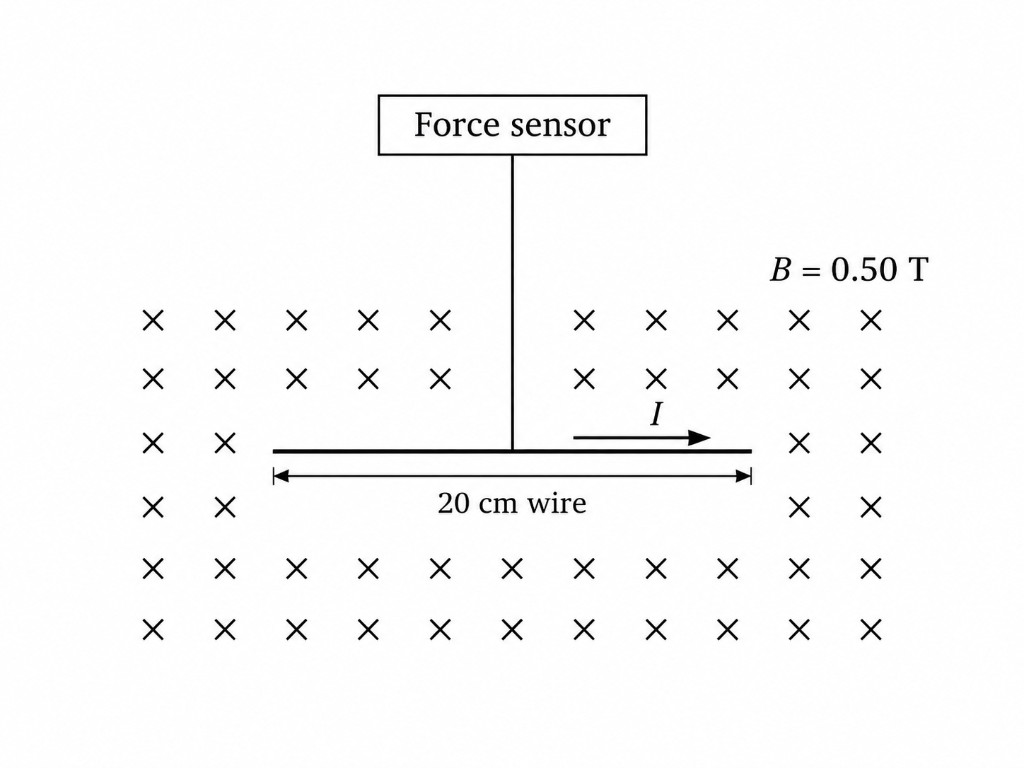
A straight, horizontal wire of length 20 cm is suspended from a sensitive force sensor. The wire is in a uniform magnetic field of strength 0.50 T, directed perpendicular to the wire. A total charge of 12 C passes through the wire over a time of 2.0 s.
What is the magnitude of the change in the reading on the force sensor?
A.
0.20 N
B.
0.60 N
C.
1.2 N
D.
2.4 N
E.
3.0 N
F.
60 N
Answer and solution
Answer: B
The question asks for the change in the reading on the force sensor. This change is caused by the magnetic force, Fm , that acts on the wire when current flows. The weight of the wire is constant and is part of the initial reading, so it does not contribute to the change.
1. First, calculate the current I flowing through the wire using the definition of current: I=tQ . I=2.0 s12 C=6.0 A .
2. Next, calculate the magnetic force Fm on the current-carrying wire. The formula is Fm=BILsin(θ) . Since the field is perpendicular to the wire, θ=90∘ and sin(90∘)=1 . So, Fm=BIL .
3. Convert the length to SI units: L=20 cm=0.20 m .
4. Substitute the values into the force equation: Fm=(0.50 T)×(6.0 A)×(0.20 m) . Fm=(0.50×0.20)×6.0=0.10×6.0=0.60 N .
This magnetic force is the change in the reading on the sensor.
▸Question 3
Two objects, X and Y, are in motion. Object X has 3 times the momentum of object Y and 4 times the kinetic energy of object Y.
What is the ratio of their masses, mYmX ?
A.
163
B.
43
C.
94
D.
49
E.
12
F.
36
Answer and solution
Answer: D
1. Rearrange the relationship Ek=2mp2 to make mass the subject: m=2Ekp2 . 2. This reveals the proportional relationship m∝Ekp2 . 3. We are given the scaling factors for momentum ( pX=3pY ) and kinetic energy ( EkX=4EkY ). 4. Substitute these factors into the proportional relationship: mYmX=4(3)2=49 .
▸Question 4
The intensity I of a physical field varies with distance r from a point source according to a power law relationship I=krn , where k and n are constants. Experimental measurements yield the following data:
At rAt r=2.0 m,=4.0 m,II=72 W m−2=18 W m−2
What is the intensity I at a distance of r=3.0 m ?
A.
24 W m−2
B.
32 W m−2
C.
36 W m−2
D.
45 W m−2
E.
48 W m−2
Answer and solution
Answer: B
First, determine the power law exponent n .
Comparing the two data points:
I1I2=7218=41
r1r2=2.04.0=2
Since the intensity decreases by a factor of 4 when the distance doubles ( 22=4 ), the relationship is an inverse square law ( I∝r−2 or n=−2 ).
We can find the constant k using the first point (or the second):
Ir2=k⟹72×(2.0)2=72×4=288
Now calculate I for r=3.0 m :
I=r2k=(3.0)2288=9288
I=32 W m−2
▸Question 5
A fixed mass of gas is sealed in a rigid container and heated.
Which statement best explains the increase in pressure?
A.
The particles have greater average speed and transfer more momentum to the walls per unit time.
B.
The particles become larger, so less empty space remains.
C.
The number of particles increases while their average speed remains constant.
D.
The particles move more slowly and therefore remain in contact with the walls for longer.
E.
The average spacing between particles must increase because the gas is hotter.
Answer and solution
Answer: A
Heating increases average particle kinetic energy and speed. More frequent and more forceful wall collisions increase momentum transferred per unit time, hence force and pressure. The fixed particle number and container volume rule out an increase in particle number or average spacing.
▸Question 6
A transmission line receives 20kW at 2.0kV . The total resistance of its cables is 5.0Ω .
The voltage at the sending end is increased to 10kV , while the power entering the line remains 20kW . The cable resistance is unchanged.
By how much does the power lost in the cables decrease?
A.
20W
B.
100W
C.
400W
D.
480W
E.
500W
Answer and solution
Answer: D
Initially I=20000/2000=10A , so the loss is I2R=500W . Afterwards I=20000/10000=2A , so the loss is 20W . The reduction is 500−20=480W .
▸Question 7
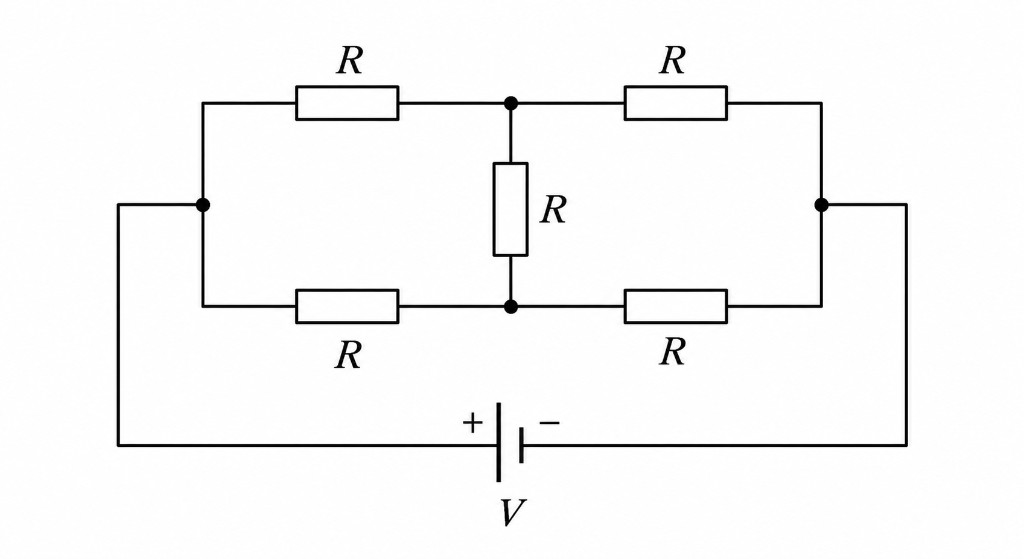
A circuit is constructed with five identical resistors, each of resistance R , connected to a DC supply of voltage V . The circuit consists of two parallel branches, each containing two resistors in series. A fifth identical resistor connects the midpoint of the first branch to the midpoint of the second branch. The total power dissipated by the circuit is P . If the connecting resistor between the two branches is removed, which expression gives the new total power dissipated?
A.
21P
B.
54P
C.
P
D.
45P
E.
2P
Answer and solution
Answer: C
The circuit described is a Wheatstone bridge with five identical resistors, each of resistance R . Let the two series resistors in the first branch be R1 and R2 , and in the second branch be R3 and R4 . The fifth resistor, R5 , connects the junction between R1 and R2 to the junction between R3 and R4 .
Since all resistors are identical ( R1=R2=R3=R4=R5=R ), we can check the balance condition for the Wheatstone bridge: R2R1=RR=1R4R3=RR=1 Since the ratios are equal ( 1=1 ), the bridge is balanced. This means that the electric potential at the midpoint of the first branch is identical to the potential at the midpoint of the second branch. Consequently, there is no potential difference across the central connecting resistor ( R5 ).
Because there is no potential difference across R5 , no current flows through it. Therefore, R5 dissipates no power and does not contribute to the overall equivalent resistance of the circuit. The total power dissipated by the circuit, P , is determined by the equivalent resistance of the four outer resistors.
When the central resistor ( R5 ) is removed, the circuit's equivalent resistance remains unchanged because it was not carrying any current. The circuit effectively consists of two parallel branches, each with a total resistance of R+R=2R . The equivalent resistance of these two parallel branches is: Req=2R+2R(2R)(2R)=4R4R2=R The initial power dissipated was P=ReqV2=RV2 . After removing the central resistor, the equivalent resistance remains R . Thus, the new total power dissipated will be P′=RV2=P .
Therefore, the total power dissipated by the circuit remains the same.
▸Question 8
The graph shows the displacement of a particle undergoing simple harmonic motion as a function of time.What is the average speed of the particle during the first 4.0 s of its motion?
A.
0ms−1
B.
0.25ms−1
C.
0.50ms−1
D.
1.0ms−1
E.
2πms−1
F.
2.0ms−1
Answer and solution
Answer: D
First, we extract the amplitude ( A ) and period ( T ) from the graph.
The maximum displacement is 0.5m , so the amplitude is A=0.5m .
The motion starts at maximum positive displacement, returns to maximum positive displacement at t=2.0s . So the period is T=2.0s .
Average speed is defined as total distance divided by total time. In one period ( T ), the particle moves from its positive amplitude position to its negative amplitude position and back again. The distance covered is: - from x=+A to x=0 (distance A ) - from x=0 to x=−A (distance A ) - from x=−A to x=0 (distance A ) - from x=0 to x=+A (distance A )
The total distance in one period is 4A .
So, the distance travelled in one period is 4×0.5m=2.0m .
The time interval is 4.0s , which is exactly two periods ( 2T ).
Total distance travelled in 4.0s is 2×(4A)=2×2.0m=4.0m .
Total time taken is 4.0s .
average speed=total timetotal distance=4.0s4.0m=1.0ms−1
▸Question 9
Three devices use different regions of the electromagnetic spectrum:
1. a thermal camera detecting radiation emitted by a warm hand; 2. a lamp producing ultraviolet radiation; 3. a scanner producing X-rays.
Which row lists the devices in order of increasing radiation frequency and correctly compares the speeds of their radiation in a vacuum?
A.
1, 2, 3; all three speeds are equal
B.
1, 3, 2; all three speeds are equal
C.
3, 2, 1; all three speeds are equal
D.
1, 2, 3; speed increases in this order
E.
2, 1, 3; speed decreases in this order
Answer and solution
Answer: A
The thermal camera detects infrared. The frequency order is infrared, ultraviolet, X-rays. All three are electromagnetic waves and travel at the same speed in a vacuum, despite their different frequencies.
▸Question 10
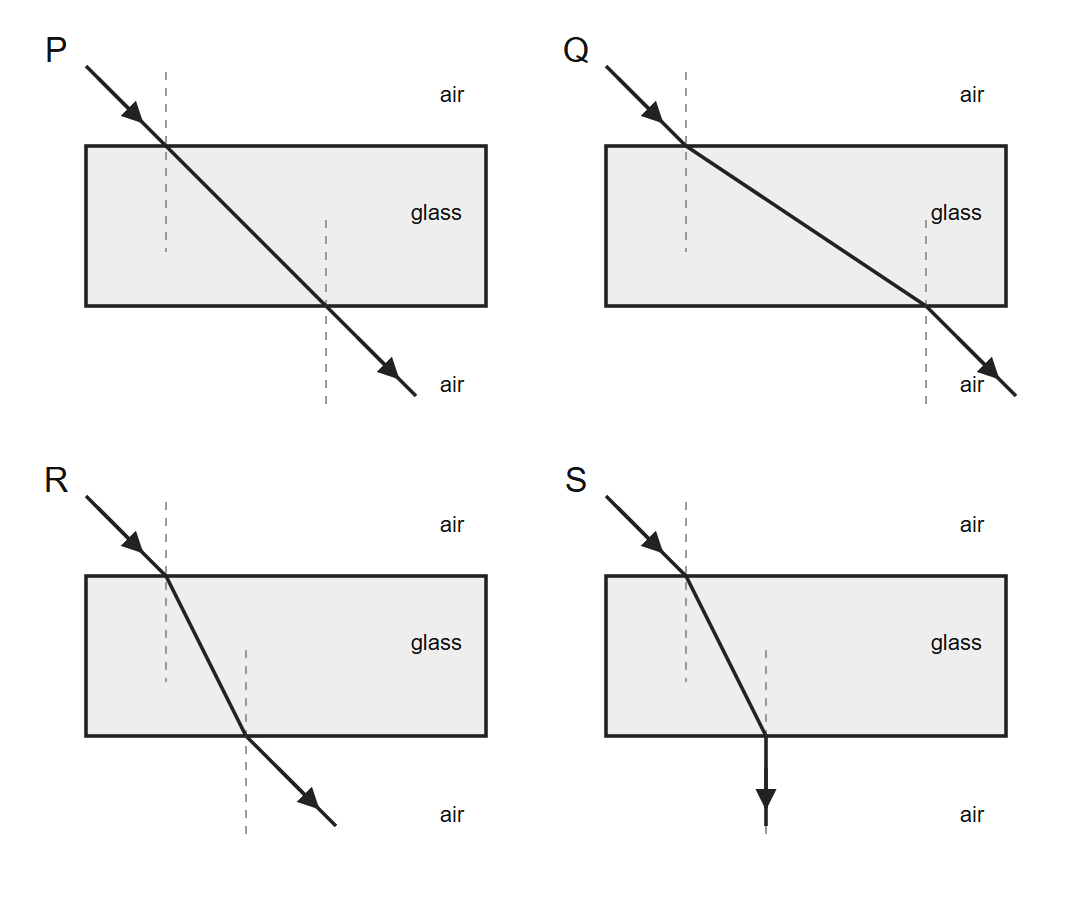
Each diagram is intended to show a ray travelling from air through a rectangular glass block and back into air. Light travels more slowly in glass than in air. The two faces crossed are parallel.
Which diagram shows a possible path? Ignore partial reflection.
A.
P
B.
Q
C.
R
D.
S
E.
None of them
Answer and solution
Answer: C
The ray must bend towards the normal on entering glass and away from the normal on leaving. For parallel faces with air on both sides, the emergent ray is parallel to the incident ray. Only R satisfies all these conditions.
▸Question 11
Straight water waves cross a boundary from deep water into shallow water. In the deep water, the distance from the first crest to the fifth crest is 24cm . The wave speed there is 30cms−1 .
In the shallow water, the distance from the first crest to the fifth crest is 16cm .
What are the wave frequency and the speed in the shallow water?
A.
1.25Hz , 20cms−1
B.
5.0Hz , 20cms−1
C.
5.0Hz , 45cms−1
D.
7.5Hz , 30cms−1
E.
1.25Hz , 5.0cms−1
Answer and solution
Answer: B
Five crests span four wavelengths: λd=24/4=6cm . Thus f=30/6=5Hz . Frequency is unchanged by refraction, and λs=16/4=4cm , so vs=5×4=20cms−1 .
▸Question 12
An electric kettle has a power input of 2.5 kW. When used to boil water, it produces steam at a steady rate of 1.0 g s⁻¹.
What is the rate of energy loss from the kettle to the surroundings?
(Specific latent heat of vaporisation of water = 2.0×10⁶ J kg⁻¹; specific heat capacity of water = 4.2×10³ J kg⁻¹ K⁻¹)
A.
0 W
B.
500 W
C.
1500 W
D.
2000 W
E.
2500 W
F.
4500 W
Answer and solution
Answer: B
The steam production rate is 1.0gs−1=1.0×10⁻³kgs−1 . The useful power used for vaporisation is P=m˙Lv=(1.0×10⁻³)(2.0×10⁶)=2000W . The input is 2500 W, so the loss rate is 2500−2000=500W . Therefore the correct option is B.
▸Question 13
A nucleus of Thorium-232 ( 90232Th ) decays through a series of emissions to become a stable nucleus of Lead-208 ( 82208Pb ). The decay series consists entirely of alpha ( α ) particles and beta-minus ( β− ) particles. What are the total numbers of α and β− particles emitted during this process?
A.
4 α , 6 β−
B.
6 α , 4 β−
C.
6 α , 8 β−
D.
6 α , 12 β−
Answer and solution
Answer: B
Let Nα be the number of alpha particles ( 24He ) and Nβ be the number of beta-minus particles ( −10e ) emitted.
We can determine Nα and Nβ by conserving the mass number (superscript) and the atomic number (subscript).
First, for the mass number:
232=208+4Nα+0Nβ
This simplifies to 24=4Nα , which gives Nα=6 .
Next, for the atomic number:
90=82+2Nα−Nβ
Substituting our value for Nα :
90=82+2(6)−Nβ90=82+12−Nβ90=94−Nβ
Solving for Nβ gives Nβ=4 .
Therefore, 6 α particles and 4 β− particles are emitted.
▸Question 14
A small heating element at the bottom of an open tank of liquid heats a small parcel of the liquid immediately above it.
Just before this heated parcel begins to rise, how do its mass, weight, and the upthrust acting on it compare to their values before it was heated?
1. The heated parcel consists of a fixed number of particles, so its mass is unchanged. 2. Since mass is unchanged and the gravitational field strength is constant, its weight ( W=mg ) is also unchanged. 3. Heating causes the parcel to expand, meaning its volume increases. 4. Upthrust is equal to the weight of the surrounding (unheated) fluid displaced by the parcel. Because the parcel's volume has increased, it displaces a larger volume of the surrounding fluid, so the upthrust acting on it increases. 5. The increased upthrust now exceeds the unchanged weight, resulting in a net upward force that causes the parcel to rise.
▸Question 15
Two identical copper spheres, X and Y, are heated to 500 K .
Sphere X has a matte black surface.
Sphere Y has a polished silver surface.
The initial rate of energy loss, R , is determined for each sphere in a vacuum and in an atmosphere of argon gas at 298 K .
In the vacuum, it is observed that RX>RY .
Assume that the rate of heat transfer due to convection depends only on the dimensions of the sphere and the temperature difference.
Which statement correctly describes the rates in the argon atmosphere compared to the vacuum?
A.
The rates RX and RY increase by the same amount, and the ratio RYRX decreases.
B.
The rates RX and RY increase by the same amount, and the ratio RYRX stays constant.
C.
The rate RX increases more than RY because black surfaces are better thermal conductors, and the ratio RYRX increases.
D.
The rate RY increases more than RX because the polished surface reflects gas molecules, and the ratio RYRX decreases.
Answer and solution
Answer: A
In a vacuum, heat loss occurs only by radiation. A matte black surface is a better emitter than a polished silver surface, so RX>RY .
When argon is introduced, heat loss occurs by radiation and convection.
The rate of convection depends on the geometry of the object and the temperature difference, not the surface colour (emissivity). Since the spheres are identical in shape and temperature, the convective heat loss term ( C ) is the same for both.
The new rates are:
RX′′=RX+C
RY′′=RY+C
Since RX>RY and C>0 , adding the same positive constant to the numerator and denominator of the ratio RYRX brings the value closer to 1 . Therefore, the ratio decreases.
Example: If RX=10 , RY=2 , and C=6 :
Original ratio =5 .
New ratio =816=2 .
▸Question 16
A continuous wave travels from medium X to medium Y. The wave speed in medium Y is 32 of the wave speed in medium X. What is the fractional change in the wavelength of the wave?
A.
−31
B.
0
C.
31
D.
21
E.
32
Answer and solution
Answer: A
The speed v , frequency f , and wavelength λ of a wave are related by v=fλ .
When a wave passes from one medium to another, its frequency f remains constant (determined by the source). Therefore, the wavelength is directly proportional to the speed:
λ∝v
Given that the new speed vY is 32 of the original speed vX :
λY=32λX
The fractional change is:
λXλY−λX=λX32λX−λX=32−1=−31
▸Question 17
The radioactive nuclide 92235U decays into the stable nuclide 82207Pb via a series of α (alpha) and β− (beta-minus) emissions.
Which option gives the total number of α and β− particles emitted during this decay chain?
A.
5 α , 0 β−
B.
7 α , 4 β−
C.
7 α , 10 β−
D.
8 α , 6 β−
Answer and solution
Answer: B
An α particle ( 24He ) reduces the mass number, A , by 4 and the atomic number, Z , by 2. A β− particle ( −10e ) leaves A unchanged and increases Z by 1.
The change in mass number is solely due to α decay. The total change is 235−207=28 . Since each α particle reduces A by 4, the number of α particles is:
428=7
Now we consider the atomic number, Z . The overall change is from 92 to 82, a net decrease of 10. The 7 α decays would cause a decrease in Z of 7×2=14 . Let nβ be the number of β− decays. The total change in Z is the sum of the changes from both decay types:
(−14)+nβ=−10
This gives nβ=4 . So, the decay involves 7 α particles and 4 β− particles.
▸Question 18
An electric heater of constant power is used to heat a metal block. The block is initially at room temperature, 20∘C . After 10 minutes, the temperature of the block is 50∘C . The rate of thermal energy loss to the surroundings is proportional to the temperature difference between the block and the surroundings. Which of the following describes the temperature θ of the block after a total of 20 minutes?
A.
θ=50∘C
B.
50∘C<θ<80∘C
C.
θ=80∘C
D.
80∘C<θ<100∘C
E.
θ=100∘C
Answer and solution
Answer: B
The rate of temperature increase is determined by the net power supplied to the block. This is the constant power from the heater minus the power lost to the surroundings. The rate of heat loss is proportional to the temperature difference, θ−20∘C . As the block heats up, this difference increases, so the rate of heat loss increases. This means the net power supplied to the block, and therefore its rate of temperature rise, decreases over time.
In the first 10 minutes, the temperature increased by 50∘C−20∘C=30∘C . Over the next 10 minutes, the average temperature is higher, so the average rate of heat loss is greater. The temperature increase in this second interval must therefore be less than the 30∘C increase seen in the first. The final temperature θ must be greater than 50∘C but less than 50∘C+30∘C=80∘C .
▸Question 19
An object of mass 2.0 kg moves in a straight line. The velocity-time graph for its motion is shown.What is the magnitude of the constant net force acting on the object?
A.
1.0 N
B.
2.0 N
C.
4.0 N
D.
5.0 N
E.
12 N
F.
20 N
Answer and solution
Answer: C
The relationship between net force F , mass m , and acceleration a is given by Newton's Second Law, F=ma .
The acceleration is constant because the velocity-time graph is a straight line. The value of the acceleration is the gradient of the graph.
Using the points (0s,2m s−1) and (4s,10m s−1) from the graph:
a=ΔtΔv=4s−0s10m s−1−2m s−1
a=4s8m s−1=2.0m s−2
Now, we can calculate the net force:
F=ma=(2.0kg)×(2.0m s−2)=4.0N
▸Question 20
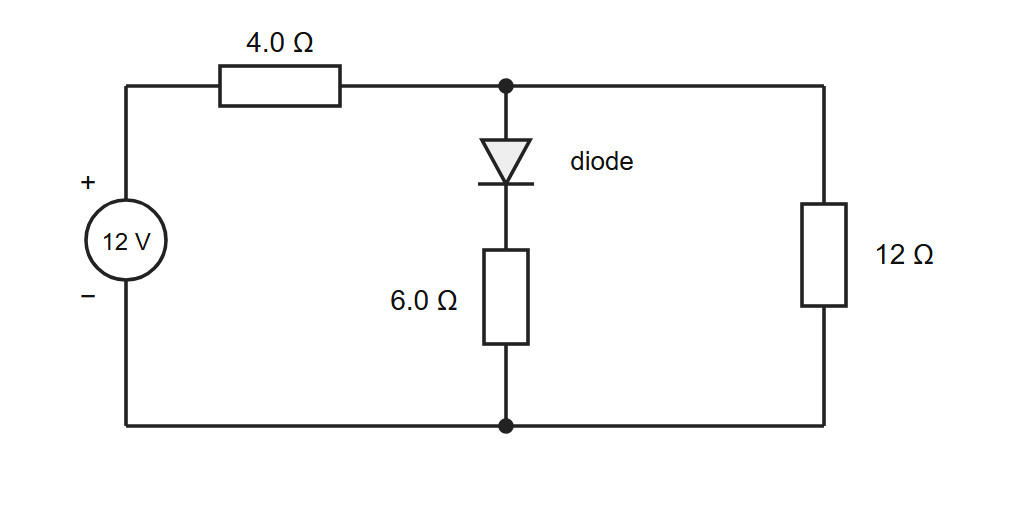
A 12V d.c. supply is connected to the circuit shown. The ideal diode initially conducts. A conducting ideal diode has zero resistance; in the reverse direction it blocks all current.
The supply connections are reversed. What is the new total power supplied to the circuit?
A.
6.0W
B.
9.0W
C.
12W
D.
18W
E.
36W
Answer and solution
Answer: B
Reversal blocks the diode branch completely. The remaining conducting path contains 4.0Ω and 12Ω in series, so R=16Ω . Hence I=12/16=0.75A and P=VI=9.0W . The blocked branch is an open circuit, not a short circuit.
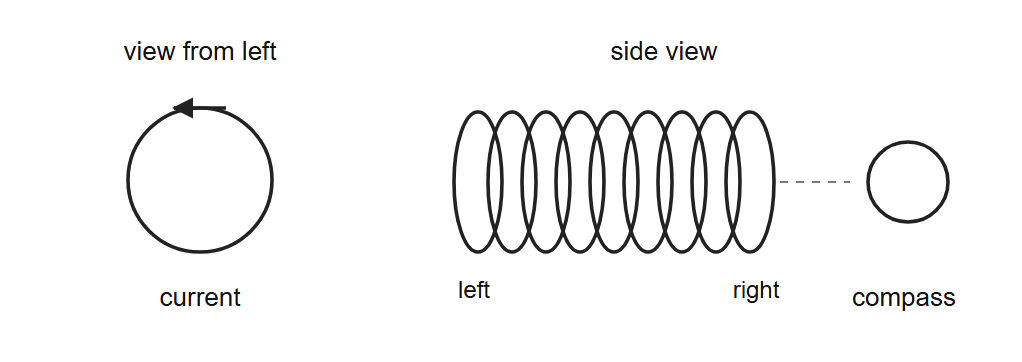
▸Question 21
The left-hand end of a solenoid is viewed directly. The current around this end flows anticlockwise, as shown. A small compass is placed on the solenoid's axis just beyond its right-hand end. Other magnetic fields are negligible.
Which way does the compass's north-seeking end point initially, and after the current is reversed?
A.
right initially; right afterwards
B.
right initially; left afterwards
C.
left initially; left afterwards
D.
left initially; right afterwards
E.
upwards initially; downwards afterwards
Answer and solution
Answer: D
Anticlockwise current makes the viewed left end a north pole, so the right end is a south pole. Just to the right of a south pole, the field points left towards it. Reversing the current reverses the poles and the field, so the compass then points right.
▸Question 22
Twelve identical resistors are connected to form the edges of a cube. A current enters the network at one vertex and leaves at the diagonally opposite vertex. Let Pin be the power dissipated in a single resistor connected directly to the input vertex. Let Pmid be the power dissipated in a single resistor that is connected to neither the input nor the output vertex. What is the value of the ratio PmidPin ?
A.
1
B.
2
C.
4
D.
9
E.
16
Answer and solution
Answer: C
Let the total current entering the cube be I . By symmetry, this current must split equally among the three resistors connected to the input vertex. The current in one of these 'input' resistors is therefore Iin=3I .
Each of these currents then reaches a vertex (e.g., from input vertex A to vertex B). From such a vertex (B), the current I/3 splits into two equivalent paths leading to the next layer of vertices (e.g., to C and F). By symmetry, the current divides equally between them.
The current in a 'middle' resistor (e.g., BC or BF), which is not connected to the input or output vertex, is therefore half of the current in an 'input' resistor: Imid=21Iin=21(3I)=6I .
The power dissipated in a resistor with resistance R is given by P=I2R . We want to find the ratio PmidPin .
A solid composite object has total volume 4.0×10⁻³m3 and is made from materials X and Y. Their densities are 2000kg m−3 and 800kg m−3 respectively.
It is fully submerged and neutrally buoyant in a fluid of density 1100kg m−3 . For this question, neutral buoyancy means that the object's total mass equals the mass of the displaced fluid: mtotal=ρfluidVtotal .
What is the mass of material X?
A.
1.1 kg
B.
2.0 kg
C.
2.4 kg
D.
4.0 kg
E.
4.4 kg
F.
6.0 kg
Answer and solution
Answer: B
Let ρF be the density of the fluid. For the object to be neutrally buoyant, its average density, ρavg , must be equal to the fluid density. So, ρavg=ρF=1100 kg m−3 .
The total mass of the object is Mtotal=ρavg×Vtotal=1100×(4.0×10−3)=4.4 kg .
Let VX and VY be the volumes of materials X and Y, and mX and mY be their masses. We have two simultaneous equations: 1. For total volume: VX+VY=Vtotal=4.0×10⁻³ m3 . 2. For total mass: mX+mY=Mtotal=4.4 kg .
We can write the masses in terms of volumes and densities ( mX=ρXVX and mY=ρYVY ):
2000VX+800VY=4.4
From the volume equation, VY=4.0×10⁻³−VX . Substituting this into the mass equation:
2000VX+800(4.0×10⁻³−VX)=4.4
2000VX+3.2−800VX=4.4
1200VX=1.2
VX=12001.2=0.001 m3=1.0×10⁻³ m3
The question asks for the mass of material X, which is mX=ρXVX .
mX=2000 kg m−3×(1.0×10−3 m3)=2.0 kg
▸Question 24
An ideal transformer has one primary coil and two separate secondary coils. The primary has 600 turns and is supplied at 120V a.c.
Secondary X has 60 turns and supplies a 6.0Ω resistor. Secondary Y has 120 turns and supplies a 24Ω resistor. Both loads are connected simultaneously.
What is the primary current?
A.
0.20A
B.
0.30A
C.
0.40A
D.
0.60A
E.
3.0A
Answer and solution
Answer: C
The secondary voltages are 12V and 24V . The load powers are 122/6=24W and 242/24=24W . The input supplies both: Ip=(24+24)/120=0.40A .
▸Question 25
A fixed mass of an ideal gas initially has pressure P and volume V . The gas is compressed at constant temperature to a final volume of V/3 . Which expression gives the final pressure of the gas?
A.
9P
B.
3P
C.
P
D.
3P
E.
9P
Answer and solution
Answer: D
For a fixed mass of an ideal gas at constant temperature, the product of pressure and volume is constant (Boyle's Law). We write this relationship as:
P1V1=P2V2
Letting the final pressure be Pfinal , we substitute the initial values P,V and the final volume V/3 :
PV=Pfinal(3V)
Rearranging to solve for Pfinal :
Pfinal=V/3PV=3P
The pressure increases by a factor of 3.
▸Question 26
A short pulse of light travels normally through a transparent block of thickness 12cm . Its speed in the block is 2.0×10⁸ms−1 .
The block is replaced by a second block of the same thickness in which the pulse travels at 1.5×10⁸ms−1 . The rest of the pulse's path is unchanged.
By how much does its arrival at a detector become later?
A.
0.10ns
B.
0.20ns
C.
0.40ns
D.
0.60ns
E.
0.80ns
Answer and solution
Answer: B
The original transit time is 0.12/(2.0×108)=0.60ns . The replacement gives 0.12/(1.5×108)=0.80ns . Subtracting gives an extra delay of 0.20ns . No bending occurs at normal incidence, but speed still changes.
▸Question 27
A DC power supply of voltage V and negligible internal resistance is connected in series with two resistors of resistances R and 2R . Which expression gives the current flowing through the resistor of resistance R ?
A.
3RV
B.
2RV
C.
3R2V
D.
RV
E.
2R3V
Answer and solution
Answer: A
In a series circuit, the current is the same through all components. To find this current, we must determine the equivalent resistance of the entire circuit.
The total resistance Rtotal is the sum of the individual resistances:
Rtotal=R+2R=3R
Applying Ohm's Law to the whole circuit:
I=RtotalV=3RV
This is the current flowing through the source and both resistors.