Equal volumes of 0.100 mol dm−3\ceHCl(aq) (a strong acid) and 0.100 mol dm−3\ceCH3COOH(aq) (a weak acid) are investigated in separate experiments at 25∘C .
Which of the following statements is/are correct?
1 The initial rate of reaction when excess solid calcium carbonate is added is greater with \ceHCl(aq) than with \ceCH3COOH(aq) .
2 When excess magnesium is added to each acid solution, the total volume of hydrogen gas produced (measured at room temperature and pressure) after both reactions have finished is greater with \ceHCl(aq) than with \ceCH3COOH(aq) .
3 The volume of 0.0500 mol dm−3\ceBa(OH)2(aq) required to completely neutralise the acid solution is the same for both acids.
A.
none of them
B.
1 only
C.
2 only
D.
3 only
E.
1 and 2 only
F.
1 and 3 only
G.
2 and 3 only
H.
1, 2 and 3
Answer and solution
Answer: F
Statement 1 is correct: \ceHCl is a strong acid and fully dissociates in aqueous solution, giving [\ceH+]=0.100 mol dm−3 . \ceCH3COOH is a weak acid and only partially dissociates, giving [\ceH+]≪0.100 mol dm−3 . The initial rate of reaction with \ceCaCO3(s) depends directly on [\ceH+] , so the initial rate is greater for \ceHCl(aq) .
Statement 2 is incorrect: Since both solutions have equal volumes and equal concentrations of monoprotic acids, they contain identical amounts (moles) of ionisable hydrogen. In the presence of excess \ceMg , the reaction drives the weak acid dissociation equilibrium to completion. The stoichiometric equation for both monoprotic acids is \ceMg+2HA−>MgA2+H2 , meaning both produce the exact same total number of moles (and therefore volume) of \ceH2(g) .
Statement 3 is correct: Complete neutralisation with \ceBa(OH)2(aq) follows the stoichiometry \ce2HA+Ba(OH)2−>BaA2+2H2O . Because both solutions contain the same total number of moles of acid, the number of moles of \ceBa(OH)2 required for complete neutralisation is identical, so the required volume of 0.0500 mol dm−3\ceBa(OH)2(aq) is the same for both.
Therefore, statements 1 and 3 only are correct.
▸Question 2
Three positive ions are detected in a mass spectrometer: \ce32S2+\ce36Ar2+\ce35Cl+ Which of the following statements is/are correct?
1 \ce36Ar2+ and \ce35Cl+ have the same electron configuration.
2 \ce36Ar2+ has more neutrons than \ce35Cl+ .
3 \ce32S2+ has the lowest mass-to-charge ratio ( m/z ) of the three ions.
A.
none of them
B.
1 only
C.
2 only
D.
3 only
E.
1 and 2 only
F.
1 and 3 only
G.
2 and 3 only
H.
1, 2 and 3
Answer and solution
Answer: F
We determine the subatomic composition for each ion:
- \ce32S2+ : - Protons = 16 - Neutrons = 32−16=16 - Electrons = 16−2=14 - Mass-to-charge ratio ( m/z ) = 232=16 - \ce36Ar2+ : - Protons = 18 - Neutrons = 36−18=18 - Electrons = 18−2=16 (electron configuration: 2,8,6) - Mass-to-charge ratio ( m/z ) = 236=18 - \ce35Cl+ : - Protons = 17 - Neutrons = 35−17=18 - Electrons = 17−1=16 (electron configuration: 2,8,6) - Mass-to-charge ratio ( m/z ) = 135=35 Evaluating each statement: - Statement 1 is correct: Both \ce36Ar2+ and \ce35Cl+ possess 16 electrons, giving them the same electron configuration ( 2,8,6 ). - Statement 2 is incorrect: Both \ce36Ar2+ and \ce35Cl+ have exactly 18 neutrons ( 36−18=18 and 35−17=18 ). - Statement 3 is correct: The m/z values are 16 for \ce32S2+ , 18 for \ce36Ar2+ , and 35 for \ce35Cl+ . Thus, \ce32S2+ has the lowest m/z .
Hence, statements 1 and 3 only are correct.
▸Question 3
Four metals W, X, Y and Z have the following properties.
- W displaces X from aqueous X sulfate. - X reacts with dilute hydrochloric acid, but Y does not. - Z is extracted from its molten compound by electrolysis. - W can be extracted from its oxide by reduction with carbon.
Which order shows decreasing reactivity?
A.
Z>W>X>Y
B.
Z>X>W>Y
C.
W>Z>X>Y
D.
Z>W>Y>X
E.
W>X>Z>Y
Answer and solution
Answer: A
W displaces X, so W>X . X reacts with acid while Y does not, so X>Y . Z requires electrolysis, placing it above carbon, while W can be reduced by carbon, placing W below carbon. Hence Z>W>X>Y , option A.
▸Question 4
In each of the following four procedures, an excess of an aqueous reagent is added to 1.0 dm3 of a 1.0 mol dm−3 aqueous solution of a salt:
- excess aqueous silver nitrate added to magnesium chloride solution - excess aqueous barium chloride added to aluminium sulfate solution - excess aqueous sodium hydroxide added to copper(II) sulfate solution - excess aqueous sodium chloride added to potassium nitrate solution
Which row in the following table identifies the procedures that form a precipitate and produce the largest, and the smallest, theoretical mass of precipitate?
| | Procedure that produces the largest mass of precipitate | Procedure that produces the smallest mass of precipitate | | --- | --- | --- | | A | \ceAgNO3 and \ceMgCl2 | \ceNaOH and \ceCuSO4 | | B | \ceAgNO3 and \ceMgCl2 | \ceNaCl and \ceKNO3 | | C | \ceBaCl2 and \ceAl2(SO4)3 | \ceAgNO3 and \ceMgCl2 | | D | \ceBaCl2 and \ceAl2(SO4)3 | \ceNaOH and \ceCuSO4 | | E | \ceBaCl2 and \ceAl2(SO4)3 | \ceNaCl and \ceKNO3 | | F | \ceNaOH and \ceCuSO4 | \ceBaCl2 and \ceAl2(SO4)3 |
A.
\ceAgNO3 and \ceMgCl2 | \ceNaOH and \ceCuSO4
B.
\ceAgNO3 and \ceMgCl2 | \ceNaCl and \ceKNO3
C.
\ceBaCl2 and \ceAl2(SO4)3 | \ceAgNO3 and \ceMgCl2
D.
\ceBaCl2 and \ceAl2(SO4)3 | \ceNaOH and \ceCuSO4
E.
\ceBaCl2 and \ceAl2(SO4)3 | \ceNaCl and \ceKNO3
F.
\ceNaOH and \ceCuSO4 | \ceBaCl2 and \ceAl2(SO4)3
Answer and solution
Answer: D
1. Identify which mixtures form a precipitate: - \ceAgNO3(aq)+MgCl2(aq) forms insoluble \ceAgCl(s) . - \ceBaCl2(aq)+Al2(SO4)3(aq) forms insoluble \ceBaSO4(s) . - \ceNaOH(aq)+CuSO4(aq) forms insoluble \ceCu(OH)2(s) . - \ceNaCl(aq)+KNO3(aq) contains only spectator ions (all sodium, potassium, chloride, and nitrate salts are fully soluble in water), so no precipitate forms ( 0 g ). The question specifies combinations that *form a precipitate*, so this combination cannot be selected.
2. Calculate the theoretical mass of precipitate for each reacting procedure ( 1.0 dm3 of 1.0 mol dm−3 solution contains 1.0 mol of solute): - \ceAgNO3 and \ceMgCl2 : 1.0 mol of \ceMgCl2 provides 2.0 mol of \ceCl− , forming 2.0 mol of \ceAgCl . Mass=2.0 mol×143.5 g mol−1=287 g - \ceBaCl2 and \ceAl2(SO4)3 : 1.0 mol of \ceAl2(SO4)3 provides 3.0 mol of \ceSO42− , forming 3.0 mol of \ceBaSO4 . Mass=3.0 mol×233 g mol−1=699 g - \ceNaOH and \ceCuSO4 : 1.0 mol of \ceCuSO4 provides 1.0 mol of \ceCu2+ , forming 1.0 mol of \ceCu(OH)2 . Mass=1.0 mol×98 g mol−1=98 g 3. Among the procedures that form a precipitate: - Largest mass: \ceBaCl2 and \ceAl2(SO4)3 ( 699 g ) - Smallest mass: \ceNaOH and \ceCuSO4 ( 98 g )
Therefore, row D is correct.
▸Question 5
Which of the following statements about drinking-water treatment is/are correct?
1. Chlorine is used to reduce the number of harmful microorganisms. 2. Fluoride ions may be added to help reduce tooth decay. 3. Chlorine is added mainly to remove dissolved salts from the water.
A.
none of them
B.
1 only
C.
2 only
D.
3 only
E.
1 and 2 only
F.
1 and 3 only
G.
2 and 3 only
H.
1, 2 and 3
Answer and solution
Answer: E
Statements 1 and 2 are correct. Chlorination is for disinfection, not desalination, so statement 3 is incorrect.
▸Question 6
Which of the following reactions involve(s) oxidation?
To determine which reactions involve oxidation, we determine the changes in oxidation states or electron transfers in each reaction:
1. In \ceH2O2 , oxygen has an oxidation state of −1 . In \ceO2 , oxygen has an oxidation state of 0 (oxidation), while in \ceH2O , it is −2 (reduction). Because this disproportionation produces \ceO2 with an increased oxidation state (loss of electrons), oxidation is involved.
2. \ceMnO4−(aq)+8H+(aq)+5e−−>Mn2+(aq)+4H2O(l) is a reduction half-equation. Manganese is reduced from +7 to +2 by gaining electrons. No oxidised species is present in this half-equation, so it does not involve oxidation.
3. In \ceCrO42− , chromium is in the +6 oxidation state. In \ceCr2O72− , chromium is also in the +6 oxidation state. Oxygen remains −2 and hydrogen remains +1 . This is an acid-base condensation reaction, not a redox reaction; no oxidation occurs.
4. In \ceSO2 , sulfur has an oxidation state of +4 . In \ceH2S , sulfur has an oxidation state of −2 . In elemental \ceS , sulfur has an oxidation state of 0 . The sulfur from \ceH2S is oxidised from −2 to 0 , while the sulfur from \ceSO2 is reduced from +4 to 0 . Therefore, oxidation is involved.
Thus, reactions 1 and 4 involve oxidation.
▸Question 7
The table shows some physical properties of four pure solid substances, W, X, Y, and Z.
| Substance | Melting point / ∘C | Electrical conductivity as a solid | Electrical conductivity when molten | Electrical conductivity of aqueous solution | | :---: | :---: | :---: | :---: | :---: | | W | 772 | poor | good | good | | X | 1650 | poor | poor | insoluble | | Y | 122 | poor | poor | good | | Z | 146 | poor | poor | poor |
Consider the following statements:
1. The electrical conductivity of molten W is due to the movement of delocalised electrons.
2. Melting substance X involves breaking strong covalent bonds.
3. When substance Y is added to water, mobile ions are produced.
Which of the statements is/are correct?
A.
none of them
B.
1 only
C.
2 only
D.
3 only
E.
1 and 2 only
F.
1 and 3 only
G.
2 and 3 only
H.
1, 2 and 3
Answer and solution
Answer: G
Let us analyse the structure and bonding of each substance based on the data:
- Substance W: High melting point ( 772∘C ), does not conduct when solid, but conducts when molten and in aqueous solution. This is characteristic of a giant ionic lattice. In the molten state, electrical conduction occurs due to the movement of mobile ions, not delocalised electrons. Thus, statement 1 is incorrect.
- Substance X: Very high melting point ( 1650∘C ), non-conductive as a solid and molten, and insoluble in water. This is characteristic of a giant covalent lattice (such as \ceSiO2 ). Melting it requires breaking many strong covalent bonds throughout the network. Thus, statement 2 is correct.
- Substance Y: Low melting point ( 122∘C ) and non-conductive when molten, showing it consists of neutral molecules (simple molecular structure). However, its aqueous solution conducts electricity well. For a solution to conduct electricity, mobile charge carriers must be present; therefore, Y must ionise/react upon dissolving in water to produce mobile ions (e.g., a solid carboxylic acid such as benzoic acid). Thus, statement 3 is correct.
- Substance Z: Low melting point ( 146∘C ) and poor conductivity in all states, characteristic of a neutral simple molecular substance (such as glucose or sucrose) that does not ionise in water.
Therefore, only statements 2 and 3 are correct.
▸Question 8
A colourless liquid turns anhydrous copper(II) sulfate from white to blue.
Which conclusion is justified by this observation alone?
A.
The liquid is pure water.
B.
The liquid contains water.
C.
The liquid contains no dissolved substances.
D.
The liquid has pH 7.
E.
The liquid boils at exactly 100∘C .
Answer and solution
Answer: B
The test confirms the presence of water, but it does not establish purity, pH or boiling point.
▸Question 9
In this question, all aqueous solutions have the same concentration in mol dm−3 .
Three separate experiments were carried out at room temperature by mixing equal volumes of the following solutions:
experiment 1: \ceMgSO4(aq) and \ceBa(OH)2(aq) experiment 2: \ceNa2SO4(aq) and \ceBa(OH)2(aq) experiment 3: \ceK2SO4(aq) and \ceBa(OH)2(aq) For each experiment, the resulting mixture was filtered, and the solid residue was washed, dried, and weighed.
Which of the following statements is/are correct?
1 Experiment 1 produces a greater mass of dry solid than Experiment 2.
2 Experiment 3 produces a greater mass of dry solid than Experiment 2.
3 After removing the solid, the filtrate from Experiment 1 has a lower concentration of dissolved ions than the filtrate from Experiment 2.
A.
none of them
B.
1 only
C.
2 only
D.
3 only
E.
1 and 2 only
F.
1 and 3 only
G.
2 and 3 only
H.
1, 2 and 3
Answer and solution
Answer: F
Let V be the volume and c be the concentration in mol dm−3 of each solution mixed.
- In Experiment 1: \ceMgSO4(aq)+Ba(OH)2(aq)−>BaSO4(s)+Mg(OH)2(s) . Both barium sulfate and magnesium hydroxide are insoluble precipitates. Therefore, cV moles of \ceBaSO4(s) and cV moles of \ceMg(OH)2(s) are formed. The total mass of dry solid is cV×[Mr(\ceBaSO4)+Mr(\ceMg(OH)2)] .
- In Experiment 2: \ceNa2SO4(aq)+Ba(OH)2(aq)−>BaSO4(s)+2NaOH(aq) . Only \ceBaSO4(s) is insoluble; sodium hydroxide is soluble. The mass of dry solid formed is cV×Mr(\ceBaSO4) .
- In Experiment 3: \ceK2SO4(aq)+Ba(OH)2(aq)−>BaSO4(s)+2KOH(aq) . Only \ceBaSO4(s) precipitates; potassium hydroxide is soluble. The mass of dry solid formed is cV×Mr(\ceBaSO4) .
Evaluating the statements: 1. Correct: Experiment 1 forms both \ceBaSO4(s) and \ceMg(OH)2(s) , whereas Experiment 2 forms only \ceBaSO4(s) . Thus, Experiment 1 yields a strictly greater mass of dry solid. 2. Incorrect: Both Experiment 2 and Experiment 3 produce exactly cV moles of \ceBaSO4(s) as the only precipitate, so they yield the same mass of dry solid. 3. Correct: In Experiment 1, essentially all \ceMg2+ , \ceSO42− , \ceBa2+ , and \ceOH− ions precipitate out as solid residue, leaving very few dissolved ions in the filtrate. In Experiment 2, \ceNa+ and \ceOH− ions remain completely dissolved in the filtrate at high concentration.
Therefore, statements 1 and 3 only are correct.
▸Question 10
Three separate aqueous solutions are electrolysed using inert electrodes:
- Solution 1: concentrated \ceNaCl(aq) - Solution 2: dilute \ceH2SO4(aq) - Solution 3: concentrated \ceCuSO4(aq) The same number of moles of electrons passes through each solution. Assume that all gases evolved behave ideally and are completely insoluble in water.
Which of the following statements is/are correct?
1 The volume of gas evolved at the cathode in Solution 1 is equal to the volume of gas evolved at the cathode in Solution 2 (measured at the same temperature and pressure).
2 The volume of gas evolved at the anode in Solution 2 is twice the volume of gas evolved at the cathode in Solution 2.
3 As electrolysis proceeds, the pH of Solution 1 increases and the pH of Solution 3 decreases.
A.
none of them
B.
1 only
C.
2 only
D.
3 only
E.
1 and 2 only
F.
1 and 3 only
G.
2 and 3 only
H.
1, 2 and 3
Answer and solution
Answer: F
Let n be the moles of electrons passed through each electrolytic cell.
**Solution 1 (concentrated \ceNaCl(aq) ):** - At the cathode: \ceNa+ is more reactive than hydrogen, so water/ \ceH+ is reduced: 2\ceH2O(l)+2\cee−→\ceH2(g)+2\ceOH−(aq) . Moles of \ceH2=2n . - At the anode: \ceCl− is oxidised: 2\ceCl−(aq)→\ceCl2(g)+2\cee− . - The remaining solution contains \ceNa+(aq) and \ceOH−(aq) (aqueous \ceNaOH ), so [\ceOH−] increases and the pH increases.
**Solution 2 (dilute \ceH2SO4(aq) ):** - At the cathode: 2\ceH+(aq)+2\cee−→\ceH2(g) . Moles of \ceH2=2n . - At the anode: 2\ceH2O(l)→\ceO2(g)+4\ceH+(aq)+4\cee− . Moles of \ceO2=4n .
**Solution 3 (concentrated \ceCuSO4(aq) ):** - At the cathode: \ceCu2+(aq)+2\cee−→\ceCu(s) . - At the anode: 2\ceH2O(l)→\ceO2(g)+4\ceH+(aq)+4\cee− . - The generation of \ceH+(aq) ions at the anode (leaving \ceH2SO4(aq) ) increases [\ceH+] , so the pH decreases.
Evaluating the statements: - Statement 1 is correct: In both Solution 1 and Solution 2, 2n mol of \ceH2(g) is evolved at the cathode. At the same temperature and pressure, equal amounts of gas occupy equal volumes. - Statement 2 is incorrect: In Solution 2, n(\ceH2)=2n at the cathode and n(\ceO2)=4n at the anode. The volume of gas evolved at the cathode is twice that at the anode, not half. - Statement 3 is correct: Solution 1 accumulates \ceOH− (pH increases) while Solution 3 accumulates \ceH+ (pH decreases).
Therefore, statements 1 and 3 only are correct.
▸Question 11
The equation summarises the oxidation of iodine by concentrated nitric acid: \ceI2+w\ceHNO3→2\ceHIO3+x\ceNO2+y\ceH2O What values of w and y are needed to balance the equation?
| | w | y | | :--- | :---: | :---: | | A | 6 | 2 | | B | 8 | 3 | | C | 10 | 4 | | D | 10 | 5 | | E | 12 | 4 |
A.
w=6 , y=2
B.
w=8 , y=3
C.
w=10 , y=4
D.
w=10 , y=5
E.
w=12 , y=4
Answer and solution
Answer: C
To find the values of w and y , we set up conservation equations for each element:
1. Nitrogen (N):w=x 2. Hydrogen (H):w=2+2y 3. Oxygen (O):3w=2(3)+2x+y=6+2x+y Substitute x=w into the oxygen equation: 3w=6+2w+y⟹w=6+y Now equate the two expressions for w : 2+2y=6+y⟹y=4 Substitute y=4 back into the expression for w : w=6+4=10 (This also gives x=10 . Checking oxygen: LHS=3(10)=30 , RHS=6+2(10)+4=30 , which is consistent.)
Therefore, w=10 and y=4 , corresponding to row C.
▸Question 12
In a series of experiments to determine the molar enthalpy change of neutralisation, various volumes of 1.0 mol dm−3\ceH2SO4(aq) and 1.0 mol dm−3\ceNaOH(aq) were mixed in an insulated polystyrene cup such that the total volume was always 60 cm3 .
The initial temperature of both solutions was 18.0∘C . The maximum temperature reached for each mixture was recorded and the results plotted on the graph shown.
Two straight lines of best fit were drawn and extrapolated to intersect at the maximum.
What is the molar enthalpy change of neutralisation (per mole of water formed) for this reaction, in kJ mol−1 ?
(Assume that the specific heat capacity of all solutions is 4.0 J g−1∘C−1 , the density of dilute solutions is 1.0 g cm−3 , and all heat transferred stays in the solution.)
A.
−2.4 kJ mol−1
B.
−30 kJ mol−1
C.
−40 kJ mol−1
D.
−60 kJ mol−1
E.
−120 kJ mol−1
F.
−2400 kJ mol−1
Answer and solution
Answer: D
1. Identify the equivalence point from the graph: The extrapolated intersection occurs at: - Volume of \ceH2SO4=20 cm3 - Volume of \ceNaOH=40 cm3 - Maximum temperature Tmax=28.0∘C 2. **Calculate the temperature rise ( ΔT ):** ΔT=28.0∘C−18.0∘C=10.0∘C 3. **Calculate the heat released ( q ):** Total volume=60 cm3⟹m=60 gq=mcΔT=60 g×4.0 J g−1∘C−1×10.0∘C=2400 J=2.4 kJ 4. Determine moles of water formed: The balanced equation is: \ceH2SO4(aq)+2NaOH(aq)−>Na2SO4(aq)+2H2O(l) At the stoichiometric point: n(\ceH2SO4)=0.020 dm3×1.0 mol dm−3=0.020 moln(\ceNaOH)=0.040 dm3×1.0 mol dm−3=0.040 mol Therefore, the moles of \ceH2O formed is: n(\ceH2O)=0.040 mol 5. Calculate the molar enthalpy change of neutralisation:ΔHneut=−n(\ceH2O)q=−0.040 mol2.4 kJ=−60 kJ mol−1
▸Question 13
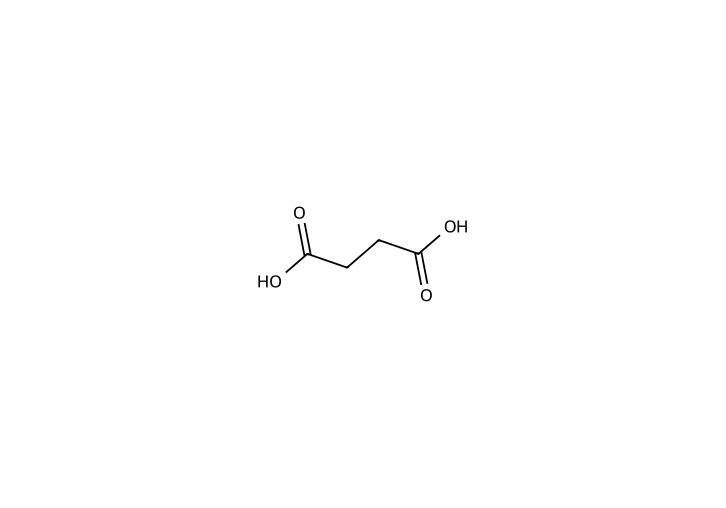
A sample of 1.18 g of the dicarboxylic acid shown below is reacted with an excess of aqueous sodium hydrogencarbonate ( \ceNaHCO3(aq) ) at room temperature and pressure.
Assuming that 1 mol of gas occupies 24.0 dm3 under these conditions, what is the volume of gas collected?
1. From the displayed structure of butanedioic acid (succinic acid), the molecular formula is \ceC4H6O4 .
2. Calculate the relative molecular mass ( Mr ): Mr=(4×12.0)+(6×1.0)+(4×16.0)=48.0+6.0+64.0=118.0 g mol−1 3. Calculate the number of moles of acid: n=118.0 g mol−11.18 g=0.010 mol 4. Each molecule contains two carboxylic acid groups ( −\ceCOOH ), so each mole of acid reacts with 2 mol of \ceNaHCO3 to produce 2 mol of \ceCO2(g) : \ceHOOC−CH2−CH2−COOH+2NaHCO3−>NaOOC−CH2−CH2−COONa+2CO2+2H2O 5. Amount of \ceCO2 gas produced: n(\ceCO2)=2×0.010 mol=0.020 mol 6. Volume of gas collected: V=0.020 mol×24.0 dm3 mol−1=0.480 dm3=480 cm3
▸Question 14
Methanol can be manufactured industrially by the reversible reaction of carbon monoxide with hydrogen in the presence of a catalyst: \ceCO(g)+2H2(g)<=>CH3OH(g) In a closed reaction vessel at constant temperature and pressure, a mixture containing 8.00 mol of \ceCO(g) and 20.0 mol of \ceH2(g) is allowed to reach equilibrium. At equilibrium, 75.0% of the \ceCO has been converted to \ceCH3OH(g) .
What is the total volume of the resulting equilibrium gas mixture?
(Assume that under these conditions, one mole of gas occupies a volume of 45.0 dm3 .)
A.
270 dm3
B.
450 dm3
C.
540 dm3
D.
630 dm3
E.
720 dm3
F.
990 dm3
G.
1260 dm3
Answer and solution
Answer: E
1. Calculate the amount of \ceCO converted: Moles of \ceCO reacted=8.00 mol×0.750=6.00 mol 2. Determine the moles of each species present at equilibrium: - Remaining \ceCO : 8.00 mol−6.00 mol=2.00 mol - Reacted \ceH2 : 2×6.00 mol=12.0 mol - Remaining \ceH2 : 20.0 mol−12.0 mol=8.00 mol - Formed \ceCH3OH : 6.00 mol 3. Calculate the total moles of gas at equilibrium: ntotal=2.00 mol+8.00 mol+6.00 mol=16.0 mol 4. Calculate the total volume of the equilibrium mixture: V=16.0 mol×45.0 dm3 mol−1=720 dm3
▸Question 15
The table shows the melting points and electrical conductivities of four pure substances, P, Q, R, and S, at standard atmospheric pressure:
| Substance | Melting point / ∘C | Electrical conductivity of solid | Electrical conductivity of liquid | | :---: | :---: | :---: | :---: | | P | −78 | non-conductor | non-conductor | | Q | 770 | non-conductor | good conductor | | R | 1420 | non-conductor | non-conductor | | S | 1538 | good conductor | good conductor |
Which of the following statements is/are correct?
1 Melting substance P requires breaking strong covalent bonds between atoms.
2 The high melting point of substance R is due to the breaking of strong covalent bonds in a giant lattice.
3 In molten Q, electrical conduction is due to mobile ions, whereas in solid S, it is due to delocalised electrons.
A.
none of them
B.
1 only
C.
2 only
D.
3 only
E.
1 and 2 only
F.
1 and 3 only
G.
2 and 3 only
H.
1, 2 and 3
Answer and solution
Answer: G
To evaluate the statements, we first identify the type of structure and bonding present in each substance:
- Substance P has a low melting point ( −78∘C ) and does not conduct electricity as a solid or a liquid. This indicates a simple molecular structure. Melting substance P involves overcoming relatively weak intermolecular forces; the strong intramolecular covalent bonds remain intact. Thus, statement 1 is incorrect.
- Substance R has a very high melting point ( 1420∘C ) and does not conduct electricity in either solid or molten states. This is characteristic of a giant covalent (macromolecular) lattice (such as silicon or silicon dioxide). Melting requires breaking many strong covalent bonds throughout the network lattice. Thus, statement 2 is correct.
- Substance Q has a high melting point ( 770∘C ), does not conduct when solid, but conducts well when molten. This is characteristic of a giant ionic lattice. In the liquid state, ions become mobile and carry the electric current.
- Substance S conducts electricity well in both solid and molten states with a high melting point ( 1538∘C ), which is characteristic of a giant metallic lattice. In solid metals, electrical conductivity is due to the movement of delocalised electrons through the lattice of metal cations. Thus, statement 3 is correct.
Statements 2 and 3 are correct, so the correct option is G.
▸Question 16
Element Q is in Group 17, Period 4 of the Periodic Table. It exists naturally as a mixture of two isotopes with mass numbers 79 and 81. The relative atomic mass of element Q is 79.9.
Which of the following statements is/are correct about element Q?
1. 55% of the atoms in a sample of element Q have a mass number of 79.
2. Aqueous element Q oxidises chloride ions to chlorine.
3. Element Q reacts with calcium to form a compound with the empirical formula \ceCaQ2 that conducts electricity when molten.
A.
none of them
B.
1 only
C.
2 only
D.
3 only
E.
1 and 2 only
F.
1 and 3 only
G.
2 and 3 only
H.
1, 2 and 3
Answer and solution
Answer: F
Element Q is in Group 17, Period 4 (bromine).
1. Let x be the fractional abundance of the isotope with mass number 79. Then (1−x) is the fractional abundance of the isotope with mass number 81: 79x+81(1−x)=79.981−2x=79.92x=1.1⟹x=0.55=55% Thus, statement 1 is correct.
2. Halogen reactivity and oxidising ability decrease down Group 17. Chlorine is above element Q (bromine), so chlorine is a stronger oxidising agent than Q. Therefore, aqueous Q cannot oxidise chloride ions to chlorine (chlorine oxidises bromide, not vice versa). Thus, statement 2 is incorrect.
3. Calcium is in Group 2 and forms \ceCa2+ ions, while element Q is in Group 17 and forms \ceQ− ions. The resulting compound has the empirical formula \ceCaQ2 . It is an ionic giant lattice, so its ions become mobile when molten, allowing it to conduct electricity. Thus, statement 3 is correct.
Therefore, statements 1 and 3 only are correct (option F).
▸Question 17
Calcium carbonate decomposes according to \ceCaCO3(s)−>CaO(s)+CO2(g) . A student heats 0.100 mol of \ceCaCO3 and obtains 4.20 g of \ceCaO . The relative formula mass of \ceCaO is 56.0 .
What is the percentage yield of \ceCaO ?
A.
60%
B.
70%
C.
75%
D.
80%
E.
90%
Answer and solution
Answer: C
The predicted mass is 0.100×56.0=5.60 g . Percentage yield =5.604.20×100=75% .
▸Question 18
A solid element M burns in air with an intense, bright white flame to form a single white solid oxide.
This oxide reacts completely with a dilute aqueous solution of acid A to form a colourless solution containing a single salt.
When aqueous barium chloride is added to a sample of acid A , followed by dilute hydrochloric acid, a dense white precipitate remains.
When aqueous sodium hydroxide is added dropwise to the solution of the salt formed from the oxide of M and acid A , a white precipitate forms which does not dissolve in excess sodium hydroxide.
Acid A also reacts with an insoluble green solid carbonate Q to produce three products, one of which is a blue solution.
Which row in the table correctly identifies M , A , and Q ?
| | Element M | Acid A | Carbonate Q | | :--- | :--- | :--- | :--- | | A | \ceCa | \ceHCl | \ceCuCO3 | | B | \ceCa | \ceH2SO4 | \ceFeCO3 | | C | \ceMg | \ceHCl | \ceCaCO3 | | D | \ceMg | \ceHNO3 | \ceCuCO3 | | E | \ceMg | \ceH2SO4 | \ceCaCO3 | | F | \ceMg | \ceH2SO4 | \ceCuCO3 | | G | \ceZn | \ceHNO3 | \ceFeCO3 | | H | \ceZn | \ceH2SO4 | \ceCuCO3 |
A.
M=\ceCa , A=\ceHCl , Q=\ceCuCO3
B.
M=\ceCa , A=\ceH2SO4 , Q=\ceFeCO3
C.
M=\ceMg , A=\ceHCl , Q=\ceCaCO3
D.
M=\ceMg , A=\ceHNO3 , Q=\ceCuCO3
E.
M=\ceMg , A=\ceH2SO4 , Q=\ceCaCO3
F.
M=\ceMg , A=\ceH2SO4 , Q=\ceCuCO3
G.
M=\ceZn , A=\ceHNO3 , Q=\ceFeCO3
H.
M=\ceZn , A=\ceH2SO4 , Q=\ceCuCO3
Answer and solution
Answer: F
1. **Identification of acid A :** The addition of aqueous barium chloride followed by dilute hydrochloric acid gives a white precipitate of \ceBaSO4(s) that does not dissolve, which is the characteristic test for sulfate ions ( \ceSO42− ). Thus, acid A is sulfuric acid ( \ceH2SO4 ).
2. **Identification of element M :** Element M burns with an intense, bright white flame to form magnesium oxide ( \ceMgO ): \ce2Mg(s)+O2(g)−>2MgO(s) . When \ceMgO reacts with dilute \ceH2SO4 , it forms \ceMgSO4(aq) . Adding aqueous \ceNaOH produces a white precipitate of \ceMg(OH)2(s) , which is insoluble in excess \ceNaOH . In contrast, \ceZn(OH)2 is amphoteric and dissolves in excess \ceNaOH to give a colourless solution, and calcium burns with a brick-red flame. Thus, M=\ceMg .
3. **Identification of carbonate Q :** \ceH2SO4 reacts with copper(II) carbonate ( \ceCuCO3 , an insoluble green solid) to produce three products: \ceCuCO3(s)+H2SO4(aq)−>CuSO4(aq)+CO2(g)+H2O(l) . The resulting \ceCuSO4(aq) solution is blue. Therefore, Q=\ceCuCO3 .
Hence, the correct combination is M=\ceMg , A=\ceH2SO4 , and Q=\ceCuCO3 , corresponding to row F.
▸Question 19
An excess of dilute nitric acid was added to a sample of solid calcium carbonate in an open conical flask placed on an electronic balance: \ceCaCO3(s)+2HNO3(aq)−>Ca(NO3)2(aq)+CO2(g)+H2O(l) The total mass of the flask and its contents was recorded at the start ( t=0 s ) and at 10 s intervals thereafter.
The reaction was complete (stopped) exactly at t=40 s .
Which row in the table could represent the readings displayed on the electronic balance during this experiment?
| | 0 s | 10 s | 20 s | 30 s | 40 s | 50 s | | :---: | :---: | :---: | :---: | :---: | :---: | :---: | | A | 200.0 g | 197.6 g | 196.4 g | 195.8 g | 195.6 g | 195.6 g | | B | 200.0 g | 197.6 g | 196.4 g | 195.8 g | 195.6 g | 195.5 g | | C | 200.0 g | 197.4 g | 196.0 g | 195.6 g | 195.6 g | 195.6 g | | D | 200.0 g | 198.9 g | 197.8 g | 196.7 g | 195.6 g | 195.6 g | | E | 200.0 g | 199.8 g | 199.2 g | 198.0 g | 195.6 g | 195.6 g | | F | 200.0 g | 202.4 g | 203.6 g | 204.2 g | 204.4 g | 204.4 g |
Because \ceCO2(g) escapes from the open flask, the mass recorded by the balance decreases over time.
1. Rate of reaction over time: As reactants are consumed, their concentration and available surface area decrease, so the rate of reaction is highest at the beginning and decreases continuously until the reaction finishes. Therefore, the decrease in mass during each successive 10 s interval must decrease progressively ( Δm0−10>Δm10−20>Δm20−30>Δm30−40 ).
2. Completion time: The reaction stops at t=40 s . This means gas is still produced between 30 s and 40 s (so Δm30−40>0 ), but no further gas is evolved after 40 s (so Δm40−50=0 , meaning the mass at 50 s equals the mass at 40 s ).
Evaluating the options: - A: The mass losses per 10 s interval are 2.4 g , 1.2 g , 0.6 g , 0.2 g , and 0.0 g . These losses decrease monotonically and reach zero after 40 s . This is correct. - B: The mass decreases by 0.1 g between 40 s and 50 s , meaning the reaction has not stopped by 40 s . - C: The mass becomes constant at 30 s (no mass lost between 30 s and 40 s ), which corresponds to a reaction that stopped at 30 s rather than 40 s . - D: The mass loss is constant ( 1.1 g every 10 s ), which incorrectly represents a constant rate of reaction. - E: The mass loss increases over time ( 0.2 g→0.6 g→1.2 g→2.4 g ), which incorrectly represents an accelerating reaction. - F: The recorded mass increases instead of decreasing.
▸Question 20
Three open beakers, each containing an excess of dilute hydrochloric acid, \ceHCl(aq) , are placed on separate digital balances.
The initial mass reading on each balance is recorded.
Equal masses ( 5.00 g ) of three pure solids are added separately to the beakers:
- Beaker 1: magnesium metal, \ceMg(s) - Beaker 2: calcium metal, \ceCa(s) - Beaker 3: magnesium carbonate, \ceMgCO3(s) In each beaker, a reaction occurs and the gas produced escapes freely into the atmosphere: \ceMg(s)+2HCl(aq)−>MgCl2(aq)+H2(g)\ceCa(s)+2HCl(aq)−>CaCl2(aq)+H2(g)\ceMgCO3(s)+2HCl(aq)−>MgCl2(aq)+H2O(l)+CO2(g) Assume that all reactions go to completion, no liquid splashes out, and evaporation of water is negligible.
1 The final balance reading for each beaker is greater than its initial reading before the solid was added.
2 Beaker 1 produces the greatest volume of gas, measured at room temperature and pressure.
3 Beaker 1 loses the greatest mass of gas to the surroundings.
A.
none
B.
1 only
C.
2 only
D.
3 only
E.
1 and 2 only
F.
1 and 3 only
G.
2 and 3 only
H.
1, 2 and 3
Answer and solution
Answer: E
Let m=5.00 g be the mass of each solid added.
First, find the molar masses of the reactants and gases evolved: - Mr(\ceMg)=24.3 g mol−1 - Mr(\ceCa)=40.1 g mol−1 - Mr(\ceMgCO3)=24.3+12.0+3(16.0)=84.3 g mol−1 - Mr(\ceH2)=2.0 g mol−1 - Mr(\ceCO2)=12.0+2(16.0)=44.0 g mol−1 Calculate the amount (in moles) of gas produced in each beaker: - Beaker 1: n(\ceH2)=24.35.00≈0.206 mol - Beaker 2: n(\ceH2)=40.15.00≈0.125 mol - Beaker 3: n(\ceCO2)=84.35.00≈0.0593 mol Calculate the mass of gas lost from each beaker: - Beaker 1: mgas=0.206 mol×2.0 g mol−1≈0.41 g - Beaker 2: mgas=0.125 mol×2.0 g mol−1≈0.25 g - Beaker 3: mgas=0.0593 mol×44.0 g mol−1≈2.61 g Now evaluate each statement:
Statement 1 is correct: In all three cases, the mass of solid added ( 5.00 g ) is greater than the mass of gas that escapes ( 0.41 g , 0.25 g , and 2.61 g respectively). Thus, the net change in mass is positive for all three beakers ( +4.59 g , +4.75 g , and +2.39 g ), meaning the final balance reading is greater than the initial reading.
Statement 2 is correct: The volume of gas at room temperature and pressure is proportional to the number of moles ( V=n×Vm ). Beaker 1 produces the greatest number of moles of gas ( 0.206 mol ), hence the greatest volume.
Statement 3 is incorrect: Although Beaker 1 produces the greatest number of moles of gas, \ceH2 has a very small molar mass ( 2.0 g mol−1 ). Beaker 3 evolves \ceCO2 ( Mr=44.0 g mol−1 ), losing 2.61 g of gas, which is the greatest mass of gas lost among all three beakers.
Therefore, statements 1 and 2 only are correct.
▸Question 21
A mixture contains an insoluble solid and two miscible liquids with boiling points 70∘C and 120∘C . Which procedure is most suitable for obtaining a pure sample of the 70∘C liquid?
A.
Fractional distillation only
B.
Filtration followed by fractional distillation
C.
Separating funnel followed by evaporation
D.
Centrifugation followed by crystallisation
E.
Filtration followed by a separating funnel
Answer and solution
Answer: B
First remove the insoluble solid by filtration, then separate the two miscible liquids by fractional distillation.
▸Question 22
A triglyceride molecule contains three ester linkages. The hydrolysis of one mole of triglyceride into glycerol and fatty acids has an enthalpy change of ΔH=+15 kJ mol−1 . The table gives the bond energies for the bonds involved, except for the ester C-O bond.
| Bond | Bond Energy / kJ mol−1 | |---|---| | O-H (water) | 464 | | O-H (glycerol) | 455 | | C-O (fatty acid) | 358 |
Assume that the hydrolysis of each ester linkage involves breaking one ester C-O bond and one water O-H bond, and forming one fatty acid C-O bond and one glycerol O-H bond.
What is the bond energy of the ester C-O bond?
A.
344 kJ mol−1
B.
354 kJ mol−1
C.
362 kJ mol−1
D.
363 kJ mol−1
E.
364 kJ mol−1
Answer and solution
Answer: B
1. Identify the stoichiometry: A triglyceride contains 3 ester linkages. Hydrolysis requires 3 water molecules and produces 1 glycerol and 3 fatty acids. 2. Identify bonds broken and formed per mole of triglyceride: * Break: 3 × Ester C-O bonds (energy x ) + 3 × Water O-H bonds ( 464 ). * Form: 3 × Fatty acid C-O bonds ( 358 ) + 3 × Glycerol O-H bonds ( 455 ). 3. Apply Hess's Law: ΔH=∑Ebroken−∑Eformed .
+15=[3x+3(464)]−[3(358)+3(455)]
4. Solve:
15=(3x+1392)−(1074+1365)
15=3x+1392−2439
15=3x−1047
3x=1062⟹x=354 kJ mol−1
▸Question 23
A 1.60 g sample containing compound X and an unreactive impurity was added to an excess of dilute aqueous sodium hydrogencarbonate, \ceNaHCO3(aq) .
The structure of compound X is shown below.
The volume of carbon dioxide gas collected at room temperature and pressure was 360 cm3 .
What is the mass of the impurity in the sample?
( Ar : \ceH=1.0 , \ceC=12.0 , \ceO=16.0 ; molar gas volume at room temperature and pressure = 24000 cm3 mol−1 )
A.
0.16 g
B.
0.64 g
C.
0.72 g
D.
0.88 g
E.
0.96 g
F.
1.44 g
Answer and solution
Answer: B
1. **Find the moles of \ceCO2 evolved:** n(\ceCO2)=24000 cm3 mol−1360 cm3=0.0150 mol 2. Determine the stoichiometry from the structure: Compound X (citric acid) contains three carboxylic acid groups ( −\ceCOOH ) and one tertiary alcohol group ( −\ceOH ). Alcohol groups do not react with \ceNaHCO3 . Each carboxylic acid group reacts with \ceNaHCO3 in a 1:1 ratio to release \ceCO2 : \ce−COOH+NaHCO3−>−COONa+H2O+CO2 Thus, 1 mol of compound X produces 3 mol of \ceCO2 .
3. **Calculate the moles and mass of compound X :** n(X)=30.0150 mol=0.0050 mol The molecular formula of compound X is \ceC6H8O7 : Mr(X)=(6×12.0)+(8×1.0)+(7×16.0)=72.0+8.0+112.0=192.0 g mol−1Mass of X=0.0050 mol×192.0 g mol−1=0.960 g 4. Calculate the mass of the impurity:Mass of impurity=1.60 g−0.960 g=0.64 g
▸Question 24
Substances \ceA and \ceB react in a closed container of fixed volume to form substance \ceC . The reaction goes to completion.
The graph shows how the concentrations of \ceA , \ceB , and \ceC change over time.
Which row in the table correctly gives the balanced equation for the reaction, the limiting reactant, and the percentage of the initial amount of the excess reactant that has reacted?
| | Balanced equation | Limiting reactant | Percentage of excess reactant reacted | |---|---|---|---| | A | \ce2A+3B−>2C | \ceB | 75% | | B | \ce2A+3B−>2C | \ceB | 25% | | C | \ce2A+3B−>2C | \ceA | 75% | | D | \ce3A+2B−>2C | \ceB | 75% | | E | \ce3A+2B−>2C | \ceA | 25% | | F | \ce4A+3B−>2C | \ceB | 75% | | G | \ce4A+3B−>2C | \ceA | 25% | | H | \ceA+3B−>2C | \ceB | 33% |
1. Identify Reactants and Product: The concentrations of \ceA and \ceB decrease over time, so they are reactants. The concentration of \ceC increases from zero, so \ceC is the product.
2. **Determine Changes in Concentration ( Δ[X] ):** - For \ceA : initial =0.80 mol dm−3 , final =0.20 mol dm−3⟹∣Δ[\ceA]∣=0.60 mol dm−3 . - For \ceB : initial =0.90 mol dm−3 , final =0.00 mol dm−3⟹∣Δ[\ceB]∣=0.90 mol dm−3 . - For \ceC : initial =0.00 mol dm−3 , final =0.60 mol dm−3⟹∣Δ[\ceC]∣=0.60 mol dm−3 .
3. Determine Stoichiometry: The mole ratios of reaction equal the ratio of concentration changes: ∣Δ[\ceA]∣:∣Δ[\ceB]∣:∣Δ[\ceC]∣=0.60:0.90:0.60=2:3:2 Therefore, the balanced equation is \ce2A+3B−>2C .
4. Identify Limiting Reactant:\ceB drops to 0.00 mol dm−3 when the reaction finishes, so \ceB is the limiting reactant. \ceA remains at 0.20 mol dm−3 , so \ceA is in excess.
5. Calculate Percentage of Excess Reactant Reacted:Percentage reacted=[\ceA]0∣Δ[\ceA]∣×100%=0.80 mol dm−30.60 mol dm−3×100%=75% Thus, row A is the correct option.
▸Question 25
Argon is used to provide a protective atmosphere around some hot metals during welding.
Which property of argon is most important for this use?
A.
It is very reactive with metals.
B.
It is chemically very unreactive.
C.
It is a strong oxidising agent.
D.
It has a very high melting point.
E.
It forms acidic oxides readily.
Answer and solution
Answer: B
Argon is a noble gas and is very unreactive, so it can protect hot metal from reaction with the surrounding air.
▸Question 26
An aqueous solution of barium hydroxide, \ceBa(OH)2(aq) , is mixed in an equimolar ratio with dilute sulfuric acid, \ceH2SO4(aq) . A white precipitate of barium sulfate, \ceBaSO4(s) , forms alongside liquid water, \ceH2O(l) , causing the electrical conductivity of the mixture to drop to near zero.
Which of the following represents the correct balanced ionic equation for this reaction?
1. Write the full balanced molecular equation: \ceBa(OH)2(aq)+H2SO4(aq)−>BaSO4(s)+2H2O(l) 2. Dissociate all soluble, strong electrolytes (aqueous ionic compounds and strong acids) into their constituent ions: \ceBa(OH)2(aq)−>Ba2+(aq)+2OH−(aq)\ceH2SO4(aq)−>2H+(aq)+SO42−(aq) 3. Write the total ionic equation: \ceBa2+(aq)+2OH−(aq)+2H+(aq)+SO42−(aq)−>BaSO4(s)+2H2O(l) 4. Identify and cancel spectator ions (ions that appear unchanged on both sides of the equation): Here, \ceBa2+ and \ceSO42− combine to form insoluble \ceBaSO4(s) , and \ceH+ and \ceOH− combine to form un-ionised \ceH2O(l) . No ions remain in the aqueous phase unchanged, so there are no spectator ions.
Therefore, the complete balanced ionic equation is: \ceBa2+(aq)+2OH−(aq)+2H+(aq)+SO42−(aq)−>BaSO4(s)+2H2O(l) which corresponds to option C.
▸Question 27
The monatomic ions X2+ , Y− and Z3− are isoelectronic (they contain the same number of electrons).
Which of the following gives the elements X, Y and Z in order of increasing atomic number (lowest first)?
A.
X, Y, Z
B.
Z, Y, X
C.
Y, X, Z
D.
Z, X, Y
Answer and solution
Answer: B
The atomic number is equal to the number of protons ( p ). The charge ( q ) of an ion is determined by the difference between the number of protons and electrons ( e ):
q=p−e⟹p=e+q
Since the ions are isoelectronic, they all have the same number of electrons, e . We can express the number of protons for each element as:
* For X2+ ( q=+2 ): pX=e+2 * For Y− ( q=−1 ): pY=e−1 * For Z3− ( q=−3 ): pZ=e−3 Comparing the values:
(e−3)<(e−1)<(e+2)
Thus, the order of increasing atomic number is Z, Y, X.