A bag contains n green counters and (n−2) red counters, where n≥3 .
Two counters are drawn at random from the bag without replacement.
The probability that the two counters are of different colours is 158 .
What is the sum of all possible values of n ?
A.
4
B.
6
C.
8
D.
10
E.
12
F.
16
G.
24
Answer and solution
Answer: D
The total number of counters in the bag is: Total=n+(n−2)=2n−2 The number of ways to choose 2 counters of different colours (one green and one red) is: n×(n−2) The total number of ways to choose any 2 counters from the 2n−2 counters is: (22n−2)=2(2n−2)(2n−3)=(n−1)(2n−3) Setting the probability equal to 158 gives: (n−1)(2n−3)n(n−2)=158 Cross-multiplying and expanding: 15n(n−2)=8(n−1)(2n−3)15n2−30n=8(2n2−5n+3)15n2−30n=16n2−40n+24 Rearranging into standard quadratic form: n2−10n+24=0(n−4)(n−6)=0 Thus, n=4 or n=6 . Both values satisfy the condition n≥3 .
The sum of all possible values of n is: 4+6=10
▸Question 2
A set of 200 quadratic equations is considered. Each equation has exactly two real roots, and none of the roots are zero.
It is found that: - 30% of the equations have two positive roots. - 45% of the equations have two negative roots.
The remaining equations each have one positive and one negative root.
What is the total number of positive roots and negative roots, respectively, in the set?
A.
(110,140)
B.
(110,230)
C.
(120,180)
D.
(170,140)
E.
(170,230)
F.
(230,170)
Answer and solution
Answer: E
Step 1:
First, determine the number of equations in each of the three categories.
Total number of equations is 200. - Number of equations with two positive roots (PP): 0.30×200=60 . - Number of equations with two negative roots (NN): 0.45×200=90 . - The percentage of equations with one positive and one negative root (PN) is 100%−30%−45%=25% . So, the number of PN equations is 0.25×200=50 .
Step 2:
Calculate the total number of positive roots. Each PP equation contributes 2 positive roots, and each PN equation contributes 1 positive root.
Total positive roots = (60×2)+(90×0)+(50×1)=120+0+50=170 .
Step 3:
Calculate the total number of negative roots. Each NN equation contributes 2 negative roots, and each PN equation contributes 1 negative root.
Total negative roots = (60×0)+(90×2)+(50×1)=0+180+50=230 .
Step 4:
The total number of positive roots is 170, and the total number of negative roots is 230.
The answer is (170,230) .
▸Question 3
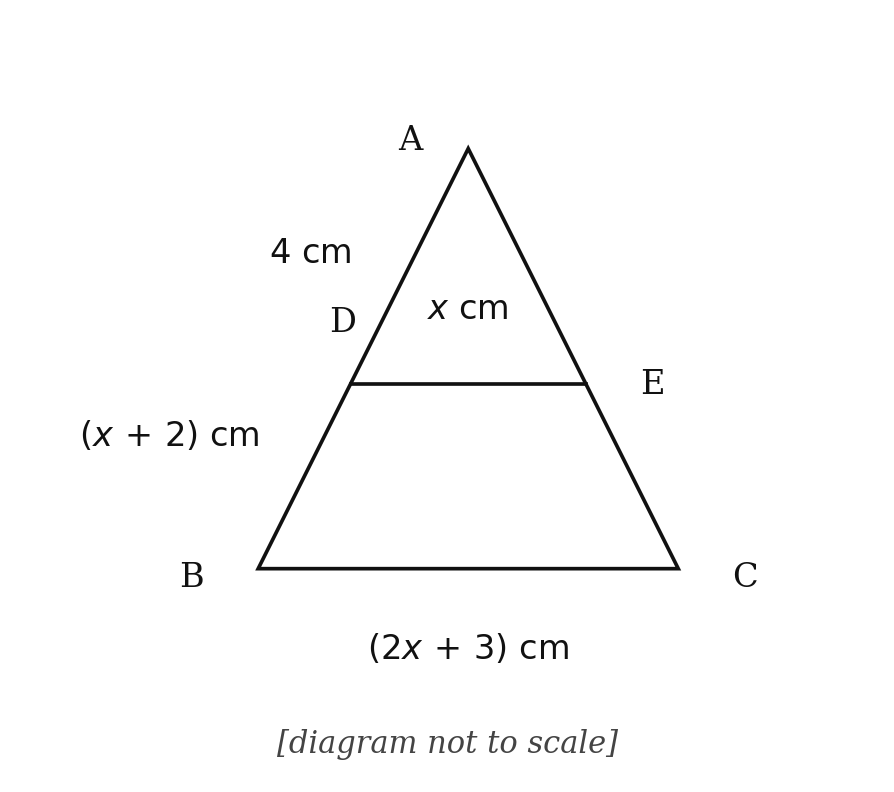
In the triangle ABC shown below, points D and E lie on the sides AB and AC respectively, such that DE is parallel to BC . AD=4 cm , DB=(x+2) cm , DE=x cm , and BC=(2x+3) cm .
What is the length, in cm, of BC ?
A.
1+13
B.
1+213
C.
3+21
D.
5+213
E.
9
F.
9+221
Answer and solution
Answer: D
Since DE is parallel to BC , triangle ADE is similar to triangle ABC .
The total length of side AB is: AB=AD+DB=4+(x+2)=x+6 Using the ratio of corresponding sides in similar triangles: ABAD=BCDEx+64=2x+3x Cross-multiplying gives: 4(2x+3)=x(x+6)8x+12=x2+6xx2−2x−12=0 Solving for x using the quadratic formula: x=2(1)−(−2)±(−2)2−4(1)(−12)=22±4+48=22±52=1±13 Since lengths must be positive, x=1+13 .
The question asks for the length of BC : BC=2x+3=2(1+13)+3=2+213+3=5+213 cm
▸Question 4
The table shows summary statistics for an original dataset of 25 values and a subset of 5 values that is removed from it.
| | number of values | mean | range | | :--- | :---: | :---: | :---: | | original dataset | 25 | 40 | 15 | | removed subset | 5 | 32 | 8 |
What can be deduced about the mean and range of the remaining 20 values?
A.
mean=38 , range≤15
B.
mean=38 , range≥8
C.
mean=38 , range≥15
D.
mean=42 , range≤15
E.
mean=42 , range≥8
F.
mean=42 , range≥15
Answer and solution
Answer: D
1. Calculate the sum of the original dataset: Sumoriginal=25×40=1000 2. Calculate the sum of the removed subset: Sumremoved=5×32=160 3. Calculate the sum and mean of the remaining 20 values: Sumremaining=1000−160=840Meanremaining=20840=42 4. Deduce the bound on the range: Let the maximum and minimum of the original dataset be xmax and xmin , so xmax−xmin=15 . For any subset of the dataset, the maximum cannot exceed xmax and the minimum cannot be less than xmin . Therefore, the range of the remaining values satisfies: rangeremaining=xrem, max−xrem, min≤xmax−xmin=15 Thus, mean=42 and range≤15 .
▸Question 5
A combined set of data consists of two groups, P and Q. The number of values in group Q is three times the number of values in group P. The mean of group P is 20 and the mean of the combined set is 32.
What is the mean of group Q?
A.
28
B.
36
C.
44
D.
68
Answer and solution
Answer: B
Let the number of values in group P be n . Since group Q has three times the number of values, it has 3n values. The total number of values in the combined set is n+3n=4n .
The combined mean is the weighted average of the means of the two groups. Let xˉQ be the mean of group Q. We are given that the mean of group P is 20 and the combined mean is 32.
32=n+3nn(20)+3n(xˉQ)
The factor n is common to all terms in the fraction and can be cancelled:
32=420+3xˉQ
Now we can solve for xˉQ :
4×32128108xˉQ=20+3xˉQ=20+3xˉQ=3xˉQ=3108=36
The mean of group Q is 36.
▸Question 6
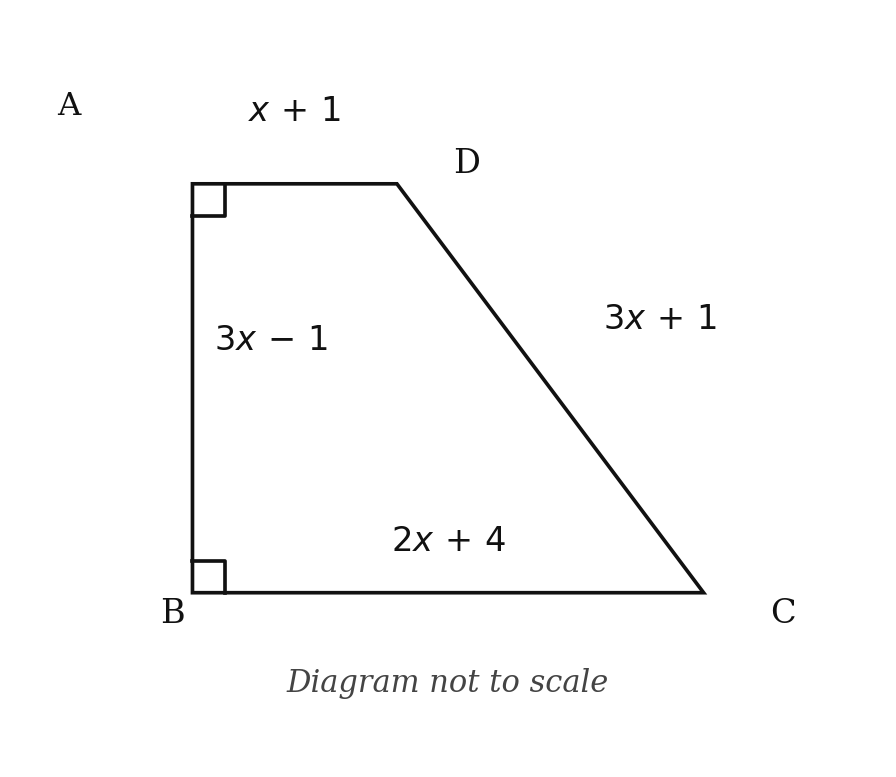
The diagram shows a trapezium ABCD in which AD is parallel to BC , and ∠DAB=∠ABC=90∘ .
The lengths of the sides, in centimetres, are: - AD=x+1 - AB=3x−1 - BC=2x+4 - CD=3x+1 [diagram not to scale]
What is the area, in cm2 , of the trapezium?
A.
24
B.
32
C.
48
D.
56
E.
64
F.
72
G.
112
Answer and solution
Answer: D
Let a perpendicular be drawn from vertex D to the side BC , meeting BC at point E .
Since ∠DAB=∠ABC=90∘ and DE⊥BC , quadrilateral ABED is a rectangle. Therefore: - BE=AD=x+1 - DE=AB=3x−1 The segment EC is: EC=BC−BE=(2x+4)−(x+1)=x+3 Applying Pythagoras' theorem to the right-angled triangle DEC : DE2+EC2=CD2(3x−1)2+(x+3)2=(3x+1)2 Expanding the brackets: (9x2−6x+1)+(x2+6x+9)=9x2+6x+110x2+10=9x2+6x+1x2−6x+9=0(x−3)2=0⟹x=3 Using x=3 , the lengths are: - Parallel sides: AD=3+1=4 cm and BC=2(3)+4=10 cm - Perpendicular height: AB=3(3)−1=8 cm The area of the trapezium is: Area=2AD+BC×AB=24+10×8=7×8=56 cm2
▸Question 7
The theoretical power available to a wind turbine is directly proportional to the cube of the wind speed.
At a wind speed of v , the turbine operates at an efficiency of 20% and produces an actual power output of 50 kW .
At a wind speed of 2v , the turbine operates at an efficiency of 15% .
What is the actual power output of the turbine at the wind speed of 2v ?
A.
60 kW
B.
75 kW
C.
150 kW
D.
300 kW
E.
400 kW
F.
1700 kW
Answer and solution
Answer: D
First, we relate actual power to theoretical power using the efficiency at wind speed v :
Pactual=Efficiency×Ptheo
This gives:
50=0.20×Ptheo,1
Solving for the initial theoretical power:
Ptheo,1=0.2050=250 kW
Since theoretical power is directly proportional to the cube of the wind speed ( Ptheo∝v3 ), doubling the wind speed to 2v increases the theoretical power by a factor of 23=8 :
Ptheo,2=8×250=2000 kW
Finally, we calculate the new actual power using the new efficiency of 15% :
Pactual,2=0.15×2000=300 kW
Therefore the correct answer is D.
▸Question 8
A set of numbers, S1 , consists of n1 values, each equal to 10. A second set of numbers, S2 , consists of n2 values, each equal to 30.
When the numbers from S1 and S2 are combined, the mean of the resulting set is 14.
A new set is formed by combining the numbers from S1 with a set of 2n2 values, each equal to 30.
What is the mean of this new set?
A.
18
B.
350
C.
22
D.
7130
E.
9250
F.
370
Answer and solution
Answer: B
Let the sum of values in set S1 be Σ1=10n1 and in set S2 be Σ2=30n2 . The total number of values in the first combination is n1+n2 .
The mean of the combined set is given as 14. We can set up an equation:
n1+n2Σ1+Σ2=n1+n210n1+30n2=14
Now, we solve for the ratio of n1 to n2 :
10n1+30n2=14(n1+n2)
10n1+30n2=14n1+14n2
16n2=4n1
n1=4n2
This means the ratio n1:n2 is 4:1 .
For the second part of the problem, we form a new set by combining the numbers from S1 with a set of 2n2 values, each equal to 30.
The sum of values in this new combination is 10n1+30(2n2)=10n1+60n2 . The total number of values is n1+2n2 .
The new mean, xˉnew , is:
xˉnew=n1+2n210n1+60n2
We can now substitute the relationship n1=4n2 into this expression:
The curve with equation y=ax2+bx+c has a maximum value of 9 at x=2 . The curve passes through the point (0,1) . What is the value of a ?
A.
-4
B.
-2
C.
-1
D.
1
E.
2
F.
4
Answer and solution
Answer: B
The curve has a maximum value of 9 at x=2 , so its vertex is at the point (2,9) .
This allows us to write the equation of the parabola in vertex form, y=a(x−h)2+k , which becomes:
y=a(x−2)2+9
We are also given that the curve passes through the point (0,1) . Substituting these coordinates into the equation allows us to solve for a :
111−8a=a(0−2)2+9=a(−2)2+9=4a+9=4a=−2
The value of a is −2 .
▸Question 10
A fair six-sided die with faces numbered 1 to 6 is rolled once.
- If the number rolled is prime, a biased coin with P(Heads)=32 is tossed 2 times. - If the number rolled is not prime, a fair coin is tossed 3 times.
What is the probability that exactly two heads are obtained in total?
A.
14441
B.
10843
C.
21691
D.
14459
E.
167
F.
7259
G.
43
Answer and solution
Answer: D
Step 1: Find the probabilities for the outcome of the die roll. The possible outcomes are {1,2,3,4,5,6} . The prime numbers are {2,3,5} , so: P(prime)=63=21 The non-prime numbers are {1,4,6} (note that 1 is not prime), so: P(not prime)=63=21 Step 2: Calculate the conditional probabilities of obtaining exactly 2 heads. - Case 1: Prime rolled (2 tosses of a biased coin with P(H)=32 ): P(2 heads∣prime)=(32)2=94 - Case 2: Not prime rolled (3 tosses of a fair coin with P(H)=21 ): P(2 heads∣not prime)=(23)(21)2(21)1=3×81=83 Step 3: Apply the law of total probability: P(exactly 2 heads)=P(prime)×P(2 heads∣prime)+P(not prime)×P(2 heads∣not prime)P(exactly 2 heads)=21×94+21×83=92+163=14432+27=14459
▸Question 11
A polygon has n sides.
The mean of 5 of its interior angles is 120∘ .
The mean of its remaining interior angles is 160∘ .
What is the value of n ?
A.
6
B.
8
C.
9
D.
10
E.
18
F.
48
Answer and solution
Answer: B
The sum of the interior angles of an n -sided polygon is given by 180(n−2)∘ .
The polygon has n angles in total. The sum of the first 5 interior angles is:
5×120=600
There are n−5 remaining interior angles, and their sum is:
(n−5)×160
Equating the sum of these two groups to the total sum of interior angles gives:
600+160(n−5)=180(n−2)
Expanding both sides:
600+160n−800=180n−360
Simplifying the left hand side:
160n−200=180n−360
Rearranging to solve for n :
160=20n
n=8
(Alternatively, using exterior angles: the mean exterior angles are 180−120=60∘ and 180−160=20∘ . The equation 5(60)+20(n−5)=360 simplifies to 300+20n−100=360 , yielding 20n=160 and n=8 .)
Therefore the correct answer is B.
▸Question 12
The equation (7×10−1x×103+4x×102)2−(3×10−2x×104+2x×103)=2.4×10⁷ has two real solutions for x .
What is the positive difference between these two solutions?
A.
0.1
B.
2.4
C.
2.5
D.
4.9
E.
9.8
F.
49
Answer and solution
Answer: D
Simplify each term using standard form and index rules:
1. First term: 7×10−1x×103+4x×102=0.71400x=2000x=2×10³x Squaring this gives: (2×10³x)2=4×106x2 2. Second term: 3×10−2x×104+2x×103=0.0312000x=400000x=4×105x 3. Substitute back into the equation: 4×106x2−4×10⁵x=2.4×10⁷ Divide the entire equation by 105 : 40x2−4x=240 Divide by 4 : 10x2−x−60=0 4. Solve the quadratic equation using the quadratic formula: x=2(10)−(−1)±(−1)2−4(10)(−60)=201±1+2400=201±2401 Since 492=2401 , 2401=49 : x1=201+49=2050=2.5x2=201−49=20−48=−2.4 5. The positive difference between the two solutions is: x1−x2=2.5−(−2.4)=4.9
▸Question 13
A composite material is formed from two substances, X and Y. Substance X has a density of 3.0 g cm−3 and constitutes 32 of the material by volume. Substance Y has a density of 9.0 g cm−3 and constitutes the remaining 31 by volume. What is the density of the composite material?
A.
4.0 g cm−3
B.
5.0 g cm−3
C.
6.0 g cm−3
D.
7.0 g cm−3
E.
8.0 g cm−3
Answer and solution
Answer: B
The density of the composite material is calculated by summing the individual densities weighted by their respective volume fractions.
We calculate:
ρcomposite=(3×32)+(9×31)
Simplifying the terms gives:
ρcomposite=2+3=5 g cm−3
▸Question 14
Water flows through a cylindrical pipe of internal diameter 5 cm into a cylindrical tank of internal diameter 2 m .
The depth of the water in the tank increases at a constant rate of 3 cm per minute.
What is the speed of the water in the pipe, in m s−1 ?
A.
0.02
B.
0.2
C.
0.8
D.
3.2
E.
48
F.
80
Answer and solution
Answer: C
Let dp and dt be the internal diameters of the pipe and the tank, and let vp and vt be the speed of the water in the pipe and the rate of depth increase in the tank, respectively. By equating the volume flow rates, we have:
Apvp=Atvt
where Ap and At are the cross-sectional areas.
First, convert all measurements to metres and seconds to match the requested final units. The radius of the tank is rt=1 m , so its cross-sectional area is At=π(1)2=π m2 .
The radius of the pipe is rp=2.5 cm=0.025 m=401 m , so its cross-sectional area is Ap=π(401)2=1600π m2 .
The rate of depth increase in the tank is:
vt=3 cm min−1=60 s0.03 m=20001 m s−1
Substitute these values into the flow rate equation:
1600πvp=π(20001)
which simplifies to:
vp=20001600=0.8 m s−1
Therefore the correct answer is C.
▸Question 15
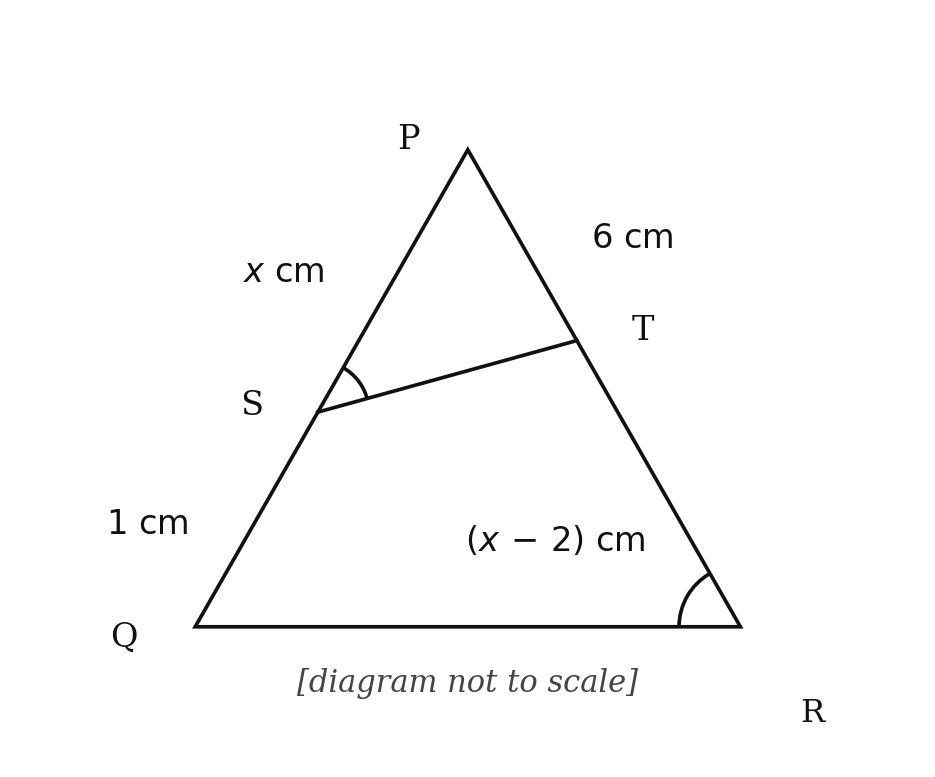
In the diagram, S is a point on side PQ and T is a point on side PR of triangle PQR .
The angle ∠PST is equal to ∠PRQ .
The lengths of the segments are: - PS=x cm - SQ=1 cm - PT=6 cm - TR=(x−2) cm What is the length of side PR ?
A.
6 cm
B.
8 cm
C.
9 cm
D.
12 cm
E.
(5+7) cm
Answer and solution
Answer: D
Since ∠SPT=∠QPR (common angle) and ∠PST=∠PRQ (given), triangle PST is similar to triangle PRQ by AA similarity ( △PST∼△PRQ ).
The ratio of corresponding sides is: PRPS=PQPT From the given segment lengths: - PQ=PS+SQ=x+1 - PR=PT+TR=6+(x−2)=x+4 Substituting into the ratio: x+4x=x+16 Cross-multiplying gives: x(x+1)=6(x+4)x2+x=6x+24x2−5x−24=0(x−8)(x+3)=0 Since lengths must be positive, x=8 .
Therefore, the length of PR is: PR=x+4=8+4=12 cm
▸Question 16
The real numbers x and y satisfy the equation
2x2−3xy+2y2=7
What is the maximum possible value of x−y ?
A.
214
B.
2
C.
7
D.
4
E.
27
F.
42
Answer and solution
Answer: B
Let k=x−y , which means x=y+k . Substitute this into the given equation:
2(y+k)2−3(y+k)y+2y2=7
Expand the terms:
2(y2+2ky+k2)−3y2−3ky+2y2=7
Simplify and collect like terms with respect to y :
y2+ky+2k2−7=0
For y to be a real number, this quadratic equation must have real roots, so its discriminant must be non-negative ( Δ≥0 ):
k2−4(1)(2k2−7)≥0
28−7k2≥0
k2≤4
Taking the square root gives −2≤k≤2 . Thus, the maximum possible value of k=x−y is 2 . Therefore the correct answer is B.
▸Question 17
A machine extrudes a continuous solid cylinder of plastic of diameter 4 cm. The volume of plastic extruded is 240π cm³ per minute.
What is the speed at which the cylinder emerges from the machine, in mm per second?
A.
1
B.
2.5
C.
10
D.
40
E.
60
F.
600
Answer and solution
Answer: C
The relationship between volume rate, cross-sectional area, and speed is:
Volume Rate = Area × Speed
First, calculate the cross-sectional area of the cylinder in cm². The diameter is given as 4 cm, so the radius r is 2 cm.
A=πr2=π(2)2=4π cm2
Next, use the given volume rate to find the speed in cm per minute.
240π cm3/min=4π cm2×Speed
Speed=4π240π=60 cm/min
Finally, convert the units of the speed from cm/min to the required mm/s.
To convert cm to mm, multiply by 10:
60 cm/min=60×10 mm/min=600 mm/min
To convert minutes to seconds, divide by 60:
600 mm/min=60600 mm/s=10 mm/s
Thus, the speed is 10 mm/s.
▸Question 18
Seven distinct numbers are written in strictly increasing order: x1<x2<x3<x4<x5<x6<x7 Their mean is M , their median is m , and their range is R .
The smallest and largest of these seven numbers are then removed, leaving five numbers.
Which of the following statements must be true?
1 The median of the remaining five numbers is equal to m .
2 The range of the remaining five numbers is strictly less than R .
3 If M=m , the mean of the remaining five numbers is equal to M .
A.
none of them
B.
1 only
C.
2 only
D.
3 only
E.
1 and 2 only
F.
1 and 3 only
G.
2 and 3 only
H.
1, 2 and 3
Answer and solution
Answer: E
We analyse each statement in turn:
1. The median of the 7 ordered numbers is the middle (4th) value, x4=m . After removing the smallest and largest, five ordered numbers remain: x2,x3,x4,x5,x6 . Their median is the middle (3rd) value, which is also x4=m . Therefore, statement 1 must be true.
2. The original range is R=x7−x1 . The range of the remaining five numbers is x6−x2 . Since the numbers are strictly increasing, x6<x7 and x2>x1 , so x6−x2<x7−x1 . Therefore, statement 2 must be true.
3. The sum of the seven numbers is 7M . The sum of the remaining five is 7M−(x1+x7) , so their mean is 57M−(x1+x7) . For this to equal M , we need x1+x7=2M . Knowing only that M=m does not guarantee this.
For example, take the numbers 1,2,3,10,11,12,31 . - The median is m=10 . - The mean is M=770=10 , so M=m . - After removing 1 and 31 , the remaining numbers are 2,3,10,11,12 , with mean 538=7.6eq10 .
Thus, statement 3 is not necessarily true.
Hence, only statements 1 and 2 must be true.
▸Question 19
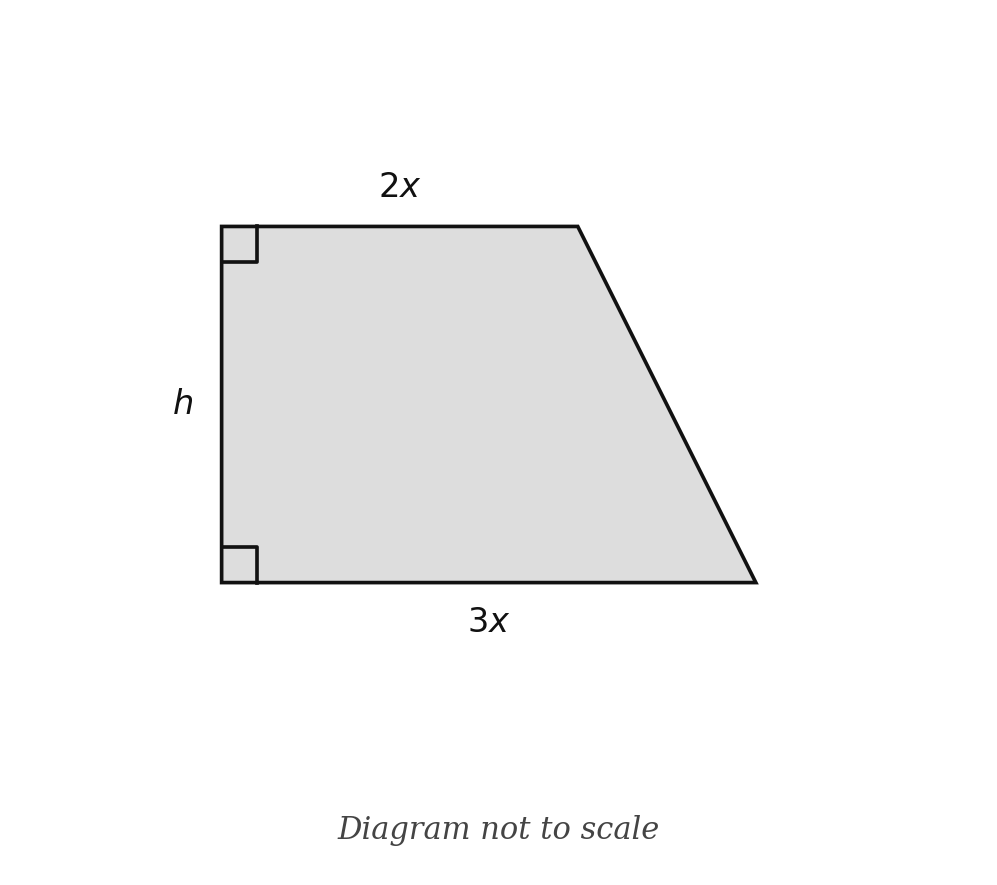
The diagram shows a right-angled trapezium with parallel horizontal sides of lengths 2x and 3x , and vertical height h . The area of this trapezium is A1 .
A new trapezium is formed by modifying these dimensions: - the side of length 3x is increased by 40% - the side of length 2x is decreased by 35% - the vertical height h is increased by 20% The area of the new trapezium is A2 .
The relationship between A1 and A2 can be expressed as A2=kA1 .
What is the value of k ?
A.
2527
B.
5057
C.
45
D.
2533
E.
57
Answer and solution
Answer: D
1. Find the initial area A1 : A1=22x+3x×h=25xh=2.5xh 2. Determine the modified dimensions: - New longer parallel side: 3x×(1+10040)=3x×1.4=4.2x - New shorter parallel side: 2x×(1−10035)=2x×0.65=1.3x - Sum of new parallel sides: 4.2x+1.3x=5.5x - New vertical height: h×(1+10020)=1.2h 3. Calculate the new area A2 : A2=25.5x×1.2h=2.75x×1.2h=3.3xh 4. Find the ratio k=A1A2 : k=2.5xh3.3xh=2.53.3=2533 Hence, the correct option is D.
▸Question 20
The tensile strengths of a batch of 50 manufactured fibres are tested. The batch consists of 30 carbon fibres and 20 glass fibres.
Statistics for the carbon fibres and for the entire batch of 50 fibres are shown in the table:
| Fibre group | Number of fibres | Mean tensile strength / GPa | Range of tensile strength / GPa | | :--- | :---: | :---: | :---: | | Carbon fibres | 30 | 3.6 | 1.1 | | All 50 fibres combined | 50 | 3.2 | 1.6 |
What can be deduced about the mean and range of the tensile strength of the 20 glass fibres?
A.
mean=2.6 GPa , range≤1.6 GPa
B.
mean=2.6 GPa , 1.1 GPa≤range≤1.6 GPa
C.
mean=2.6 GPa , range≥1.6 GPa
D.
mean=2.8 GPa , range≤1.6 GPa
E.
mean=2.8 GPa , 1.1 GPa≤range≤1.6 GPa
F.
mean=2.8 GPa , range≥1.6 GPa
Answer and solution
Answer: A
To find the mean tensile strength of the glass fibres: 1. The total sum of the tensile strengths of all 50 fibres is: Σxtotal=50×3.2 GPa=160 GPa 2. The sum of the tensile strengths of the 30 carbon fibres is: Σxcarbon=30×3.6 GPa=108 GPa 3. The sum for the 20 glass fibres is therefore: Σxglass=160 GPa−108 GPa=52 GPa 4. The mean tensile strength of the glass fibres is: xˉglass=2052 GPa=2.6 GPa To deduce the range of the glass fibres: - The range of a subset of data cannot exceed the range of the entire set because max(glass)≤max(total) and min(glass)≥min(total) . - Therefore, range(glass)=max(glass)−min(glass)≤max(total)−min(total)=1.6 GPa .
Thus, mean=2.6 GPa and range≤1.6 GPa , which corresponds to option A.
▸Question 21
The region R in the xy -plane is defined by the inequalities: x≥0,y≥0,x+y≤6,3x+y≤12 What is the area of R ?
A.
3
B.
9
C.
12
D.
15
E.
18
Answer and solution
Answer: D
The region lies in the first quadrant, bounded by the lines x+y=6 and 3x+y=12 . The effective boundary is formed by the inner envelope of these lines.
The intercepts on the axes are: - For x+y=6 : (6,0) and (0,6) . - For 3x+y=12 : (4,0) and (0,12) .
We need to satisfy both x+y≤6 and 3x+y≤12 . For points on the x-axis ( y=0 ), this means x≤6 and 3x≤12⟹x≤4 . So, the x-intercept for the region is (4,0) . For points on the y-axis ( x=0 ), this means y≤6 and y≤12 . So, the y-intercept for the region is (0,6) .
We find the intersection of the boundary lines x+y=6 and 3x+y=12 : Subtracting the first equation from the second: (3x+y)−(x+y)=12−6⟹2x=6⟹x=3 . Substituting x=3 into x+y=6 gives 3+y=6⟹y=3 . So, the intersection point is (3,3) .
The region is a quadrilateral with vertices (0,0) , (4,0) , (3,3) , and (0,6) .
We calculate the area by splitting the quadrilateral into two triangles using the line from the origin to (3,3) : 1. Triangle with vertices (0,0) , (4,0) , and (3,3) . Its base is on the x -axis, with length 4 . Its height is the y -coordinate of (3,3) , which is 3 . Area is 21×base×height=21×4×3=6 . 2. Triangle with vertices (0,0) , (0,6) , and (3,3) . Its base is on the y -axis, with length 6 . Its height is the x -coordinate of (3,3) , which is 3 . Area is 21×base×height=21×6×3=9 .
The total area is the sum of these two areas: 6+9=15 .
▸Question 22
The following six numbers are given in ascending order:
10,16,h,2h,38,44
The mean of these six numbers is equal to their median.
What is the value of h ?
A.
7.2
B.
12.0
C.
13.5
D.
18.0
E.
24.0
F.
36.0
Answer and solution
Answer: D
The list contains six numbers, which is an even quantity. The numbers are given in ascending order.
The median is the average of the two middle terms, which are the 3rd and 4th terms.
Median=2h+2h=23h
The mean is the sum of all the numbers divided by the count of the numbers, which is 6.
Sum=10+16+h+2h+38+44=108+3h
Mean=6108+3h
The problem states that the mean is equal to the median.
6108+3h=23h
To solve for h , we can multiply both sides by 6:
108+3h=3(3h)
108+3h=9h
108=6h
h=6108=18
We can check that for h=18 , the list is 10,16,18,36,38,44 , which is in ascending order as required.
▸Question 23
It takes time T for a single pipe to fill a particular cylindrical tank.
A new cylindrical tank is used, which has three times the radius and one-third the height of the original tank.
This new tank is filled using 6 pipes simultaneously. Each of these pipes has a radius that is twice the radius of the original pipe, and the water flows through each at half the speed of the water in the original pipe.
In terms of T , what is the time taken to fill the new tank?
A.
121T
B.
81T
C.
41T
D.
21T
E.
43T
Answer and solution
Answer: C
Let the original time be T . The time taken to fill a tank is given by the ratio of the tank's volume to the total flow rate of water into it. T=Flow RateVolume Let's analyze the scaling of the volume and the flow rate separately.
1. Tank Volume Scaling: The volume of a cylinder is V=πr2h . The volume is proportional to the square of the radius and the height. The new tank has radius 3r and height 31h . The scaling factor for the volume is (3)2×(31)=9×31=3 . So, the new volume Vnew=3Voriginal .
2. Total Flow Rate Scaling: The flow rate from a single pipe is its cross-sectional area multiplied by the flow speed. The area is proportional to the square of the pipe's radius, so the rate is proportional to rpipe2sflow . Each new pipe has radius 2rpipe and flow speed 21sflow . The scaling factor for the flow rate of a single pipe is (2)2×(21)=4×21=2 . So, each new pipe has a flow rate that is twice the original pipe's rate. There are 6 such pipes working together, so the total new flow rate is 6×2=12 times the original flow rate. So, Rnew,total=12Roriginal .
3. New Time Calculation: The new time, Tnew , is the ratio of the new volume to the new total flow rate.
Find the set of values of the real constant k for which the line with equation y=2x does not intersect the circle with equation x2+y2−4x+6y+k=0 .
A.
16/5<k<13
B.
k>16/5
C.
k<13
D.
k<16/5
E.
k>13
F.
16/5≤k<13
Answer and solution
Answer: A
The set of values for k is 16/5<k<13 . Therefore, the correct option is A.
▸Question 25
A square has side length 2a .
A circle, C , is inscribed in the square. A quarter-circle, Q , has its centre at one vertex of the square and has a radius equal to the side length of the square.
What is the area of Q minus the area of C ?
A.
0
B.
2πa2
C.
3πa2
D.
−3πa2
E.
a2(4−π)
F.
πa2
Answer and solution
Answer: A
Let the side length of the square be L=2a .
First, consider the inscribed circle, C . For a circle to be inscribed in a square, its diameter must be equal to the side length of the square. Diameter of C=L=2a . Therefore, the radius of C is rC=a . The area of circle C is given by the formula A=πr2 . So, the area of C is:
AC=π(a)2=πa2
Next, consider the quarter-circle, Q . Its centre is at a vertex of the square and its radius is equal to the side length of the square. Radius of Q is rQ=L=2a . The area of a full circle with this radius would be πrQ2=π(2a)2=4πa2 . Since Q is a quarter-circle, its area is 41 of the area of the full circle:
AQ=41π(2a)2=41π(4a2)=πa2
The question asks for the area of Q minus the area of C . This is:
AQ−AC=πa2−πa2=0
Therefore, the correct answer is 0.
▸Question 26
Given that p=2x and q=3x , which one of the following is an expression for 182x−16x+1×12x−1 in terms of p and q ?
A.
q2p
B.
q24p
C.
q29p
D.
q9p
E.
9q2p
F.
9pq2
Answer and solution
Answer: C
Express each base in terms of its prime factors 2 and 3 :
- 6x+1=(2×3)x+1=2x+1×3x+1 - 12x−1=(22×3)x−1=22(x−1)×3x−1=22x−2×3x−1 - 182x−1=(2×32)2x−1=22x−1×32(2x−1)=22x−1×34x−2 Now combine the powers of 2 : Power of 2=(x+1)+(2x−2)−(2x−1)=3x−1−2x+1=x So the factor of 2 is 2x=p .
Now combine the powers of 3 : Power of 3=(x+1)+(x−1)−(4x−2)=2x−4x+2=2−2x So the factor of 3 is 32−2x=32×(3x)−2=9×q−2=q29 .
Multiplying these together gives: q29p
▸Question 27
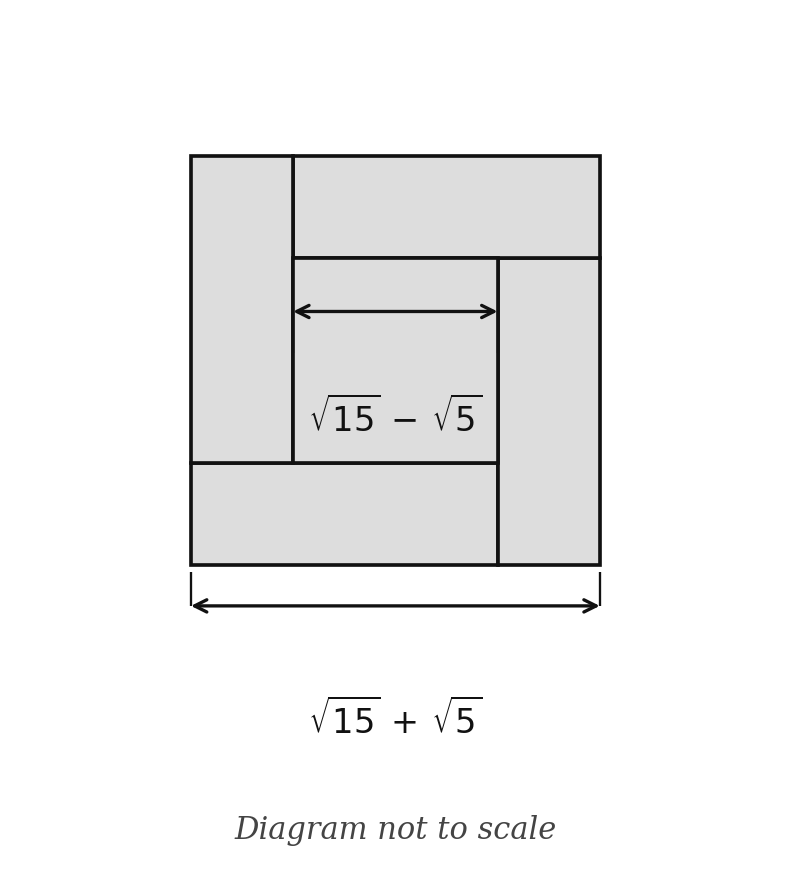
The diagram shows four identical shaded rectangles arranged inside a large square to leave a central unshaded square.
The side length of the outer square is 15+5 .
The side length of the inner unshaded square is 15−5 .
What is the total area of the shaded region?
A.
0
B.
53
C.
103
D.
203
E.
40
F.
40+203
G.
403
Answer and solution
Answer: D
The total area of the shaded region is the area of the outer square minus the area of the inner unshaded square: Area=(15+5)2−(15−5)2 Expanding each squared term: (15+5)2=(15)2+2155+(5)2=15+275+5=20+225×3=20+103(15−5)2=(15)2−2155+(5)2=15−275+5=20−103 Subtracting the inner area from the outer area: Area=(20+103)−(20−103)=203 Alternatively, using the identity (a+b)2−(a−b)2=4ab with a=15 and b=5 : Area=4ab=4155=475=4(53)=203