In January, the price of item P was 25% higher than the price of item Q.
In February, the price of item P decreased by 20%, while the price of item Q increased by 10%.
In March, the price of item P increased by 15%, while the price of item Q decreased by 5%.
In March, the price of item P was £6.30 more than the price of item Q.
What was the price of item Q in January?
A.
£42
B.
£50
C.
£60
D.
£66
E.
£70
F.
£75
G.
£600
Answer and solution
Answer: C
Let Q represent the price of item Q in January.
In January, the price of item P was: PJan=1.25Q In February: PFeb=1.25Q×(1−0.20)=1.25Q×0.80=1.00QQFeb=Q×(1+0.10)=1.10Q In March: PMar=1.00Q×(1+0.15)=1.15QQMar=1.10Q×(1−0.05)=1.10Q×0.95=1.045Q The difference in price in March is: PMar−QMar=1.15Q−1.045Q=0.105Q We are given that this difference is £6.30: 0.105Q=6.30Q=0.1056.30=1056300=60 Therefore, the price of item Q in January was £60.
▸Question 2
The expression 3−133+3 can be written in the form a+b3 , where a and b are integers. What is the value of a+b ?
A.
0
B.
3
C.
6
D.
9
E.
18
Answer and solution
Answer: D
To write the expression in the required form, we need to rationalise the denominator. We do this by multiplying the numerator and denominator by the conjugate of the denominator, which is 3+1 .
3−133+3=(3−1)(3+1)(33+3)(3+1)
Expanding the brackets in the numerator gives 3(3)+33+33+3=9+63+3=12+63 . The denominator becomes (3)2−12=3−1=2 .
The expression simplifies to:
212+63=6+33
Comparing this to the form a+b3 , we can see that a=6 and b=3 . Therefore, the value of a+b is 6+3=9 .
▸Question 3
A fair four-sided die has faces labelled 1,2,3,4 . A fair six-sided die has faces labelled 1,1,2,3,4,6 .
Both dice are rolled simultaneously. Let a be the score on the four-sided die and b be the score on the six-sided die.
What is the probability that the quadratic equation x2+ax+b=0 has real roots?
A.
247
B.
83
C.
125
D.
2411
E.
127
Answer and solution
Answer: C
For the quadratic equation x2+ax+b=0 to have real roots, its discriminant must be non-negative: Δ=a2−4(1)(b)≥0⟹a2≥4b⟹b≤4a2 The total number of equally likely outcomes is 4×6=24 .
We systematically test each possible value of a∈{1,2,3,4} and count how many faces on the six-sided die ( {1,1,2,3,4,6} ) satisfy the condition:
- If a=1 : b≤41=0.25 . No faces satisfy this ( 0 outcomes). - If a=2 : b≤44=1 . The two faces with ' 1 ' satisfy this ( 2 outcomes). - If a=3 : b≤49=2.25 . The faces with ' 1,1,2 ' satisfy this ( 3 outcomes). - If a=4 : b≤416=4 . The faces with ' 1,1,2,3,4 ' satisfy this ( 5 outcomes).
The total number of favourable outcomes is: 0+2+3+5=10 Therefore, the probability is: P(real roots)=2410=125
▸Question 4
A square of side length x has area A .
The square is modified to form the pentagon shown in the diagram below: - the base length b is 50% greater than x , - the height h is 20% less than x , - a right-angled triangular corner with base 31b and height 21h is removed from the top-right corner.
What is the area of the resulting pentagon in terms of A ?
A.
109A
B.
A
C.
1011A
D.
6067A
E.
56A
F.
1013A
Answer and solution
Answer: C
1. The area of the initial square is A=x2 .
2. The dimensions of the bounding rectangle are: b=x+0.50x=23xh=x−0.20x=54x 3. The area of the bounding rectangle is: Arect=b×h=(23x)(54x)=56x2=56A 4. The removed triangular corner has base 31b and height 21h , giving an area of: Atri=21×(31b)×(21h)=121bh=121(56A)=101A 5. The area of the resulting pentagon is: Apentagon=Arect−Atri=56A−101A=1012A−101A=1011A
▸Question 5
A component has a volume of V cubic inches. One inch is equivalent to L centimetres. The component is made from a material with a density of D g/cm3 . The material is supplied in blocks, each with a mass of M kg . Each block costs C pounds.
Which of the following expressions gives the cost of the material for the component, in pence? (There are 100 pence in one pound and 1000 grams in one kilogram.)
A.
10MVCDL3
B.
10MVCDL
C.
10ML3VCD
D.
M100VCDL3
E.
1000MVCDL3
F.
10MDVCL3
Answer and solution
Answer: A
We must construct the expression for the total cost by converting units at each stage.
1. Convert volume to metric units: The component has a volume of V cubic inches. Since 1 inch = L cm, it follows that 1 cubic inch = (L cm)3=L3 cm3 . The volume of the component in cm³ is therefore V×L3=VL3 cm3 .
2. Calculate mass in grams: The material density is D g/cm3 . The mass of the component is given by density multiplied by volume. Mass in grams = (VL3)×D=VDL3 g .
3. Convert mass to kilograms: There are 1000 grams in a kilogram. To convert the mass to kg, we divide by 1000. Mass in kg = 1000VDL3 kg .
4. Calculate the number of blocks required: The material is supplied in blocks of mass M kg. The number of blocks needed is the total mass divided by the mass per block: Number of blocks = Mass per block (kg)Total mass (kg)=MVDL3/1000=1000MVDL3 .
5. Calculate the total cost in pounds: Each block costs C pounds. The total cost in pounds is the number of blocks multiplied by the cost per block: Cost in £ = 1000MVDL3×C=1000MVCDL3 .
6. Convert the total cost to pence: There are 100 pence in a pound. To convert the cost to pence, we multiply by 100: Cost in pence = 1000MVCDL3×100=1000M100VCDL3=10MVCDL3 .
Therefore, the correct expression is 10MVCDL3 .
▸Question 6
The diagram shows a trapezium with parallel horizontal sides of length 2x+1 and 2x+3 , and perpendicular height 42−x .
Given that the area of the trapezium is 402 , what is the value of x ?
A.
−1.5
B.
−0.5
C.
0.5
D.
1.5
E.
2.5
Answer and solution
Answer: C
The area A of a trapezium with parallel sides a and b and perpendicular height h is: A=21(a+b)h Substitute the given side lengths and height: a=2x+1b=2x+3h=42−x=(22)2−x=24−2x Simplify the sum of the parallel sides by factoring out 2x : a+b=2x+1+2x+3=2x⋅21+2x⋅23=2x(2+8)=10⋅2x Compute the area expression: A=21⋅(10⋅2x)⋅24−2x=5⋅2x⋅24−2x=5⋅24−x Express the given area 402 in terms of base 2: 402=5×8×2=5×23×21/2=5⋅23.5 Equating the two expressions: 5⋅24−x=5⋅23.5⟹4−x=3.5⟹x=0.5
▸Question 7
The graphs of the functions y=(k−1)x2+6x and y=−k−7 intersect at exactly one point. What is the sum of all possible real values of the constant k ?
A.
-6
B.
-5
C.
1
D.
2
E.
3
Answer and solution
Answer: B
For the graphs to intersect at exactly one point, the equation formed by setting them equal must have exactly one real solution for x .
(k−1)x2+6x=−k−7
Rearranging gives:
(k−1)x2+6x+(k+7)=0
There are two cases for this equation to have a unique solution.
Case 1: The equation is linear. This occurs if the coefficient of x2 is zero. k−1=0⟹k=1 . If k=1 , the equation becomes 6x+(1+7)=0 , or 6x+8=0 , which has one solution. Thus, k=1 is a possible value.
Case 2: The equation is a quadratic with a single repeated root. This requires k−1eq0 and the discriminant, Δ , to be zero.
Δ=62−4(k−1)(k+7)=0
36−4(k2+6k−7)=0 Dividing by 4: 9−(k2+6k−7)=016−k2−6k=0k2+6k−16=0 Factoring the quadratic in k : (k+8)(k−2)=0 This gives k=−8 and k=2 . Both are valid as neither is equal to 1.
The set of all possible values for k is {−8,1,2} . The sum of these values is −8+1+2=−5 .
▸Question 8
Two solid objects, X and Y , are mathematically similar. The volume of X is 24 and the volume of Y is 81. The total surface area of X is S . Which expression gives the total surface area of Y ?
A.
278S
B.
94S
C.
32S
D.
23S
E.
49S
F.
827S
Answer and solution
Answer: E
We start by finding the ratio of the volumes of Y and X :
VXVY=2481=827
For mathematically similar solids, the volume ratio is the cube of the linear scale factor, k . Thus:
k3=827⟹k=3827=23
The ratio of surface areas is the square of the linear scale factor ( k2 ). We calculate:
AXAY=k2=(23)2=49
Since the surface area of X is S , the surface area of Y is 49S .
▸Question 9
A box contains only black discs and white discs. The total number of discs in the box is 15.
There are more black discs than white discs in the box.
Two discs are drawn at random from the box without replacement.
The probability that both discs drawn are of the same colour is 2111 .
What is the probability that both discs drawn are black?
A.
212
B.
71
C.
215
D.
72
E.
31
F.
73
G.
94
H.
32
Answer and solution
Answer: F
Let b be the number of black discs in the box. The number of white discs is 15−b .
Since there are more black discs than white discs, we have b>15−b⟹2b>15⟹b≥8 .
Two discs are drawn without replacement. The total number of ways to draw two discs is: (215)=215×14=105 The probability that both discs drawn are of the same colour is the sum of the probabilities of drawing two black discs and drawing two white discs: P(same colour)=15×14b(b−1)+(15−b)(14−b)=2111 Multiply both sides by 210 ( 15×14 ): b2−b+(210−29b+b2)=2111×210=1102b2−30b+210=1102b2−30b+100=0b2−15b+50=0(b−10)(b−5)=0 Since b≥8 , we have b=10 (and the number of white discs is 5 ).
The probability that both discs drawn are black is: P(both black)=15×14b(b−1)=21010×9=21090=73
▸Question 10
A set of 5 distinct integers has a mean of 10, a median of 5 and a range of 20. The integer 8 is added to the set.
Which of the following correctly describes the changes to the mean, the median and the range of the set?
A.
Mean decreases, Median unchanged, Range increases
B.
Mean increases, Median increases, Range unchanged
C.
Mean decreases, Median increases, Range unchanged
D.
Mean increases, Median unchanged, Range increases
E.
Mean decreases, Median increases, Range increases
Answer and solution
Answer: C
Let's analyse the effect on the mean, range, and median in turn.
Mean: The original mean of the 5 integers is 10. The integer being added, 8, is less than the mean. Adding a value below the current mean will always cause the mean to decrease. So, the mean decreases.
Range: Let the original set in ascending order be x1,x2,x3,x4,x5 . The median is x3=5 , so the minimum value x1 must be less than 5. The mean is 10. For the mean to be 10 with a median of 5, the maximum value x5 must be greater than 10 (otherwise the sum would be too small). The value being added, 8, lies between the original minimum ( x1<5 ) and maximum ( x5>10 ). Therefore, the range, which is x5−x1 , is unchanged.
Median: The original set has 5 elements, so the median is the 3rd value, which is 5. After adding 8, the new set has 6 elements. The new median is the average of the 3rd and 4th values in the new sorted list. Since 8 is greater than 5, the 3rd value in the new sorted list is still 5. The 4th value is either the original x4 or 8. As the original integers are distinct, x4>5 , so the 4th value is definitely greater than 5. The new median is 25+k for some integer k>5 . This value must be greater than 5. So, the median increases.
Combining these results: the mean decreases, the median increases, and the range is unchanged.
▸Question 11
An unlimited supply of gold and silver coins is available. The probability of selecting a gold coin is 31 .
Two boxes, Box 1 and Box 2, are prepared. To prepare each box, two coins are selected from the supply and placed inside.
It is known that each box contains at least one gold coin.
One coin is then drawn from Box 1 and one coin is drawn from Box 2.
What is the probability that both coins drawn are gold?
A.
251
B.
91
C.
259
D.
53
E.
169
F.
54
Answer and solution
Answer: C
Let G be a gold coin and S be a silver coin. We are given P(G)=31 and so P(S)=1−31=32 .
When creating a box by selecting two coins, the four possible outcomes for its contents have the following probabilities:
- P(GG)=P(G)×P(G)=31×31=91 - P(GS)=P(G)×P(S)=31×32=92 - P(SG)=P(S)×P(G)=32×31=92 - P(SS)=P(S)×P(S)=32×32=94 The event that a box contains one of each coin is GS or SG, so P(one of each)=P(GS)+P(SG)=92+92=94 .
The condition is that each box contains 'at least one gold coin'. This event, let's call it A , eliminates the SS outcome. The probability of this condition being met for a single box is:
P(A)=P(at least one G)=1−P(SS)=1−94=95
We now find the conditional probabilities for the composition of a box, given event A .
P(box is GG∣A)=P(A)P(box is GG∩A)=P(A)P(GG)=5/91/9=51
P(box is GS or SG∣A)=P(A)P(GS or SG)=5/94/9=54
Let DG be the event of drawing a gold coin from a conditioned box. We use the law of total probability:
P(DG)=P(DG∣box is GG)P(box is GG∣A)+P(DG∣box is GS/SG)P(box is GS/SG∣A)
If the box is GG, the probability of drawing a gold coin is 1. If the box is GS or SG, the probability of drawing a gold coin is 21 .
So, the probability of drawing a gold coin from one box is:
P(DG)=(1×51)+(21×54)=51+52=53
This is the probability for Box 1. By symmetry, it is also the probability for Box 2. Since the two draws are independent, the probability that both coins drawn are gold is:
P(both gold)=P(DG from Box 1)×P(DG from Box 2)=53×53=259
▸Question 12
A factory processes 1200 kg of raw material in batches of 20 kg.
In Stage 1, each batch is converted into 10 units of substance P and 5 units of substance G.
In Stage 2, all of substance P is processed, with each unit of P producing 0.5 units of substance G.
All the substance G from both stages is used to create a final product, F. 3 units of G are required to produce 2 units of F. The product F is produced at a constant rate of 5 units per minute.
What is the total time, in minutes, taken to produce all of F?
A.
40
B.
80
C.
90
D.
120
E.
180
F.
240
Answer and solution
Answer: B
The solution involves tracking the quantities produced through each stage.
1. Calculate the number of batches: The total mass of raw material is 1200 kg, and each batch is 20 kg. Number of batches = 201200=60 batches.
2. Calculate substances produced in Stage 1: Each of the 60 batches produces 10 units of P and 5 units of G. Total substance P produced = 60×10=600 units. Total substance G from Stage 1 = 60×5=300 units.
3. Calculate substance G produced in Stage 2: All 600 units of substance P are processed. Each unit of P produces 0.5 units of G. Total substance G from Stage 2 = 600×0.5=300 units.
4. Calculate the total amount of substance G: The total amount of G is the sum from both stages. Total G = (G from Stage 1) + (G from Stage 2) = 300+300=600 units.
5. Calculate the total amount of final product F: 3 units of G are required to produce 2 units of F. This is a ratio of 3 units G2 units F . Total F produced = 600 units of G×32=31200=400 units.
6. Calculate the total time: The product F is produced at a rate of 5 units per minute. Total time = RateTotal units of F=5400=80 minutes.
▸Question 13
A composite cylindrical rod of length L consists of a solid inner core of radius R and a surrounding outer shell of inner radius R and outer radius 2R .
The core is made of a material with density ρ and has mass M . The shell is made of a material with density 2ρ .
What is the total mass of the rod?
A.
3M
B.
4M
C.
6M
D.
7M
E.
8M
F.
9M
Answer and solution
Answer: D
Let the volume of the inner core be Vc=πR2L . Its mass is given as M , which establishes the relationship M=ρVc .
The volume of the outer shell, Vs , is the difference between the volume of the entire cylinder (radius 2R ) and the volume of the core.
Vs=π(2R)2L−πR2L=(4−1)πR2L=3Vc
The shell has density 2ρ , so its mass Ms is:
Ms=(density)×(volume)=(2ρ)×(3Vc)=6ρVc
Since we know M=ρVc , we can express the shell's mass in terms of M : Ms=6(ρVc)=6M .
The total mass of the rod is the sum of the core mass and the shell mass: Mtotal=M+Ms=M+6M=7M .
▸Question 14
A set of n distinct items ( n≥3 ) is arranged in a random linear order. Two specific items, X and Y , are chosen from the set. Which expression gives the probability that item X appears earlier in the arrangement than item Y ?
A.
n(n−1)1
B.
n1
C.
n2
D.
21
E.
nn−1
Answer and solution
Answer: D
We consider the symmetry of the situation. In any random arrangement of the n distinct items, there are only two possibilities for the relative ordering of X and Y :
1. X appears earlier than Y . 2. Y appears earlier than X .
For every arrangement where X precedes Y , there is a corresponding arrangement formed by swapping the positions of X and Y where Y precedes X . Since the ordering is random, these two cases are equally likely and cover all possibilities.
Therefore, the probability that X appears earlier than Y is independent of n :
P(X before Y)=21
This result holds for any n≥2 .
▸Question 15
The quadratic equation in x
x2+(42−2k×8k)x+162−k=0
has exactly one real root.
What is the value of k ?
A.
−3
B.
−2
C.
0
D.
1
E.
2
F.
3
Answer and solution
Answer: D
The given quadratic is x2+bx+c=0 , where a=1 , b=42−2k×8k , and c=162−k .
First, express b and c as powers of 2 :
b=(22)2−2k×(23)k=24−4k×23k=24−k
c=(24)2−k=28−4k
For exactly one real root, the discriminant must be zero, so b2=4ac :
b2=(24−k)2=28−2k
4ac=4(1)(28−4k)=22×28−4k=210−4k
Equating the two expressions gives:
28−2k=210−4k
Since the bases are equal, we can equate the exponents:
8−2k=10−4k
Rearranging this linear equation yields 2k=2 , so k=1 .
Therefore the correct answer is D.
▸Question 16
Five years ago, the ratio of the age of P to the age of Q was 5 : 2. In 12 years, P will be 21 years older than Q.
What is the current age of P?
A.
19
B.
23
C.
35
D.
40
E.
47
Answer and solution
Answer: D
The age difference between P and Q is constant. We are told that in 12 years, P will be 21 years older than Q. This means P is always 21 years older than Q.
Five years ago, the ratio of their ages was 5:2 . Let their ages at that time be 5x and 2x . The difference in their ages was 5x−2x=3x .
We can equate this difference to the known age gap:
3x=21⟹x=7
So, five years ago, P's age was 5x=5×7=35 .
P's current age is therefore 35+5=40 .
▸Question 17
A 3D printer extrudes a cylindrical filament of plastic with a diameter of 4 mm. The filament is fed at a constant rate of 5 mm per second for a total of 10 minutes.
The density of the plastic is π2.5 g/cm 3 .
What is the total mass of plastic used, in grams?
A.
0.5
B.
2
C.
30
D.
120
E.
300
F.
3000
Answer and solution
Answer: C
The calculation proceeds in three main stages: finding the length of the filament, finding its volume, and then finding its mass.
1. Calculate the total length of the filament. The printer runs for 10 minutes. We need to convert this to seconds to match the feed rate unit. Time in seconds = 10 minutes×60minuteseconds=600 seconds. The total length L is the feed rate multiplied by the time: L=5smm×600 s=3000 mm.
2. Calculate the volume of the filament. The density is given in g/cm 3 , so it is best to convert all dimensions to cm. Length L=3000 mm =300 cm. The diameter is 4 mm, so the radius is r=2 mm =0.2 cm. The filament is a cylinder, so its volume V is given by the formula V=πr2L .
V=π×(0.2 cm)2×(300 cm)
V=π×0.04 cm2×300 cm
V=π×(4×10−2)×(3×102) cm3
V=12π cm3
3. Calculate the mass of the plastic. The relationship between mass, density ( ρ ), and volume is Mass =ρ×V .
Mass=(π2.5cm3g)×(12π cm3)
Mass=2.5×12 g
To calculate 2.5×12 without a calculator, we can write 2.5 as 25 :
Mass=25×12 g=5×6 g=30 g
Thus, the total mass of plastic used is 30 g.
▸Question 18
How many integer values of x are there such that the value of the expression 3x+13x+31 is an integer?
A.
2
B.
4
C.
8
D.
16
Answer and solution
Answer: B
Let the given expression be N . We can rewrite it using algebraic manipulation, which is equivalent to polynomial long division:
N=3x+13x+31=3x+1(3x+1)+30=1+3x+130
For N to be an integer, the term 3x+130 must be an integer. This requires that 3x+1 is an integer factor of 30.
Furthermore, since x must be an integer, 3x is a multiple of 3. This means that 3x+1 must be a number that is 1 more than a multiple of 3. In modular arithmetic terms, we require 3x+1≡1(mod3) .
The integer factors of 30 are ±1,±2,±3,±5,±6,±10,±15,±30 .
We now check which of these factors satisfy the condition k≡1(mod3) :
- Positive factors: 1 and 10 satisfy the condition. - Negative factors: −2 and −5 satisfy the condition (since −2=3(−1)+1 and −5=3(−2)+1 ).
The possible values for 3x+1 are therefore 1,10,−2,−5 .
Each of these leads to a valid integer value for x : - 3x+1=1⟹3x=0⟹x=0 - 3x+1=10⟹3x=9⟹x=3 - 3x+1=−2⟹3x=−3⟹x=−1 - 3x+1=−5⟹3x=−6⟹x=−2 There are 4 such integer values of x .
▸Question 19
The line L1 passes through the point A(1,2) and is perpendicular to the line segment connecting A and B(5,4) . The line L2 passes through B and is perpendicular to the line x+3y=0 . The lines L1 and L2 intersect at the point C . What is the area of the triangle ABC ?
A.
5
B.
10
C.
20
D.
30
E.
40
Answer and solution
Answer: B
We first determine the equations of the lines L1 and L2 .
The gradient of the segment AB is 5−14−2=21 . Since L1 is perpendicular to AB and passes through A(1,2) , its gradient is −2 . Its equation is:
y−2=−2(x−1)⟹y=−2x+4
The line x+3y=0 has gradient −31 . Since L2 is perpendicular to this and passes through B(5,4) , its gradient is 3 . Its equation is:
y−4=3(x−5)⟹y=3x−11
We find the intersection point C by equating the expressions for y :
−2x+4=3x−11⟹5x=15⟹x=3
Substituting x=3 into either equation gives y=−2 . Thus, C is at (3,−2) .
Since L1 is perpendicular to AB , the triangle ABC is right-angled at A . We calculate the side lengths:
An equilateral triangle and a regular 12-sided polygon are inscribed in the same circle. The area of the equilateral triangle is 273 .
What is the area of the regular 12-sided polygon?
A.
27
B.
54
C.
108
D.
1083
E.
216
F.
324
Answer and solution
Answer: C
Let R be the radius of the circle in which both polygons are inscribed.
The area of a regular n -sided polygon inscribed in a circle of radius R can be found by dividing it into n congruent isosceles triangles. Each triangle has two sides of length R and the angle between them is n360∘ . The area of one such triangle is 21R2sin(n360∘) .
For the equilateral triangle ( n=3 ), the central angle is 3360∘=120∘ . The total area is:
Area3=3×(21R2sin(120∘))
We know that sin(120∘)=sin(60∘)=23 .
Area3=3×21R2(23)=433R2
We are given that the area of the triangle is 273 .
433R2=273
Dividing both sides by 33 gives:
41R2=9⟹R2=36
Now, we find the area of the regular 12-sided polygon (dodecagon, n=12 ). The central angle is 12360∘=30∘ . The total area is:
Area12=12×(21R2sin(30∘))
We know that sin(30∘)=21 .
Area12=12×21R2(21)=3R2
Substituting the value of R2=36 :
Area12=3×36=108
▸Question 21
A cubic polynomial P(x) with leading coefficient 1 can be factorised as P(x)=(x−r1)(x−r2)(x−r3) , where r1,r2 and r3 are positive integers.
The curve y=P(x) passes through the point (3,−4) .
How many distinct polynomials P(x) satisfy these conditions?
A.
1
B.
3
C.
4
D.
5
E.
6
F.
18
Answer and solution
Answer: D
Since P(x)=(x−r1)(x−r2)(x−r3) and the curve passes through (3,−4) , we have:
P(3)=(3−r1)(3−r2)(3−r3)=−4
Let di=3−ri . We need to find the number of distinct multisets of integers {d1,d2,d3} such that d1d2d3=−4 . Since ri are positive integers, ri≥1 , which means di=3−ri≤2 .
The integer factors of −4 are ±1,±2,±4 . We systematically list the multisets of three factors that multiply to −4 , checking the condition di≤2 :
Case 1: One negative factor, two positive factors. - {−4,1,1} : maximum factor is 1≤2 (Valid, roots are 7,2,2 ) - {−2,2,1} : maximum factor is 2≤2 (Valid, roots are 5,1,2 ) - {−1,2,2} : maximum factor is 2≤2 (Valid, roots are 4,1,1 ) - {−1,4,1} : contains 4 , but 4ot≤2 (Invalid, one root would be −1 )
Case 2: Three negative factors. - {−4,−1,−1} : maximum factor is −1≤2 (Valid, roots are 7,4,4 ) - {−2,−2,−1} : maximum factor is −1≤2 (Valid, roots are 5,5,4 )
There are exactly 5 valid multisets, each corresponding to a distinct polynomial. Therefore the correct answer is D.
▸Question 22
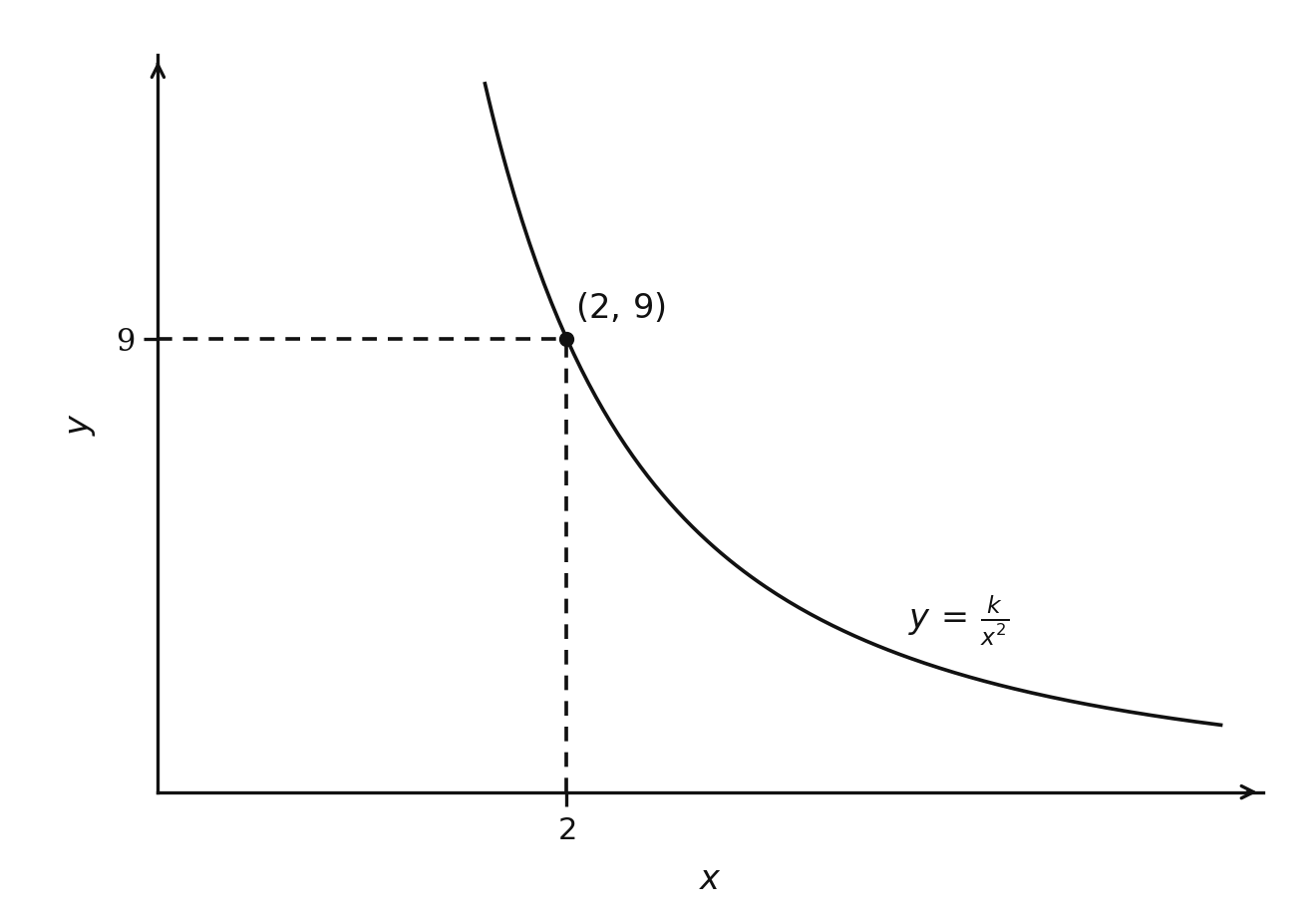
The diagram shows part of the curve y=x2k , where k is a positive constant and x>0 . The curve passes through the point (2,9) .
Also, x is directly proportional to z3 . When z=2 , x=24 .
Which of the following is an expression for y in terms of z ?
A.
y=4z61
B.
y=z64
C.
y=z54
D.
y=z36
E.
y=z612
F.
y=z636
G.
y=481z6
H.
y=4z6
Answer and solution
Answer: B
1. Find k using the given point on the curve. Since y=x2k passes through (2,9) : 9=22k=4k⟹k=36. So y=x236 .
2. Find how x depends on z . Since x is directly proportional to z3 , write x=cz3 . When z=2 , x=24 : 24=c⋅23=8c⟹c=3. So x=3z3 .
3. Substitute into the equation for y : y=(3z3)236=9z636=z64.
▸Question 23
A system's success depends on two independent paths, A and B. The system succeeds if at least one path succeeds. Each path consists of 3 relays in series. A path succeeds only if all 3 of its relays succeed. All relays are identical and independent, each with a probability p of success. In 128 independent trials, the expected number of system successes is 30.
What is the value of p ?
A.
241
B.
81
C.
83
D.
21
E.
85
F.
87
Answer and solution
Answer: D
Let PS be the probability of the system succeeding in a single trial. The expected number of successes in n trials is given by E(X)=nPS . We are given n=128 and E(X)=30 . Therefore,
PS=12830=6415
Now, we need to express PS in terms of p . Let Ppath be the probability that a single path succeeds. For a path to succeed, all 3 of its relays must succeed. Since the relays are independent, we multiply their probabilities:
Ppath=p×p×p=p3
The probability that a single path fails is therefore 1−Ppath=1−p3 .
The system succeeds if at least one path succeeds. It is easier to calculate the probability that the system fails, which happens if and only if both paths fail. Since the paths are independent, the probability that both fail is:
P(system fails)=P(path A fails)×P(path B fails)=(1−p3)(1−p3)=(1−p3)2
The probability of the system succeeding is the complement of it failing:
PS=1−P(system fails)=1−(1−p3)2
Now we can set up the equation using the value of PS we found:
1−(1−p3)2=6415
Rearranging to solve for p :
(1−p3)2=1−6415=6449
Taking the square root of both sides:
1−p3=±6449=±87
This gives two possible cases:
Case 1: 1−p3=87
p3=1−87=81
p=381=21
Case 2: 1−p3=−87
p3=1−(−87)=1+87=815
Since p is a probability, we must have 0≤p≤1 , which implies 0≤p3≤1 . The result p3=815 is greater than 1, so this case is not possible.
The only valid solution is p=21 .
▸Question 24
Three regular polygons meet at a single vertex, completely covering the angle around it.
One polygon is a square. The other two have n sides and m sides respectively, where n<m .
What is the maximum possible value of m ?
A.
8
B.
12
C.
16
D.
20
E.
24
F.
42
Answer and solution
Answer: D
Let the three regular polygons have 4 , n , and m sides. The sum of their interior angles at the common vertex must be 360∘ .
The interior angle of a regular k -sided polygon is given by the formula 180(k−2)/k degrees, or 180−k360 degrees.
The interior angle of a square is 90∘ .
So, the condition is:
90+(180−n360)+(180−m360)=360
450−360(n1+m1)=360
90=360(n1+m1)
36090=n1+m1
41=n1+m1
We need to find integer solutions for n and m with the constraints 3≤n<m .
To solve this Diophantine equation, we can rearrange it:
nm=4n+4m
nm−4n−4m=0
By adding 16 to both sides, we can factorise by completing the rectangle:
nm−4n−4m+16=16
(n−4)(m−4)=16
Since n and m are integers representing the number of sides of a polygon, n−4 and m−4 must be integer factors of 16.
From the condition 3≤n<m , it follows that n−4≥−1 and m−4>n−4 .
We list the integer factor pairs (a,b) of 16 such that a<b and a≥−1 : 1. a=1,b=16 : n−4=1⟹n=5m−4=16⟹m=20 This gives the valid solution (n,m)=(5,20) .
2. a=2,b=8 : n−4=2⟹n=6m−4=8⟹m=12 This gives the valid solution (n,m)=(6,12) .
(The pair a=4,b=4 would give n=m=8 , which violates n<m . Negative factor pairs like (−16,−1) would give n<3 , which is not possible for a polygon.)
The possible values for m are 20 and 12. The maximum of these is 20.
▸Question 25
Three quantities x , y and z are related by the ratios x:y=3:2 and z:y=5:4 . What is the ratio x:z ?
A.
3:5
B.
5:6
C.
6:5
D.
8:15
E.
15:8
Answer and solution
Answer: C
We are given the ratios x:y=3:2 and z:y=5:4 .
To find the ratio x:z , we must first express both ratios with a common value for y . The values for y are currently 2 and 4. The lowest common multiple is 4.
We can scale the first ratio by multiplying both parts by 2:
x:y=3:2=(3×2):(2×2)=6:4
Now we have the two ratios x:y=6:4 and z:y=5:4 .
Since the value corresponding to y is 4 in both ratios, we can directly compare the values for x and z . This gives the ratio x:z=6:5 .
▸Question 26
The variables x and y are positive.
For which of the following relationships is y inversely proportional to x ?
A.
The sum x+y is a constant.
B.
y=x2k for some non-zero constant k .
C.
y=x+ck for some non-zero constants k and c .
D.
The product xy is a non-zero constant.
E.
The ratio xy is a non-zero constant.
F.
y=xk+c for some non-zero constants k and c .
Answer and solution
Answer: D
The statement ' y is inversely proportional to x ' means that y=xk for some non-zero constant of proportionality k . Multiplying both sides by x gives an equivalent definition: the product xy must be a non-zero constant ( xy=k ).
We examine each option:
- **A: The sum x+y is a constant.** Let x+y=c . Then y=c−x . This is a linear relationship, not inverse proportion.
- **B: y=x2k for some non-zero constant k .** This states that y is inversely proportional to x2 , not to x .
- **C: y=x+ck for some non-zero constants k and c .** This states that y is inversely proportional to the quantity (x+c) , not to x . The product xy=x+ckx is not constant.
- **D: The product xy is a non-zero constant.** This is the definition of inverse proportion, xy=k . This is the correct answer.
- **E: The ratio xy is a non-zero constant.** Let xy=k . Then y=kx . This is the definition of direct proportion.
- **F: y=xk+c for some non-zero constants k and c .** If we form the product xy , we get xy=(xk+c)x=k+cx . Since x is a variable and c is non-zero, the product xy is not constant. This relationship describes a vertically translated reciprocal graph.
Therefore, only the relationship described in option D represents inverse proportionality between y and x .
▸Question 27
The following four lengths are denoted by P, Q, R, and S.
P = 5μm Q = 0.02mm R = 200nm S = 5×10⁻⁵m Arrange these lengths in order, from smallest to largest.
A.
R,P,Q,S
B.
S,Q,P,R
C.
P,Q,S,R
D.
Q,S,R,P
E.
R,P,S,Q
F.
R,Q,S,P
Answer and solution
Answer: A
To compare the four lengths, we should convert them all to a common unit, for example, metres (m).
First, recall the standard SI prefixes: - milli (m) = 10−3 - micro ( μ ) = 10−6 - nano (n) = 10−9 Now, convert each length to metres:
For P:
P=5μm=5×10⁻⁶m
For Q:
Q=0.02mm=0.02×10⁻³m=2×10−2×10−3m=2×10⁻⁵m
For R:
R=200nm=200×10−9m=2×102×10−9m=2×10⁻⁷m
For S:
S=5×10⁻⁵m
Now we have the four lengths in metres: - P = 5×10⁻⁶m - Q = 2×10⁻⁵m - R = 2×10⁻⁷m - S = 5×10⁻⁵m To order them from smallest to largest, we compare their powers of 10. A more negative exponent corresponds to a smaller number.
- The smallest exponent is −7 , so R is the smallest length. - The next smallest exponent is −6 , so P is the second smallest length. - Both Q and S have an exponent of −5 . We must compare their coefficients. Since 2<5 , we have Q<S .
The final order from smallest to largest is R, then P, then Q, then S.