The graph shows the current through a filament lamp at different voltages. The lamp is connected in series with a 10Ω resistor to a 7.0V d.c. supply.
What is the power transferred to the lamp?
A.
0.90W
B.
1.2W
C.
1.6W
D.
2.1W
E.
2.8W
Answer and solution
Answer: B
At I=0.30A , the graph gives Vlamp=4.0V . The resistor voltage is IR=3.0V , so this operating point uses the full 7.0V . Thus Plamp=VI=4.0×0.30=1.2W . The total supply power is not the lamp power.
▸Question 2
The figure shows the intensity of an electromagnetic signal as a function of its wavelength, λ .The signal has two distinct intensity peaks: a taller peak at wavelength λA and a shorter peak at a longer wavelength λB . This signal is then re-plotted to show its intensity as a function of frequency, f . Let fA be the frequency corresponding to λA and fB be the frequency corresponding to λB . Which statement correctly describes the new graph?
A.
The peak originally at λA is at a higher frequency than the peak from λB , and it is the taller peak.
B.
The peak originally at λA is at a lower frequency than the peak from λB , and it is the taller peak.
C.
The peak originally at λA is at a higher frequency than the peak from λB , but it is the shorter peak.
D.
The peak originally at λA is at a lower frequency than the peak from λB , and it is the shorter peak.
E.
The two peaks will appear at the same frequency on the new graph.
F.
The new frequencies are given by the relations fA=cλA and fB=cλB .
Answer and solution
Answer: A
For any electromagnetic wave, the speed of light c , frequency f , and wavelength λ are related by the wave equation:
c=fλ
This can be rearranged to find the frequency for a given wavelength:
f=λc
This shows that frequency is inversely proportional to wavelength. A shorter wavelength corresponds to a higher frequency, and a longer wavelength corresponds to a lower frequency.
From the graph and the stem, we are given that λB is a longer wavelength than λA , so λB>λA . Applying the inverse relationship, the corresponding frequencies must satisfy fB<fA . So, the peak that was at the shorter wavelength λA will be at the higher frequency fA .
Re-plotting the data against a different variable on the x-axis does not change the intensity values on the y-axis. The intensity of each component of the signal remains the same. The stem and graph state that the peak at λA is taller than the peak at λB . Therefore, on the new graph, the peak at frequency fA will be taller than the peak at frequency fB .
Combining these two points, the peak from λA is at a higher frequency ( fA>fB ) and is the taller peak. This corresponds to option A.
▸Question 3
The graph shows the voltage from a simple a.c. generator whose coil rotates at constant speed. One voltage cycle corresponds to one complete rotation.
The rotation speed is doubled and the magnetic field strength is left unchanged. The coil starts in the same position and rotates in the same direction.
What is the first time after t=0 at which the new voltage reaches a positive maximum, and how does the new peak voltage compare with the old peak voltage?
A.
1.0ms ; smaller
B.
1.0ms ; larger
C.
2.0ms ; unchanged
D.
4.0ms ; larger
E.
8.0ms ; unchanged
Answer and solution
Answer: B
The original period is 8.0ms , so the first positive maximum is at 2.0ms . Doubling the rotation speed halves all corresponding times, giving 1.0ms . Faster cutting of the magnetic field produces a larger peak voltage.
▸Question 4
A fixed mass of an ideal gas is kept at a constant temperature inside a cylinder fitted with a piston. The piston is pulled outwards so that the volume of the gas increases at a constant rate.
Which statement best describes the pressure of the gas?
A.
It is constant.
B.
It is increasing at a constant rate.
C.
It is increasing at a decreasing rate.
D.
It is decreasing at a constant rate.
E.
It is decreasing at a decreasing rate.
Answer and solution
Answer: E
For a fixed mass of an ideal gas at constant temperature, Boyle's Law states that pressure P is inversely proportional to volume V . We can write this as P=Vk , where k is a constant.
The problem states that the volume increases at a constant rate. We can express this as V(t)=V0+rt , where V0 is the initial volume and r is a constant positive rate.
Substituting this into the pressure equation gives the pressure as a function of time:
P(t)=V0+rtk
As time t increases, the denominator (V0+rt) increases. Since the numerator k is a positive constant, the pressure P(t) must decrease. This eliminates options A, B, and C.
Now we must consider the rate of decrease. Let's look at the change in pressure over two consecutive, equal time intervals. In the first interval, the volume increases by a fixed amount ΔV . In the second interval, it increases by the same amount ΔV .
The change in pressure is given by ΔP=Pfinal−Pinitial . Because the graph of P vs V ( P=k/V ) is a convex curve, for a given change in volume ΔV , the corresponding change in pressure ∣ΔP∣ is larger at smaller volumes and smaller at larger volumes.
Since the volume is continuously increasing, the pressure drop for each successive time interval becomes smaller. Therefore, the pressure is decreasing, and the rate at which it decreases is also decreasing.
▸Question 5
Two solid spheres, P and Q, fall vertically through a fluid of density ρ . Sphere P has radius r and density 3ρ ; sphere Q has radius 2r and density 2ρ .
For this question, the upthrust equals the weight of displaced fluid, and the volume of a sphere is proportional to the cube of its radius. The resistive force on a sphere of actual radius s is F=ksv , where v is its speed and k is constant.
Both spheres reach terminal velocities vP and vQ . What is vQ/vP ?
A.
1
B.
2
C.
38
D.
4
E.
8
Answer and solution
Answer: B
At terminal velocity, the net force on the sphere is zero. The forces acting are Weight ( W ), Upthrust ( U ), and Drag ( F ).
W=U+F⟹F=W−U
Using W=Vρsphereg and U=Vρfluidg , where volume V=34πr3 :
F=Vg(ρsphere−ρfluid)∝r3(ρsphere−ρ)
We are given the drag law F=krv . Equating the expressions for force:
krv∝r3(ρsphere−ρ)
Rearranging for velocity v :
v∝rr3(ρsphere−ρ)=r2(ρsphere−ρ)
Now we calculate the value for each sphere:
For sphere P ( r,3ρ ):
vP∝r2(3ρ−ρ)=2r2ρ
For sphere Q ( 2r,2ρ ):
vQ∝(2r)2(2ρ−ρ)=4r2(ρ)=4r2ρ
Taking the ratio:
vPvQ=2r2ρ4r2ρ=2
▸Question 6
An electric motor has an electrical power input of 160 W. The motor lifts a mass of 8.0 kg vertically at a constant speed of 1.5 m s⁻¹.
What is the efficiency of the motor? (Assume the acceleration due to gravity g=10 m s⁻².)
A.
7.5%
B.
15%
C.
25%
D.
40%
E.
50%
F.
75%
Answer and solution
Answer: F
The efficiency, β , is defined as the ratio of the useful power output, Pout , to the total electrical power input, Pin .
β=PinPout
The input power is given as Pin=160 W.
The useful power output is the power used to lift the mass. Since the mass is lifted at a constant speed, the upward lifting force, F , provided by the motor must be equal in magnitude to the weight of the mass, W=mg .
F=mg=8.0kg×10m s−2=80N
The useful power is the rate at which work is done by this force, which is given by Pout=Fv .
Pout=80N×1.5m s−1=120W
Now, we can calculate the efficiency:
β=160W120W=1612=43=0.75
Expressed as a percentage, the efficiency is 0.75×100%=75% .
▸Question 7
A station sends a microwave signal to a satellite 36000km away. The satellite immediately sends an infrared signal to a second station 45000km away from it.
Treat both paths as vacuum and ignore processing time. The speed of light is 3.0×10⁸ms−1 .
What is the shortest time between emission at the first station and reception at the second?
A.
0.030s
B.
0.12s
C.
0.15s
D.
0.27s
E.
0.54s
Answer and solution
Answer: D
Both microwave and infrared signals travel at the same speed in vacuum. Add the two path lengths, rather than their difference: t=3.0×10⁸(36000+45000)×1000=0.27s.
▸Question 8
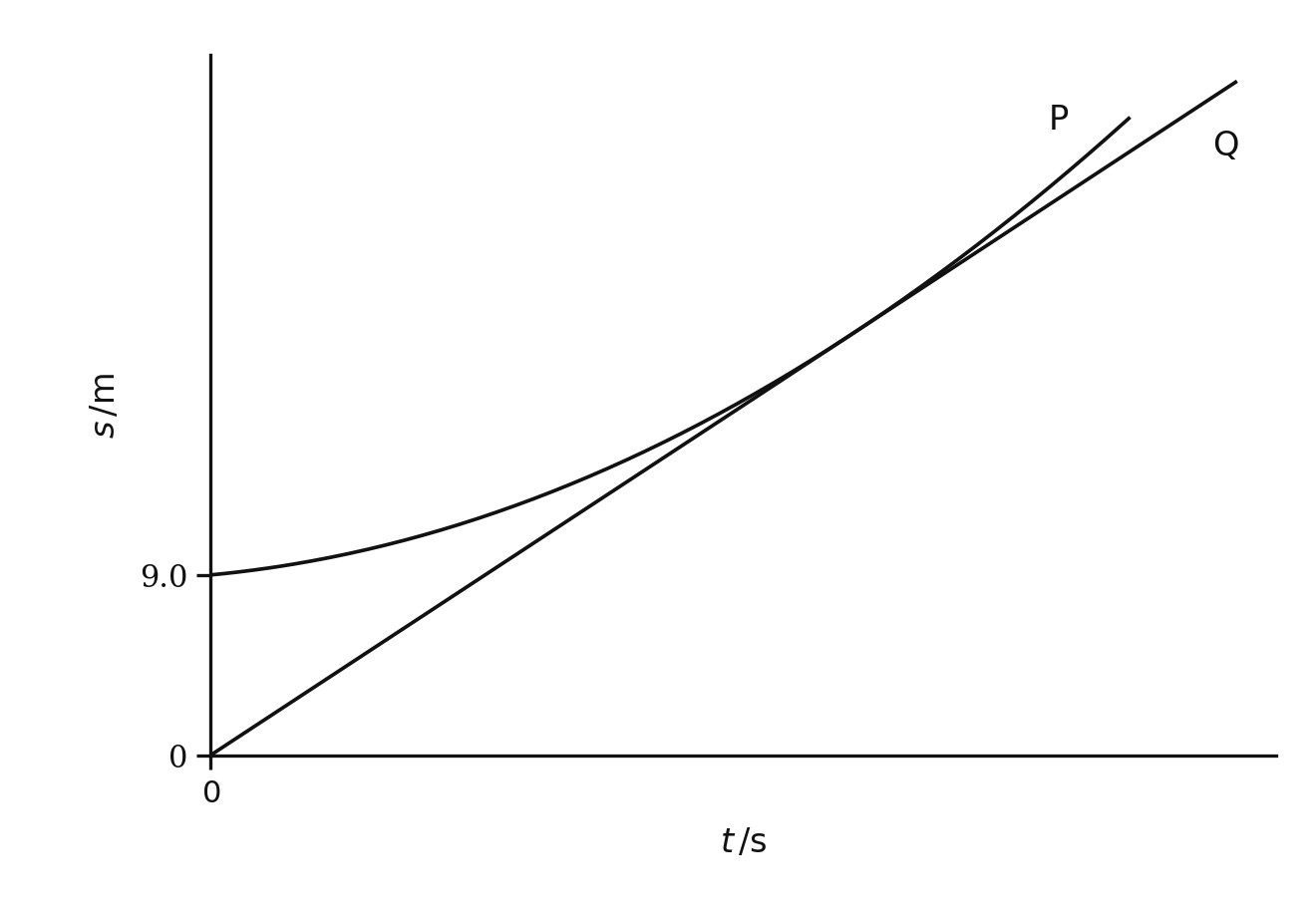
The displacement–time ( s – t ) graph shows the motion of two particles, P and Q , travelling in the same direction along a straight line.
Particle P starts at time t=0 from displacement s=9.0 m with an initial velocity of 1.0 m s−1 and moves with a constant acceleration of 2.0 m s−2 .
Particle Q starts at time t=0 from displacement s=0 and moves with a constant speed v .
On the graph, the straight line representing the motion of Q is tangent to the curve representing the motion of P .
What is the value of v ?
A.
3.0 m s−1
B.
5.0 m s−1
C.
6.0 m s−1
D.
7.0 m s−1
E.
8.0 m s−1
F.
9.0 m s−1
G.
12.0 m s−1
H.
13.0 m s−1
Answer and solution
Answer: D
The displacement of particle P as a function of time t is given by the kinematic equation: sP(t)=s0+ut+21at2 Substituting s0=9.0 m , u=1.0 m s−1 , and a=2.0 m s−2 : sP(t)=9.0+1.0t+21(2.0)t2=t2+t+9.0 The displacement of particle Q moving with constant speed v from s=0 is: sQ(t)=vt Since the line representing Q is tangent to the curve representing P , they touch at exactly one time t .
Method 1 (Equating velocities and positions): At the point of tangency, the instantaneous velocity of P equals the speed of Q : vP(t)=dtdsP=2t+1=v Since their positions are also equal at this instant: t2+t+9.0=vt Substitute v=2t+1 into the position equation: t2+t+9.0=(2t+1)t=2t2+tt2=9.0⟹t=3.0 s(since t>0) Thus, the speed of Q is: v=2(3.0)+1=7.0 m s−1Method 2 (Using the discriminant): Equating displacements: t2+t+9.0=vt⟹t2+(1−v)t+9.0=0 For tangency, there must be a unique solution (repeated root), so the discriminant must be zero: Δ=(1−v)2−4(1)(9.0)=0(1−v)2=361−v=−6⟹v=7.0 m s−1
▸Question 9
A small parcel of liquid at the bottom of a container is heated by a source below it. The parcel expands and begins to rise, initiating a convection current.
Which statement best explains the physical origin of the net upward force acting on this heated parcel?
A.
The temperature of the parcel increases, giving the molecules sufficient kinetic energy to overcome gravity and move upwards.
B.
The density of the parcel decreases, causing the weight of the surrounding fluid it displaces to exceed the weight of the parcel itself.
C.
The volume of the parcel increases, causing the internal pressure of the parcel to become significantly greater than the external pressure from the surrounding fluid.
D.
The density of the parcel increases, resulting in a stronger reaction force from the container base that pushes the parcel upwards.
E.
The mass of the parcel decreases due to the expansion, reducing the gravitational force acting on it.
Answer and solution
Answer: B
Convection is driven by buoyancy. We analyse the forces on the parcel:
1. **Weight ( W ):** The mass m of the parcel is constant, so its weight W=mg is constant. 2. **Upthrust ( U ):** By Archimedes' principle, the upward buoyant force is equal to the weight of the fluid displaced: U=ρfluidVparcelg .
When the parcel is heated, its temperature increases and it expands (volume Vparcel increases). Since mass is constant, its density ρparcel=Vparcelm decreases.
The expansion increases the volume of fluid displaced, increasing the upthrust U . Since the surrounding fluid is cooler and denser than the heated parcel ( ρfluid>ρparcel ), the upthrust U becomes larger than the parcel's weight W .
Fnet=U−W>0
Thus, the direct cause of the upward force is the decrease in density (relative to the surroundings), which creates a buoyant imbalance.
▸Question 10
The graph shows how the velocity of a test vehicle travelling along a straight horizontal track varies with time over a period of 50 s .
What is the total distance travelled by the vehicle, its distance from its starting position at t=50 s , and the magnitude of its average velocity over the 50 s period?
| | Total distance travelled / m | Distance from starting position / m | Magnitude of average velocity / m s−1 | | :--- | :--- | :--- | :--- | | A | 100 | 100 | 2.0 | | B | 100 | 100 | 4.4 | | C | 100 | 220 | 2.0 | | D | 100 | 220 | 4.4 | | E | 220 | 100 | 2.0 | | F | 220 | 100 | 4.4 | | G | 220 | 220 | 2.0 | | H | 220 | 220 | 4.4 |
total distance: 100 m ; distance from start: 100 m ; average velocity: 2.0 m s−1
B.
total distance: 100 m ; distance from start: 100 m ; average velocity: 4.4 m s−1
C.
total distance: 100 m ; distance from start: 220 m ; average velocity: 2.0 m s−1
D.
total distance: 100 m ; distance from start: 220 m ; average velocity: 4.4 m s−1
E.
total distance: 220 m ; distance from start: 100 m ; average velocity: 2.0 m s−1
F.
total distance: 220 m ; distance from start: 100 m ; average velocity: 4.4 m s−1
G.
total distance: 220 m ; distance from start: 220 m ; average velocity: 2.0 m s−1
H.
total distance: 220 m ; distance from start: 220 m ; average velocity: 4.4 m s−1
Answer and solution
Answer: E
1. **Displacement in the positive direction ( 0 s≤t≤30 s ):** The area under the graph from t=0 to t=30 s forms a trapezium with parallel sides of length 30 s and (20−10)=10 s , and height 8.0 m s−1 : s1=21×(30+10)×8.0=160 m 2. **Displacement in the negative direction ( 30 s≤t≤50 s ):** The area between the graph and the time axis from t=30 to t=50 s forms a triangle with base 20 s and height −6.0 m s−1 : s2=21×20×(−6.0)=−60 m 3. Total distance travelled: Distance is a scalar quantity equal to the sum of the magnitudes of each segment's displacement: d=∣s1∣+∣s2∣=160+60=220 m 4. Distance from starting position: The net displacement is: Δx=s1+s2=160−60=100 m Therefore, the vehicle is 100 m from its starting position.
5. Magnitude of average velocity: Average velocity is total displacement divided by total time: ∣vˉ∣=Δt∣Δx∣=50 s100 m=2.0 m s−1 *(Note: Average speed would be 50220=4.4 m s−1 , but average velocity is requested).*
Thus, the correct row is E.
▸Question 11
An electrical heater with a power output of 100 W is used to melt a large block of ice at 0 °C . The ice melts at a constant rate of 0.20 g s−1 .
What is the rate at which thermal energy is lost to the surroundings? (specific latent heat of fusion of ice = 3.5×10⁵ J kg−1 )
A.
30 W
B.
40 W
C.
70 W
D.
100 W
E.
170 W
F.
70 kW
Answer and solution
Answer: A
The principle of conservation of energy states that the total power input from the heater must equal the sum of the power used to melt the ice and the power lost to the surroundings.
Pinput=Pmelt+Plost
First, we must calculate the power required to melt the ice, Pmelt . Power is the rate of energy transfer, and the energy required for a phase change is given by E=mLf . Therefore, the power required for melting is the rate of mass change multiplied by the specific latent heat of fusion, Lf .
The rate of melting is given in g s⁻¹, which must be converted to kg s⁻¹:
rate=0.20 g s−1=0.20×10⁻³ kg s−1=2.0×10⁻⁴ kg s−1
Now, calculate Pmelt :
Pmelt=(2.0×10⁻⁴ kg s−1)×(3.5×105 J kg−1)
Pmelt=(2.0×3.5)×10(−4+5) W=7.0×101 W=70 W
This is the 'useful' power. The power lost to the surroundings is the difference between the input power and the useful power:
Plost=Pinput−Pmelt=100 W−70 W=30 W
▸Question 12
An oscilloscope displays the signal from a microphone. For each sound, the trace measurements and oscilloscope settings are given in the table. The microphone's voltage amplitude is proportional to the sound-wave amplitude.
Compared with sound P, sound Q has:
<div class="md-table-wrap"><table class="md-table"><thead><tr><th>Sound</th><th>Divisions per cycle</th><th>Time / ms per division</th><th>Peak height / divisions</th><th>Voltage / V per division</th></tr></thead><tbody><tr><td>P</td><td>4.0</td><td>0.50</td><td>3.0</td><td>0.20</td></tr><tr><td>Q</td><td>2.0</td><td>0.50</td><td>2.0</td><td>0.30</td></tr></tbody></table></div>
A.
half the frequency and the same amplitude
B.
the same frequency and half the amplitude
C.
the same frequency and the same amplitude
D.
double the frequency and double the amplitude
E.
double the frequency and the same amplitude
Answer and solution
Answer: E
For P, TP=4×0.50=2.0ms . For Q, TQ=2×0.50=1.0ms , so its frequency is doubled. Both voltage amplitudes are 3×0.20=2×0.30=0.60V ; hence the sound amplitudes are equal.
▸Question 13
A sample initially contains 120 unstable nuclei of one isotope. Each nucleus decays directly to a stable nucleus. After one half-life, 72 unstable nuclei remain.
Which statement is correct?
A.
The observation proves that the quoted half-life is wrong.
B.
Exactly 36 of the remaining nuclei must decay during the next half-life.
C.
The 72 surviving nuclei are less likely to decay because they have already survived one half-life.
D.
The expected number remaining after the next half-life is 36, but the actual number may differ.
E.
The next decay must occur after exactly one seventy-second of a half-life.
Answer and solution
Answer: D
Half-life describes the probability of decay, not an exact schedule for a small sample. Each surviving nucleus still has a one-half probability of surviving the next half-life. The expected number remaining is 72/2=36 , with random variation around that value.
▸Question 14
A ray of light is directed horizontally towards a plane mirror M1 which is inclined at an angle of 30∘ to the horizontal. The reflected ray strikes a second plane mirror M2 and, after reflecting from M2 , travels vertically upwards, as shown in the diagram.
Mirror M1 is now rotated clockwise through an angle α , where α<30∘ . The direction of the incident ray is unchanged.
In what direction and through what angle should mirror M2 be rotated in order for the ray to still emerge vertically upwards after reflecting from mirror M2 ?
A.
clockwise through an angle α
B.
anticlockwise through an angle α
C.
clockwise through an angle 2α
D.
anticlockwise through an angle 2α
E.
clockwise through an angle 2α
F.
anticlockwise through an angle 2α
Answer and solution
Answer: A
There are two equivalent ways to solve this problem:
Method 1: Geometric optics property of successive reflections When a light ray undergoes two successive reflections in a single plane, the total angular deflection of the ray depends only on the angle ϕ between the planes of the two mirrors (the total deflection is 2ϕ ).
Since the direction of the incident ray is fixed, the direction of the emerging ray will remain unchanged if and only if the angle ϕ between mirror M1 and mirror M2 remains unchanged.
Therefore, if mirror M1 is rotated clockwise through an angle α , mirror M2 must also be rotated clockwise through the same angle α so that the relative angle between them is preserved.
Method 2: Direct angle tracing 1. When mirror M1 is rotated clockwise by α , the ray reflected from M1 rotates clockwise by 2α . 2. If mirror M2 is rotated clockwise by an angle β , its normal also rotates clockwise by β . 3. The incoming ray to M2 has shifted by 2α clockwise, while the normal to M2 has shifted by β clockwise. The angle of the reflected ray from M2 changes by 2β−2α relative to its initial direction. 4. For the emerging ray to remain strictly vertical, the net change in its final direction must be zero: 2β−2α=0⟹β=α Thus, mirror M2 must be rotated clockwise through an angle α .
▸Question 15
A ball is projected vertically upwards from the ground. It rises to a maximum height H and then falls back to the ground. Throughout the motion, the ball is subject to a force of air resistance that increases as the speed of the ball increases.
Let Wup be the magnitude of the work done by air resistance during the ascent. Let Wdown be the magnitude of the work done by air resistance during the descent.
Which of the following statements correctly compares Wup and Wdown ?
A.
Wup=Wdown , because the distance travelled is the same in both phases.
B.
Wup>Wdown , because the speed at any given height is greater during the ascent.
C.
Wup<Wdown , because the time taken for the descent is greater than for the ascent.
D.
Wup<Wdown , because the ball accelerates due to gravity during the descent.
Answer and solution
Answer: B
The work done by air resistance is given by the integral of the drag force over the distance travelled:
W=∫Fdragds
Mechanical energy is continuously dissipated by air resistance throughout the flight. Therefore, at any specific height h , the mechanical energy of the ball is lower on the way down than on the way up. Since the potential energy mgh is the same at height h in both phases, the kinetic energy (and thus speed) must be lower on the way down:
vdown(h)<vup(h)
Since the force of air resistance increases with speed, the drag force at any height h is smaller during the descent than during the ascent. Consequently, the integral of the force over the height H is smaller for the descent:
Wup>Wdown
▸Question 16
A periodic wave travels through a medium with a speed of 5.0 m/s . The period of the wave is 2.0 s .
What is the number of complete wavelengths that fit into a distance of 120 m along the direction of propagation?
A.
12
B.
24
C.
48
D.
60
Answer and solution
Answer: A
First, we determine the wavelength λ of the wave. The wavelength is the distance traveled by the wave in one period ( T ). Using the wave speed v :
λ=vT
Substituting the given values:
λ=5.0 m/s×2.0 s=10 m
The number of complete wavelengths N that fit into a total distance d=120 m is found by dividing the distance by the wavelength:
N=λd=10 m120 m=12
▸Question 17
A variable resistor is connected to a power supply that provides a constant voltage. The resistance of the resistor decreases at a constant rate over a period of time, but remains positive.
Which statement correctly describes the power dissipated by the resistor during this time?
A.
It is increasing at an increasing rate.
B.
It is increasing at a constant rate.
C.
It is increasing at a decreasing rate.
D.
It is not changing.
E.
It is decreasing at a constant rate.
F.
It is decreasing.
Answer and solution
Answer: A
The power P dissipated in a resistor with resistance R and a constant voltage V across it is given by the formula:
P=RV2
We are told that V is constant and R decreases at a constant rate. Let the initial resistance be R0 and the constant rate of decrease be k . Then the resistance at time t is R(t)=R0−kt .
Substituting this into the power equation gives:
P(t)=R0−ktV2
As time t increases, the denominator (R0−kt) decreases. Since the numerator V2 is constant, the value of the fraction P(t) must increase.
Now we must determine the rate of this increase. Let's consider the change in power over two consecutive, equal time intervals, Δt . In each interval, the resistance decreases by the same amount, ΔR=kΔt .
Consider the change in power when the resistance changes from R to R−ΔR . The change is ΔP=R−ΔRV2−RV2 .
The graph of y=1/x is convex (it curves upwards). This means that for a fixed change in the input (a fixed ΔR ), the change in the output is larger when the input value is smaller.
As time passes, R gets smaller. Therefore, the change in power, ΔP , for each subsequent time interval Δt becomes larger. This means the power is increasing, and the rate of that increase is also increasing.
▸Question 18
A sound wave travels to the right through a long tube of air. A tiny marked air particle is initially at P.
Which description of the particle's motion is correct as the wave passes?
A.
It travels to the right with the wave and stops far from P.
B.
It oscillates up and down, perpendicular to the tube.
C.
It moves back and forth along the tube, with no net transport over a complete oscillation.
D.
It remains stationary while the surrounding air carries the wave.
E.
It follows a circular path whose radius is the wavelength.
Answer and solution
Answer: C
Sound in air is longitudinal: particles move back and forth parallel to the propagation direction. Energy moves along the tube without the bulk transport of air with the wave.
▸Question 19
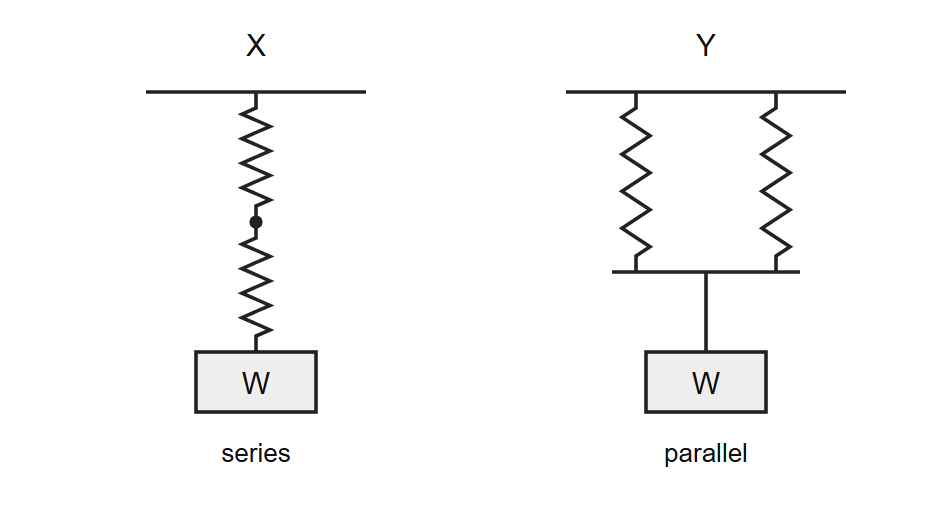
Two identical light springs obey Hooke's law. In arrangement X they are in series; in arrangement Y they are in parallel. The same load of weight W is supported at rest in each arrangement.
What is the ratio of the total elastic energy stored in X to that stored in Y?
A.
1:4
B.
1:2
C.
1:1
D.
2:1
E.
4:1
Answer and solution
Answer: E
Let each spring constant be k . In X, each spring carries W , so the total energy is 2[W2/(2k)]=W2/k . In Y, each carries W/2 , so the total energy is 2[(W/2)2/(2k)]=W2/(4k) . The ratio is 4:1 .
▸Question 20
An initially uncharged insulating object loses 5.0×10¹⁰ electrons when rubbed. It later gains 2.0×10¹⁰ electrons.
What is its final charge? The magnitude of the charge on one electron is 1.6×10⁻¹⁹C .
A.
−11.2nC
B.
−4.8nC
C.
+3.2nC
D.
+4.8nC
E.
+11.2nC
Answer and solution
Answer: D
Overall the object has lost 3.0×10¹⁰ electrons, so it is positive. The charge is (3.0×10¹⁰)(1.6×10⁻¹⁹)=4.8×10⁻⁹C=+4.8nC .
▸Question 21
Two stationary coils share an iron core. The graph shows the current in coil P. A voltmeter is connected across coil Q.
Increasing the current in P produces a positive voltage in Q. The voltmeter connections are fixed.
During which labelled intervals is the voltage in Q non-zero?
A.
I and II only
B.
all four intervals
C.
I, III and IV only
D.
II and IV only
E.
I and III only
Answer and solution
Answer: E
Only a changing current in P produces a changing magnetic field and an induced voltage in Q. The current increases in I and decreases in III, so the induced voltages are non-zero with opposite signs. The constant currents in II and IV give zero voltage, even though the current in II is non-zero.
▸Question 22
A resistor of constant resistance dissipates 100 W when the potential difference across it is V . The potential difference is reduced to 0.8V . What is the new power dissipated by the resistor?
A.
64 W
B.
80 W
C.
100 W
D.
125 W
Answer and solution
Answer: A
For a fixed resistance R , the electrical power dissipated is given by P=RV2 .
This implies that power is proportional to the square of the voltage ( P∝V2 ).
The voltage changes by a factor of 0.8 (or 54 ). The power therefore changes by a factor of:
0.82=0.64(or (54)2=2516)
The new power is:
Pnew=0.64×100 W=64 W
▸Question 23
A progressive wave of frequency 5 Hz travels from point P to point Q. The distance from P to Q is 6 m . An observer at Q detects a wave peak 0.10 s after an observer at P detects a peak.
If the wavelength is known to be between 3 m and 5 m , what is the speed of the wave?
A.
12 m/s
B.
20 m/s
C.
30 m/s
D.
60 m/s
Answer and solution
Answer: B
The period of the wave is T=f1=51=0.2 s .
The wave travels from P to Q. The time taken for a specific wavefront to travel this distance, ttravel , relates to the observed time difference Δtobs=0.10 s by:
ttravel=Δtobs+nT
where n is a non-negative integer ( 0,1,2,… ). The possible travel times are:
- If n=0 : t=0.10 s⟹v=0.16=60 m/s . - If n=1 : t=0.30 s⟹v=0.36=20 m/s . - If n=2 : t=0.50 s⟹v=0.56=12 m/s .
We calculate the corresponding wavelengths using λ=fv :
- For v=60 m/s , λ=12 m . - For v=20 m/s , λ=4 m . - For v=12 m/s , λ=2.4 m .
The constraint 3 m<λ<5 m is only satisfied by λ=4 m , so the speed is 20 m/s .
▸Question 24
Two spherical organisms, X and Y, have the same density and specific heat capacity. The radius of organism Y is three times the radius of organism X ( rY=3rX ). Both are exposed to a radiant heat source that provides uniform energy per unit surface area.
Which option correctly identifies the ratio of total heat energy absorbed per unit time by Y compared to X, and the ratio of the initial rate of temperature rise of Y compared to X?
A.
Energy absorbed: 3:1 ; Rate of temperature rise: 1:3
B.
Energy absorbed: 9:1 ; Rate of temperature rise: 3:1
C.
Energy absorbed: 9:1 ; Rate of temperature rise: 1:3
D.
Energy absorbed: 27:1 ; Rate of temperature rise: 1:1
E.
Energy absorbed: 27:1 ; Rate of temperature rise: 1:9
Answer and solution
Answer: C
We determine the scaling factors based on the radius ratio of 3 ( rY=3rX ).
1. Energy Absorbed: The rate of heat absorption is proportional to surface area ( A ). For a sphere, area scales with the square of the radius ( r2 ).
Ratio of Area=32=9
Therefore, Y absorbs 9 times as much energy as X ( 9:1 ).
2. Heat Capacity: Heat capacity is proportional to mass ( M ). Assuming constant density, mass scales with volume ( V ), which scales with the cube of the radius ( r3 ).
Ratio of Mass=33=27
Therefore, Y has a heat capacity 27 times that of X.
3. Rate of Temperature Rise: The rate of temperature change ( tΔT ) is determined by the energy input divided by the heat capacity:
Rate∝Heat CapacityEnergy Input
Comparing Y to X:
Ratio of Rate=279=31
Thus, Y absorbs 9 times the energy but heats up at 31 the rate of X ( 1:3 ).
▸Question 25
A solid cuboid has a volume of 0.0040m3 and a uniform density of 2000kgm−3 . The areas of its three distinct faces are in the ratio 1:2:8 .
What is the maximum pressure the cuboid can exert when it rests on a horizontal surface? (Use gravitational field strength g=10Nkg−1 )
A.
100Pa
B.
800Pa
C.
1000Pa
D.
4000Pa
E.
8000Pa
Answer and solution
Answer: E
First, calculate the mass and weight of the cuboid.
m=ρV=(2000kgm−3)×(0.0040m3)=8.0kg
W=mg=(8.0kg)×(10Nkg−1)=80N
Next, find the areas of the faces. Let the side lengths of the cuboid be x,y,z . The face areas are A1=xy , A2=yz , and A3=zx . The volume is V=xyz . The product of the face areas is:
A1A2A3=(xy)(yz)(zx)=x2y2z2=(xyz)2=V2
The areas are in the ratio 1:2:8 . Let them be A1=k , A2=2k , and A3=8k . Their product is (k)(2k)(8k)=16k3 .
We know the volume V=0.0040m3=4.0×10⁻³m3 . So, V2=(4.0×10⁻³)2=16×10−6m6 .
Equating the two expressions for the product of the areas:
16k3=16×10−6m6
k3=10−6m6
k=10−2m2=0.01m2
The three face areas are A1=0.01m2 , A2=0.02m2 , and A3=0.08m2 .
Maximum pressure, Pmax , is exerted when the cuboid rests on its smallest face, Amin=A1=0.01m2 .
Pmax=AminW=0.01m280N=8000Pa
▸Question 26
A sealed, fixed-volume vessel containing an ideal gas is placed in a large room of constant temperature and allowed to cool. The rate of heat loss from the gas is proportional to the temperature difference between the gas and the room. At time t=0 , the pressure of the gas is 240kPa . At t=20minutes , the pressure is 120kPa . The half-life of the excess pressure is 10minutes . The excess pressure is the difference between the gas pressure and its final equilibrium pressure.
What are the final equilibrium pressure of the gas and the pressure at t=30minutes ?
A.
Pf=80kPa ; P(30)=90kPa
B.
Pf=80kPa ; P(30)=120kPa
C.
Pf=120kPa ; P(30)=135kPa
D.
Pf=80kPa ; P(30)=100kPa
E.
Pf=0kPa ; P(30)=60kPa
Answer and solution
Answer: D
Let P(t) be the pressure at time t , and let Pf be the final equilibrium pressure. The excess pressure is ΔP(t)=P(t)−Pf .
From the problem statement, the rate of cooling follows Newton's Law of Cooling, which implies an exponential decay for the temperature difference. Since P∝T for an ideal gas at constant volume, the excess pressure ΔP(t) also decays exponentially.
Let ΔP0 be the excess pressure at t=0 . The excess pressure at a later time t is given by ΔP(t)=ΔP0(21)t/T1/2 , where the half-life is T1/2=10minutes .
The total pressure is P(t)=Pf+ΔP(t) .
We are given two data points: 1. At t=0 : P(0)=240kPa .
240=Pf+ΔP0(21)0/10=Pf+ΔP0
(Equation 1)
2. At t=20minutes : P(20)=120kPa . The number of half-lives passed is 20/10=2 .
120=Pf+ΔP0(21)2=Pf+4ΔP0
(Equation 2)
We now have a system of two linear equations. Subtracting Equation 2 from Equation 1:
240−120=(Pf+ΔP0)−(Pf+4ΔP0)
120=43ΔP0
ΔP0=120×34=40×4=160kPa
Substitute ΔP0 back into Equation 1 to find Pf :
240=Pf+160⟹Pf=240−160=80kPa
So, the final equilibrium pressure is 80kPa .
Now we need to find the pressure at t=30minutes . The number of half-lives passed is 30/10=3 .
P(30)=Pf+ΔP0(21)3=80+160×81
P(30)=80+20=100kPa
The final equilibrium pressure is 80kPa and the pressure at t=30minutes is 100kPa .
▸Question 27
An ideal transformer has 800 turns on its primary coil and 40 on its secondary coil. The primary is supplied at 240V a.c.
Identical lamps rated at 12V,6.0W are connected in parallel across the secondary. The primary current must not exceed 0.15A .
What is the largest number of lamps that can operate at their rated power?
A.
3
B.
4
C.
5
D.
6
E.
12
Answer and solution
Answer: D
The secondary voltage is 240×40/800=12V , as required. The maximum input power is 240×0.15=36W . For an ideal transformer the output power is also 36W , enough for 36/6=6 lamps.