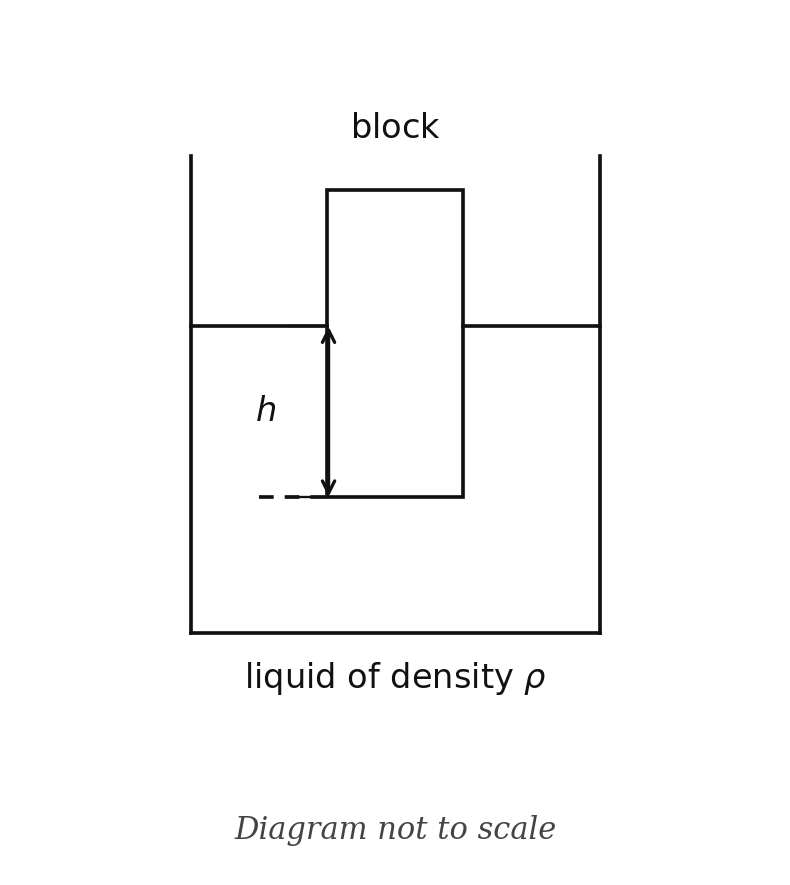
A solid block of uniform cross-sectional area A and mass m floats upright in a liquid of density ho , as shown in the diagram. The lower portion of the block is submerged to a depth h .
The liquid is then heated uniformly. The liquid expands so that its density ho decreases, while the thermal expansion of the solid block is negligible. The block remains floating upright.
Here are three statements about the system after the liquid is heated:
1 The submerged depth h of the block increases.
2 The upthrust (buoyant force) acting on the block decreases.
3 The liquid pressure acting on the bottom surface of the block remains unchanged.
Which of these statements is/are correct?
A.
none of them
B.
1 only
C.
2 only
D.
3 only
E.
1 and 2 only
F.
1 and 3 only
G.
2 and 3 only
H.
1, 2 and 3
Answer and solution
Answer: F
1 is correct: For a floating object in vertical equilibrium, the upward buoyant force equals the weight of the block: U=hogVsub=hogAh=mg . Rearranging gives h=ρAm . Because the liquid expands upon heating, its density ho decreases while m and A remain constant, so the submerged depth h increases.
2 is incorrect: Since the block is floating in equilibrium both before and after heating, the buoyant force must balance the downward gravitational force ( U=mg ). The mass of the block does not change, so the buoyant force remains constant.
3 is correct: The hydrostatic pressure due to the liquid at the bottom surface of the block is p=hogh . Substituting h=ρAm gives p=ρg(ρAm)=Amg . Since m , g , and A are all constant, this pressure remains unchanged.
▸Question 2
A radioisotope thermal generator uses a radioactive isotope P, which decays into a single stable isotope Q. The heat generated is proportional to the activity of the sample.
The fuel is initially pure isotope P, which has a half-life of 20 years. After 80 years of operation, what is the ratio of the number of atoms of Q to the number of atoms of P?
A.
1/16
B.
1/15
C.
7
D.
15/16
E.
15
F.
16
Answer and solution
Answer: E
The problem asks for the ratio of the number of atoms of Q ( NQ ) to the number of atoms of P ( NP ) after a certain time.
1. First, determine the number of half-lives that have elapsed. The time elapsed is 80 years, and the half-life is 20 years. Number of half-lives, n=half-lifetime elapsed=2080=4 .
2. Let the initial number of atoms of P be N0 . After n half-lives, the number of remaining atoms of P is given by:
NP=N0(21)n
For n=4 , the number of remaining P atoms is:
NP=N0(21)4=16N0
3. Since the sample was initially pure P, every atom of P that decays becomes an atom of the stable isotope Q. The number of atoms of Q is the initial number of P atoms minus the number of P atoms remaining.
NQ=N0−NP=N0−16N0=1615N0
4. The required ratio is NPNQ .
NPNQ=N0/1615N0/16=15
Therefore, the ratio of the number of atoms of Q to the number of atoms of P is 15.
▸Question 3
A continuous transverse wave travels at a constant speed of 12 m s−1 along a stretched string in the positive x -direction. The graph shows the displacement y of the string as a function of position x at time t=0 .
What is the total distance travelled by a particle of the string during a time interval of 0.50 s , and what is the distance travelled by the wave during this same time interval?
| | distance travelled by particle / m | distance travelled by wave / m | | :--- | :--- | :--- | | A | 0.45 | 6.0 | | B | 0.45 | 12.0 | | C | 0.90 | 6.0 | | D | 0.90 | 12.0 | | E | 1.8 | 6.0 | | F | 1.8 | 12.0 | | G | 3.6 | 6.0 | | H | 3.6 | 12.0 |
distance travelled by particle: 0.45 m; distance travelled by wave: 6.0 m
B.
distance travelled by particle: 0.45 m; distance travelled by wave: 12.0 m
C.
distance travelled by particle: 0.90 m; distance travelled by wave: 6.0 m
D.
distance travelled by particle: 0.90 m; distance travelled by wave: 12.0 m
E.
distance travelled by particle: 1.8 m; distance travelled by wave: 6.0 m
F.
distance travelled by particle: 1.8 m; distance travelled by wave: 12.0 m
G.
distance travelled by particle: 3.6 m; distance travelled by wave: 6.0 m
H.
distance travelled by particle: 3.6 m; distance travelled by wave: 12.0 m
Answer and solution
Answer: E
From the displacement–distance graph: 1. Amplitude A=3.0 cm=0.030 m . 2. Wavelength λ=0.40 m .
The frequency of the wave is: f=λv=0.40 m12 m s−1=30 Hz In a time interval of Δt=0.50 s , the number of complete oscillations made by each particle is: N=fΔt=30 s−1×0.50 s=15 During one complete oscillation, a particle moves from equilibrium to maximum displacement, through equilibrium to minimum displacement, and back to equilibrium, covering a total distance of: dcycle=4A=4×3.0 cm=12 cm=0.12 m Thus, the total distance travelled by a particle in 0.50 s is: dparticle=15×0.12 m=1.8 m The distance travelled by the wave in the same time interval is: dwave=vΔt=12 m s−1×0.50 s=6.0 m Therefore, row E is correct.
▸Question 4
An electric heater supplies energy at a constant rate of 400 W to a metal block of mass 3.0 kg. The specific heat capacity of the metal is 1000 J kg⁻¹ K⁻¹. The block loses heat to its surroundings at a constant rate of 100 W.
What is the time taken for the temperature of the block to increase by 20 K?
A.
120 s
B.
150 s
C.
200 s
D.
300 s
E.
600 s
Answer and solution
Answer: C
We first calculate the total thermal energy required to raise the temperature of the block by 20 K :
Q=mcΔT=3.0×1000×20=60000 J
The effective heating power is the input power minus the rate of heat loss to the surroundings:
Pnet=Pin−Ploss=400−100=300 W
The time taken is the total energy required divided by this net power:
t=PnetQ=30060000=200 s
▸Question 5
Spherical catalyst particles of radius r fall through a gaseous reactant mixture. The drag force F acting on a particle moving with velocity v is given by:
F=kr2v2
where k is a constant.
The mass of a particle is proportional to r3 . At the terminal velocity vt , the drag force is equal to the gravitational force.
Which of the following gives the relationship between vt and r ?
A.
vt∝r2
B.
vt∝r
C.
vt∝r
D.
vt∝r1
E.
vt∝r23
Answer and solution
Answer: C
At terminal velocity, the downward gravitational force ( W ) is balanced by the upward drag force ( F ).
The gravitational force is proportional to the mass, which scales with the volume of the sphere:
W∝m∝r3
The drag force is given as:
F=kr2vt2∝r2vt2
Equating the proportionalities ( W∝F ):
r3∝r2vt2
Dividing both sides by r2 :
r∝vt2
Taking the square root gives the final relationship:
vt∝r
▸Question 6
An astronaut of mass 100 kg is at rest in space. The astronaut throws a 4.0 kg tool,
which then moves at a speed of 5.0 m/s. What is the astronaut's recoil speed?
A.
0.05 m/s
B.
0.20 m/s
C.
1.0 m/s
D.
5.0 m/s
E.
20 m/s
F.
125 m/s
Answer and solution
Answer: B
The principle of conservation of linear momentum applies. The system consists of the astronaut and the tool.
Initially, both are at rest, so the total initial momentum of the system is zero.
pinitial=0
After the tool is thrown, the total final momentum must also be zero. Let ma and va be the mass and velocity of the astronaut, and mt and vt be the mass and velocity of the tool.
pfinal=mava+mtvt
By conservation of momentum, pinitial=pfinal :
0=mava+mtvt
We are looking for the recoil speed of the astronaut, which is the magnitude of va . Rearranging the equation for va :
va=−mamtvt
Now, we substitute the given values: ma=100kg , mt=4.0kg , and vt=5.0m/s . We can take the direction of the tool as positive.
va=−1004.0×5.0=−10020=−0.20m/s
The negative sign indicates that the astronaut moves in the opposite direction to the tool. The question asks for the recoil speed, which is the magnitude of the velocity.
The speed is ∣−0.20m/s∣=0.20m/s .
▸Question 7
A U-shaped magnet rests on an electronic balance. A rigid, horizontal straight wire of length 15 cm is clamped independently in a fixed position between the poles of the magnet, perpendicular to a uniform magnetic field of flux density 0.40 T .
A constant current is switched on in the wire such that a total charge of 45 C passes through the wire in 2.5 minutes . This current causes a vertically upward magnetic force to act on the wire.
What is the resulting change in the reading displayed by the balance?
(Take the acceleration of free fall to be g=10 m s−2 .)
A.
decrease of 0.18 g
B.
increase of 0.18 g
C.
decrease of 1.8 g
D.
increase of 1.8 g
E.
decrease of 18 g
F.
increase of 18 g
G.
decrease of 108 g
H.
increase of 108 g
Answer and solution
Answer: D
1. Calculate the current in the wire: Δt=2.5 minutes=2.5×60 s=150 sI=ΔtΔQ=150 s45 C=0.30 A 2. Calculate the magnetic force on the wire ( L=15 cm=0.15 m ): F=BIL=0.40 T×0.30 A×0.15 m=0.018 N 3. Determine the force on the balance using Newton's third law: The magnetic force on the wire acts vertically upwards. By Newton's third law, the wire exerts an equal and opposite downward force of 0.018 N on the magnet.
4. Calculate the change in the balance reading: Δm=gF=10 m s−20.018 N=0.0018 kg=1.8 g Since the additional force on the magnet is downwards, the balance reading increases by 1.8 g .
▸Question 8
A circuit is set up as shown. The battery has negligible internal resistance and all three resistors are identical.
<figure class="qg-diagram"><img src="https://bcbttpsokwoapjypwwwq.supabase.co/storage/v1/object/public/question-images/esat-camp-mocks/physics/mock-5-q8.png" alt="Circuit with battery, ammeter, open switch and three identical resistors" /></figure>
When the switch is open, the reading on the ammeter is 3.0 A and the power transferred from the battery is 18 W .
The switch is now closed.
What is the new reading on the ammeter and what is the new power transferred from the battery?
| | ammeter reading / A | power transferred / W | | :--- | :--- | :--- | | A | 1.5 | 18 | | B | 1.5 | 24 | | C | 2.0 | 12 | | D | 2.0 | 24 | | E | 2.0 | 36 | | F | 3.0 | 24 | | G | 3.0 | 27 | | H | 3.0 | 36 |
A.
ammeter reading: 1.5 A , power transferred: 18 W
B.
ammeter reading: 1.5 A , power transferred: 24 W
C.
ammeter reading: 2.0 A , power transferred: 12 W
D.
ammeter reading: 2.0 A , power transferred: 24 W
E.
ammeter reading: 2.0 A , power transferred: 36 W
F.
ammeter reading: 3.0 A , power transferred: 24 W
G.
ammeter reading: 3.0 A , power transferred: 27 W
H.
ammeter reading: 3.0 A , power transferred: 36 W
Answer and solution
Answer: D
1. When the switch is open: - The lower branch is disconnected, so the circuit consists of the main-line resistor in series with the top-branch resistor and the ammeter. - Total resistance: Ropen=R+R=2R . - Using the power formula P=VI : V=IopenPopen=3.0 A18 W=6.0 V - Using Ohm's law: 2R=IopenV=3.0 A6.0 V=2.0Ω⟹R=1.0Ω 2. When the switch is closed: - The two parallel branches each have a resistance of R=1.0Ω . - Their combined equivalent resistance is: Rp=1.0+1.01.0×1.0=0.5Ω - The total resistance of the circuit becomes: Rclosed=R+Rp=1.0+0.5=1.5Ω - The total current drawn from the battery is: Itotal=RclosedV=1.5Ω6.0 V=4.0 A - The new power transferred from the battery is: Pnew=VItotal=6.0 V×4.0 A=24 W - The total current of 4.0 A splits equally between the two identical parallel branches, so the current through the ammeter is: Iammeter=24.0 A=2.0 A Therefore, the new ammeter reading is 2.0 A and the new power transferred is 24 W (Option D).
▸Question 9
The graph shown of quantity y against quantity x represents a physical relationship, where both quantities are measured in their standard SI units.
Which two of the following relationships could this graph represent?
1 momentum against velocity for an object of mass 6.0 kg 2 kinetic energy against velocity for an object of mass 12 kg 3 electrical energy transferred against charge transferred across a component with a constant potential difference of 6.0 V 4 tension against extension for a system of two identical springs connected in series, each having a spring constant of 6.0 N m−1
A.
1 and 2
B.
1 and 3
C.
1 and 4
D.
2 and 3
E.
2 and 4
F.
3 and 4
Answer and solution
Answer: B
From the graph, y is directly proportional to x (a straight line passing through the origin (0,0) ). The gradient of the line is: gradient=2.0−012.0−0=6.0 SI units Let us analyse each statement:
1. Momentum p=mv . If y=p and x=v , then y=6.0x . This is a straight line through the origin with gradient 6.0 kg . This matches the graph. (Statement 1 is correct)
2. Kinetic energy Ek=21mv2=21(12)v2=6.0v2 . A plot of Ek against v is a parabola ( y=6.0x2 ), not a straight line. (Statement 2 is incorrect)
3. Electrical energy transferred ΔE=VΔQ . If y=ΔE and x=ΔQ , then y=6.0x . This is a straight line through the origin with gradient 6.0 V=6.0 J C−1 . This matches the graph. (Statement 3 is correct)
4. For two identical springs of spring constant k=6.0 N m−1 connected in series, the effective spring constant is: keff1=6.01+6.01=6.02⟹keff=3.0 N m−1 Tension is T=keffx=3.0x . The gradient would be 3.0 N m−1 , not 6.0 N m−1 . (Statement 4 is incorrect)
Therefore, the graph can represent relationships 1 and 3.
▸Question 10
A drone travels in a straight line between two points separated by a total distance of 800 m .
For the first distance d , it travels at a constant speed of 10 m s−1 . For the remainder of the journey, it travels at a constant speed of 25 m s−1 .
The average speed for the entire journey is 16 m s−1 .
What is the value of d ?
A.
200 m
B.
250 m
C.
300 m
D.
400 m
E.
500 m
F.
600 m
Answer and solution
Answer: C
Average speed is given by: average speed=total timetotal distance The total time for the journey is: T=16 m s−1800 m=50 s The time taken for the first segment of distance d is: t1=10d The time taken for the remainder of the journey of distance (800−d) is: t2=25800−d Since t1+t2=T : 10d+25800−d=50 Multiplying the entire equation by 50 : 5d+2(800−d)=25005d+1600−2d=25003d=900d=300 m
▸Question 11
An air bubble rises through water of constant temperature. A graph of the reciprocal of the bubble's volume, 1/V , against its depth, h , is a straight line as shown.What is the atmospheric pressure at the surface of the water?
(Use: density of water, ρ=1000kgm−3 ; gravitational field strength, g=10Nkg−1 )
A.
1.0×10⁵Pa
B.
2.0×10⁴Pa
C.
5.0×10⁴Pa
D.
2.0×10⁵Pa
E.
1.0×10⁴Pa
F.
5.0×10⁵Pa
Answer and solution
Answer: A
At constant temperature, Boyle's Law states that for a fixed mass of gas, pressure P is inversely proportional to volume V , so PV=k (a constant). This can be written as 1/V=P/k .
The total pressure P on the bubble at a depth h is the sum of atmospheric pressure Patm and the hydrostatic pressure ρgh . So, P=Patm+ρgh .
Substituting this into the Boyle's Law relation gives:
V1=kPatm+ρgh=(kρg)h+kPatm
This is an equation of a straight line y=mx+c , where y=1/V and x=h . The graph confirms this linear relationship.
From the graph, we can find the equation of the line. It passes through (0,2.0) and (10,4.0) . The y -intercept is c=2.0units . The gradient is m=ΔhΔ(1/V)=10−04.0−2.0=102.0=0.2units/m .
The equation of the line is 1/V=0.2h+2.0 .
To find the atmospheric pressure, we can find the theoretical depth hint at which the total pressure would be zero. This corresponds to the h -intercept of the graph (where 1/V=0 ).
Setting 1/V=0 : 0=0.2hint+2.00.2hint=−2.0hint=−10m From the physical relationship P=Patm+ρgh , if the total pressure P were zero, we would have: 0=Patm+ρghintPatm=−ρghint Substituting the values: Patm=−(1000kgm−3)×(10Nkg−1)×(−10m)Patm=1000×10×10Pa=100000Pa=1.0×10⁵Pa .
▸Question 12
An LDR and a 3.0kΩ resistor are connected in series across a 12V supply, as shown. A control unit switches on when the voltage across the fixed resistor exceeds 8.0V . The control unit draws negligible current.
At what LDR resistance is the voltage exactly 8.0V , and which change will then switch the control unit on?
A.
1.5kΩ ; increasing light intensity
B.
1.5kΩ ; decreasing light intensity
C.
2.0kΩ ; increasing light intensity
D.
6.0kΩ ; increasing light intensity
E.
6.0kΩ ; decreasing light intensity
Answer and solution
Answer: A
The fixed resistor has 8.0V , leaving 4.0V across the LDR. Their current is the same, so RLDR/3.0=4.0/8.0 , giving 1.5kΩ . More light reduces the LDR resistance, increasing current and the fixed-resistor voltage.
▸Question 13
A student performs a calorimetry experiment using a shiny copper beaker containing hot water. To improve the accuracy of the enthalpy change determination, the student considers several modifications to reduce heat loss to the surroundings.
Which of the following modifications would be counter-productive (i.e., would increase the rate of heat loss)?
A.
Coating the outer surface of the beaker with a thin layer of dull black paint
B.
Polishing the outer surface of the beaker to a mirror finish
C.
Placing a plastic lid on top of the beaker
D.
Placing the beaker on a cork mat
E.
Wrapping the sides of the beaker in mineral wool
Answer and solution
Answer: A
The rate of heat loss depends on three mechanisms: conduction, convection, and radiation.
1. Conduction and Convection: Wrapping the beaker in mineral wool (E), placing it on a cork mat (D), and adding a lid (C) all serve to insulate the beaker or prevent air currents/evaporation, thereby reducing heat loss. 2. Radiation: The rate of thermal radiation emission depends on the emissivity of the surface. Shiny metallic surfaces have very low emissivity (they are poor emitters). Dull, black surfaces have high emissivity (they are good emitters).
Therefore, coating the shiny copper beaker with dull black paint (A) increases its emissivity, which increases the rate of heat loss by radiation. Polishing the beaker (B) would decrease emissivity and help retain heat. Thus, A is the counter-productive modification.
▸Question 14
A spring has an original length of 10.0cm . It is stretched beyond its elastic limit. The graph shows the force as the spring is then unloaded.
What is the spring's length when the force has fallen to 2.0N , and what is its permanent increase in length after complete unloading?
A.
11.0cm ; 2.0cm
B.
13.0cm ; zero
C.
13.0cm ; 2.0cm
D.
14.0cm ; 2.0cm
E.
16.0cm ; 6.0cm
Answer and solution
Answer: C
At 2.0N , the graph gives an extension of 3.0cm relative to the original length, so the length is 13.0cm . When the force reaches zero, 2.0cm of extension remains permanently.
▸Question 15
A pure substance is heated at constant power. The graph shows its temperature. During the horizontal section, solid and liquid are both present. Energy losses are negligible.
Which statement is correct during this horizontal section?
A.
The average kinetic energy of its particles stays constant while their potential energy increases.
B.
The average kinetic energy of its particles increases while their potential energy stays constant.
C.
No energy is transferred to the substance.
D.
Both the average kinetic energy and potential energy of its particles decrease.
E.
The particles stop moving until melting is complete.
Answer and solution
Answer: A
The constant temperature means that average particle kinetic energy is unchanged. Energy is still supplied and is used to change the arrangement and separation of particles during melting, increasing their potential energy.
▸Question 16
Two identical, inverted test tubes, X and Y, contain trapped air. Tube X has a total mass mX and tube Y has a total mass mY , where mX>mY .
Both tubes are submerged in water and come to rest, neutrally buoyant, at depths hX and hY respectively.
The temperature is constant throughout.
Which statement correctly compares the depths hX and hY ?
A.
hX<hY
B.
hX>hY
C.
hX=hY
D.
The relationship depends on the specific ratio mX/mY .
E.
The relationship depends on the value of atmospheric pressure.
F.
There is not enough information to determine the relationship.
Answer and solution
Answer: A
The solution is a chain of five logical steps:
1. Equilibrium Condition: For an object to be neutrally buoyant, its weight must be equal to the buoyant force acting on it. Let W be weight and FB be buoyant force. So, WX=FBX and WY=FBY .
2. Mass and Buoyant Force: The weight of each tube is W=mg . Since we are given mX>mY , it follows that WX>WY . Therefore, for equilibrium, the buoyant force on X must be greater than the buoyant force on Y: FBX>FBY .
3. Buoyant Force and Volume: The buoyant force is given by Archimedes' principle: FB=ρVg , where ρ is the density of the water and V is the volume of displaced water. In this case, the displaced volume is the volume of the trapped air ( Vgas ). Since FBX>FBY , it must be that the volume of trapped air in X is greater than in Y: VX>VY .
4. Volume and Pressure (Boyle's Law): The temperature is constant, so Boyle's Law ( P∝1/V or PV=constant ) applies to the trapped air. Since both tubes initially trapped the same amount of air, the constant is the same for both. As VX>VY , the pressure of the gas in tube X must be lower than the pressure in tube Y: PX<PY .
5. Pressure and Depth: The total pressure on the trapped gas at depth h is the sum of atmospheric pressure Patm and the hydrostatic pressure ρgh . So, P=Patm+ρgh . Since PX<PY , we have Patm+ρghX<Patm+ρghY . This simplifies to ρghX<ρghY , which means hX<hY .
Therefore, the heavier tube X comes to rest at a shallower depth than the lighter tube Y.
▸Question 17
A resistor of constant resistance dissipates 36 W when the potential difference across it is 12 V . The potential difference is changed to 8 V . What is the power dissipated by the resistor at this new potential difference?
A.
16 W
B.
24 W
C.
36 W
D.
54 W
E.
81 W
Answer and solution
Answer: A
The power dissipated by a resistor is given by P=RV2 .
Since the resistance R is constant, the power is proportional to the square of the potential difference:
P∝V2
The ratio of the new voltage to the old voltage is:
VoldVnew=128=32
Therefore, the new power Pnew is:
Pnew=Pold×(32)2=36×94=16 W
▸Question 18
A straight horizontal metal rod lies in the plane of the page in a uniform magnetic field directed into the page. The rod is moved without rotating.
Consider these motions:
1. vertically upwards in the plane of the page; 2. horizontally to the right, along the rod's own length; 3. directly into the page, parallel to the magnetic field.
For which motions is a voltage induced between the two ends of the rod?
A.
1 only
B.
2 only
C.
3 only
D.
1 and 2 only
E.
all three
Answer and solution
Answer: A
In motion 1 the rod cuts field lines so that opposite charges are separated towards its two ends. Moving along its own length does not produce end-to-end charge separation. Moving parallel to the field does not cut the field lines. Only motion 1 gives an end-to-end induced voltage.
▸Question 19
An object of constant mass m is in motion. A graph of its kinetic energy against the square of its momentum ( p2 ) is plotted.
The graph is a straight line passing through the origin with gradient G .
What is the mass m of the object in terms of G ?
A.
2G1
B.
G1
C.
2G
D.
2G
E.
G2
F.
G
Answer and solution
Answer: A
The relationship between kinetic energy ( KE ), momentum ( p ), and mass ( m ) is given by the formula:
KE=2mp2
This equation can be rearranged to highlight the relationship between KE and p2 :
KE=(2m1)p2
The question states that a graph of KE (on the y-axis) against p2 (on the x-axis) is a straight line with gradient G . The equation of a straight line through the origin is y=Gx .
By comparing the two equations, we can identify the corresponding terms: - y corresponds to KE . - x corresponds to p2 . - The gradient G corresponds to the coefficient of p2 .
Therefore, we can equate the gradient G with the term in the brackets:
G=2m1
The question asks for the mass m in terms of G . We need to rearrange this equation to make m the subject:
2mG=1
m=2G1
Thus, the correct option is A.
▸Question 20
A source and detector monitor the thickness of a continuous sheet of paper. The source must work for several years without a large correction for radioactive decay. Alpha radiation is completely stopped by the paper; beta radiation is partly absorbed; gamma radiation is hardly affected by changes in the paper's thickness.
Which source is most suitable, and what happens to the detector count rate if the sheet becomes thinner?
A.
alpha, half-life 20 years; decreases
B.
beta, half-life 2 hours; increases
C.
beta, half-life 20 years; increases
D.
beta, half-life 20 years; decreases
E.
gamma, half-life 20 years; increases strongly
Answer and solution
Answer: C
Beta radiation is sensitive to the relevant thickness changes. A long half-life avoids rapid changes in source output. A thinner sheet absorbs fewer beta particles, so the detected count rate increases.
▸Question 21
A wave travels from medium P to medium Q. In medium P, the wave speed is 400 m/s and the wavelength is 0.60 m . In medium Q, the wave speed is 1200 m/s .
What is the wavelength of the wave in medium Q?
A.
0.20 m
B.
0.60 m
C.
1.80 m
D.
5.40 m
Answer and solution
Answer: C
The frequency f of a wave is determined by the source and remains constant when the wave crosses a boundary between two media.
The relationship between wave speed v , frequency f , and wavelength λ is given by:
v=fλ
Since f is constant, the wavelength is directly proportional to the speed ( λ∝v ).
We calculate the ratio of the speeds:
vPvQ=4001200=3
Therefore, the wavelength in medium Q is:
λQ=3×λP=3×0.60=1.80 m
▸Question 22
A particle is projected vertically upwards on a planet. In the absence of an atmosphere, the particle would reach a maximum height H0 .
In the presence of an atmosphere, the particle experiences a constant resistive force of magnitude 41 of its weight.
Which expression gives the maximum height H reached by the particle in the presence of the atmosphere?
A.
43H0
B.
54H0
C.
H0
D.
45H0
E.
34H0
Answer and solution
Answer: B
Let the mass be m and the initial speed be u .
Case 1: No atmosphere (Vacuum) Conservation of mechanical energy applies. The initial kinetic energy is converted entirely to gravitational potential energy:
21mu2=mgH0
Case 2: With atmosphere The initial kinetic energy is converted into gravitational potential energy and work done against the resistive force FR . The resistive force is FR=41mg . The work done against resistance acts over the *actual* distance travelled, H :
Work done=FR×H=41mgH
The energy balance equation is:
21mu2=mgH+41mgH
Substituting 21mu2=mgH0 :
mgH0=mgH(1+41)=45mgH
H0=45H⟹H=54H0
▸Question 23
Paint droplets are given a negative charge before being sprayed towards a positively charged metal panel. The droplets stick to the panel and transfer their excess electrons to it.
The panel is kept at a constant positive charge by an electrical connection. Which row describes the electric force between two droplets and the electron transfer needed through the connection?
A.
droplets attract; electrons enter the panel
B.
droplets attract; electrons leave the panel
C.
droplets repel; electrons enter the panel
D.
no force between droplets; no electron transfer
E.
droplets repel; electrons leave the panel
Answer and solution
Answer: E
The negatively charged droplets repel one another. They deliver excess electrons to the panel, reducing its positive charge. Electrons must therefore leave through the connection to maintain the panel's positive charge.
▸Question 24
A magnet is moved along the axis of a stationary coil. Moving its north pole towards the coil gives a positive voltage at the voltmeter.
In a second experiment, its south pole is moved towards the coil, held stationary for a short time, and then moved away. The voltmeter connections are unchanged.
Which sequence describes the signs of the voltages during these three stages?
A.
negative, zero, positive
B.
positive, zero, negative
C.
negative, negative, positive
D.
positive, zero, positive
E.
negative, zero, negative
Answer and solution
Answer: A
Changing the approaching pole reverses the voltage, so the first stage is negative. A stationary magnet gives no changing field and hence zero voltage. Reversing its motion reverses the voltage again, giving positive.
▸Question 25
A light ray crosses a boundary from material X into material Y. The angles marked on the diagram are measured between the ray and the boundary.
Which statement correctly compares the wave in Y with the wave in X?
A.
lower speed, lower frequency
B.
lower speed, same frequency
C.
higher speed, same frequency
D.
higher speed, higher frequency
E.
same speed, same frequency
Answer and solution
Answer: B
The angles to the normal are 90∘−35∘=55∘ in X and 90∘−60∘=30∘ in Y. The ray bends towards the normal, so its speed decreases. Its frequency is unchanged at the boundary.
▸Question 26
A non-linear electrical component X has the current–potential difference ( I−V ) characteristic shown in the graph below.
Two identical components of type X are connected in parallel with each other. This parallel combination is connected in series with a 3.0Ω resistor and an ideal d.c. power supply of electromotive force (EMF) 9.0 V with negligible internal resistance.
What is the total power dissipated in the entire circuit?
A.
3.0 W
B.
6.0 W
C.
9.0 W
D.
12 W
E.
15 W
F.
18 W
G.
24 W
H.
27 W
Answer and solution
Answer: F
Let VX be the potential difference across the parallel combination of the two identical components, and let IX be the current passing through each component.
Because the two components are identical and connected in parallel, each has potential difference VX across it, and each carries current IX . The total current delivered by the power supply to the circuit is therefore: Itotal=2IX By Kirchhoff's voltage law around the circuit loop: E=VX+VR9.0=VX+ItotalR9.0=VX+(2IX)(3.0)VX=9.0−6.0IX We find the operating point (VX,IX) that satisfies both this linear equation and the given I−V characteristic curve: - If IX=1.0 A , then VX=9.0−6.0(1.0)=3.0 V . - Reading the graph at V=3.0 V , the current is indeed I=1.0 A .
Thus, under operating conditions: - Current through each component: IX=1.0 A - Total circuit current: Itotal=2.0 A The total power dissipated in the entire circuit is equal to the total power supplied by the battery: Ptotal=E×Itotal=9.0 V×2.0 A=18 W Alternatively, sum the powers in each component: - Power in resistor: PR=Itotal2R=(2.0)2×3.0=12 W - Power in each component: PX=VXIX=3.0 V×1.0 A=3.0 W - Total power: Ptotal=12 W+3.0 W+3.0 W=18 W
▸Question 27
A stationary sound source emits a continuous note of frequency 3300Hz . A stationary observer is positioned some distance away from the source.
A wind blows directly from the source to the observer at a constant speed of 30m/s . The speed of sound in still air is 330m/s .
What is the frequency of the sound detected by the observer?
A.
3000Hz
B.
3025Hz
C.
3300Hz
D.
3600Hz
E.
3630Hz
Answer and solution
Answer: D
The question requires careful application of the wave equation v=fλ in the correct frame of reference.
1. The source emits sound at a frequency fs=3300Hz . This is the rate at which wave crests are produced, and it does not change.
2. The sound propagates through the air. The speed of sound relative to the air is vair=330m/s . The wavelength of the sound waves in the air is determined by the source frequency and this speed:
λ=fsvair=3300Hz330m/s=0.1m
3. The air itself (the medium) is moving from the source to the observer at vwind=30m/s . For the stationary observer on the ground, the effective speed of the sound waves is the sum of the speed of sound in air and the speed of the wind.
veff=vair+vwind=330m/s+30m/s=360m/s
4. The observer detects waves with wavelength λ=0.1m arriving at this effective speed veff . The observed frequency fobs is therefore: