Test day
ESAT Test Day: Pearson VUE Rules, Breaks & Whiteboard
Our students sat the ESAT at Pearson VUE Oxford in 2024 and 2025. The academic part was stressful; the test-centre process itself was fine.
Last checked against UAT-UK: . Official UAT-UK rules below were re-checked on this date. Arrival, security and desk details from my 2025 Oxford sitting may differ by centre or cycle.
Written by Anson Chan
Between modules
Use that minute to rest. Do not turn it into another minute of work.
What happens when you arrive at Pearson VUE?
I was pretty nervous when I arrived.
At the counter I used my passport as ID. There were lockers for everything you were not allowed to take into the testing room.
Current UAT-UK guidance says candidates should arrive 30 minutes before their scheduled sitting, present accepted photographic ID and their Pearson appointment confirmation. Personal belongings are then left outside the testing room.
You do not need to bring paper, pens or other exam stationery.
You cannot use them anyway.
Are you searched before the ESAT?
Right before entering the testing area, I went through the security process.
I had to go through a security scan and briefly take my glasses off for inspection.
It feels quite serious when you are already nervous, but it was quick.
UAT-UK currently warns that candidates may have to pass through a security scan or security wand and that staff perform a visual inspection before admission to the room.
So do not be surprised by it.
What is the ESAT testing room like?
Once inside, everything was good.
I had the computer, the ESAT interface, an A4 erasable booklet, a black marker, wet wipes and earplugs.
Staff monitored candidates from behind the testing area. I did not find it distracting.
Pearson's own Professional Center tour shows the same general setup of testing stations, lockers and a monitored proctor area, although individual centres vary.
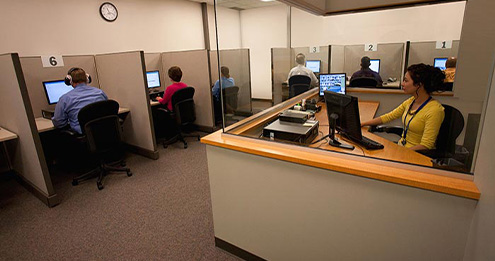
Official source
Example Pearson Professional Center testing room
Individual centres vary. This is not a photograph of the Oxford St Aldates room.
Open the Pearson Professional Center TourAt my desk
- Computer and ESAT interface
- A4 erasable booklet
- Black marker
- Wet wipes
- Earplugs
You do not have to panic-start
One thing I appreciated was that once I was at the computer, I did not feel like somebody was standing over me forcing me to start immediately.
At my sitting, I could settle myself and start when I was ready after reaching the relevant pre-test screens.
So when you sit down, get comfortable.
Check your marker. Put the booklet somewhere sensible. Get the mouse where you want it. Then begin.
The ESAT whiteboard booklet
My booklet was roughly A4 and had around 10 double-sided sheets.
One side was gridded and one side was plain.
I barely used the grid.
The marker was black and fine enough for normal calculations, although the ink could smudge underneath my writing hand. By the end my palm was black.
I was also given wet wipes, presumably for cleaning the booklet.
The important thing is that you do not need to ration the booklet as aggressively as I did.
Current UAT-UK guidance says you can raise your hand and request replacement sheets during your test.
If your marker is bad, ask for another one too.
Full first-hand detail: what the ESAT whiteboard is actually like.
Are there breaks during the ESAT?
There is no scheduled break between standard ESAT modules. A three-module test is 120 minutes back-to-back. A toilet trip is not a free break unless you have approved pause-the-clock arrangements.
| Question | Standard sitting |
|---|---|
| Scheduled module break | No |
| Standard module length | 40 minutes |
| Three-module testing time | 120 minutes |
| Toilet break | Allowed, but the clock generally continues unless approved pause-the-clock arrangements apply |
| Access arrangements | Arrange in advance through UAT-UK |
You can raise your hand and ask to use the toilet. Your test time normally continues. Some candidates can receive approved access arrangements, including rest or pause-the-clock arrangements where eligible. These need to be arranged in advance, not on the day.
- Use the toilet before entering.
- Do a few full-length 120-minute sessions without getting up.
- Avoid arriving dehydrated or after a huge meal.
What happens between ESAT modules?
There is no proper scheduled break between standard modules.
UAT-UK explicitly says there are no breaks between modules or papers.
In my 2025 sitting, after finishing a module I reached a screen asking whether I was ready for the next session.
There was a roughly one-minute countdown.
There was also a button to continue early. If I did nothing, the next module would start when the countdown expired.
That minute is more useful than it sounds.
- Take your hands off the mouse
- Relax your eyes
- Breathe
- Reset mentally
- Forget the previous module
What I would not do
In my 2025 sitting, there was roughly a one-minute transition screen between modules. I would use that minute to rest, not to erase working. Asking for another booklet is much faster than cleaning pages.
Can you drink water during the ESAT?
There was no designated water break.
Water was not sitting next to me during the test. When I wanted water, I had to step outside the testing room.
That matches the current UAT-UK rule that water is not permitted inside the test room without an approved reason.
At my centre, staff were helpful about letting me step outside.
But do not plan your test around getting a nice water break between modules. It is not part of the standard test format.
Use the toilet and drink beforehand.
Is the room distracting?
Mine wasn't.
The desk and computer setup were completely fine and the monitoring did not bother me.
I was given earplugs, which were actually useful.
Pearson test centres are designed so candidates can be monitored throughout the examination, and UAT-UK also warns that candidates may be recorded.
After the first few minutes, I stopped thinking about it.
The five things I wish I knew
1. Do not bring stationery
Your own paper and pens cannot go into the room. Leave them at home.
2. Check your marker
Do this before starting. If it is faint or running out, ask for another one.
3. Ask for more booklet space
Do not spend valuable time erasing pages just because you think you need to preserve the same booklet.
4. Use the between-module minute to rest
You have just done 40 minutes of intense problem solving. Give your brain the minute.
5. The test centre is not the scary part
I was extremely nervous going in, but once I was at the computer the physical setup was completely fine. Most of your preparation should still go into doing questions accurately under time pressure.
Experience note
This article combines current UAT-UK rules with first-hand experience from sitting the ESAT at Pearson VUE Oxford in 2025. The experience was also compared informally with friends who sat the test.
This page separates my experience from current UAT-UK rules because individual Pearson VUE centres and future test cycles can differ.
Frequently asked questions
What ID do I need for the ESAT?
I used my passport. Current UAT-UK rules accept specified forms of original, valid photographic government ID, so check the current ID policy rather than assuming you specifically need a passport.
Are there lockers at Pearson VUE?
There were lockers at the Oxford centre I used. UAT-UK says personal belongings are left outside the testing room, and Pearson's own test-centre documentation shows lockable storage as part of its Professional Center setup.
Are you searched before the ESAT?
I went through a security scan and had my glasses inspected. Current UAT-UK guidance says candidates may be scanned and will undergo a visual inspection.
Is there a break between ESAT modules?
There is no scheduled break. In my 2025 sitting there was a short transition countdown before the next module, but that is not the same thing as a normal break. Current UAT-UK guidance explicitly says there are no breaks between modules or papers.
Can you take water into the ESAT?
Normally, no. Current UAT-UK rules say water is not permitted inside the testing room without prior approval. I had to step outside when I wanted water.
What rough paper do you get in the ESAT?
I received an A4 reusable booklet with around 10 double-sided sheets, a black marker and wet wipes. Exact centre equipment may differ. UAT-UK officially describes the provided material as an erasable notebook or sheets and a pen.
Practise the conditions, not just the content
Pacing under a 40-minute clock matters more than memorising the test-centre layout. A timed diagnostic is the quickest way to see whether your pacing plan survives contact with the clock.
Related guides
ESAT whiteboard rules
What our students got for rough working, marker smudging and replacements.
ESAT calculator rules
Calculators are not permitted. Here's what you can use for working.
ESAT preparation guide
A practical 3-week plan: calibration, past papers, mocks and targeted revision.
ESAT mock tests
Timed ESAT-style practice with official NSAA and ENGAA past papers.
ESAT test dates
October 2026 and January 2027 sittings, deadlines and results dates.
Free ESAT diagnostic test
A short Maths 1 calibration that shows whether speed or accuracy is the issue.
Sources
ESATCAMP is an independent preparation resource and is not affiliated with or endorsed by UAT-UK, Pearson VUE or any university.