A sample of element \ceX consists of only three isotopes: \ce68X , \ce70X , and \ce72X . The relative atomic mass ( Ar ) of \ceX in this sample is 70.2 .
The sum of the percentage abundances must equal 100% : x+30+y=100⟹x=70−y The relative atomic mass is given by the weighted average: Ar=10068x+70(30)+72y=70.2 Substitute x=70−y into the equation: 68(70−y)+2100+72y=70204760−68y+2100+72y=70206860+4y=70204y=160y=40 Therefore, the percentage abundance of \ce72X is 40% .
▸Question 2
Magnesium is an element in Group 2 of the Periodic Table.
Which of the following statements is/are correct about magnesium?
1 Magnesium is a stronger reducing agent than calcium.
2 Magnesium has a smaller atomic radius than calcium.
3 Magnesium reacts with nitrogen gas to form a compound containing 72% magnesium by mass.
( Ar values: \ceN=14; \ceMg=24; \ceCa=40 )
A.
none of them
B.
1 only
C.
2 only
D.
3 only
E.
1 and 2 only
F.
1 and 3 only
G.
2 and 3 only
H.
1, 2 and 3
Answer and solution
Answer: G
Statement 1 is incorrect: Group 2 metals act as reducing agents by losing their two outer valence electrons ( \ceM−>M2++2e− ). Down Group 2, atomic radius and electron shielding increase, lowering the first and second ionisation energies. Consequently, reactivity and reducing power increase down the group, so calcium is a stronger reducing agent than magnesium.
Statement 2 is correct: Magnesium is in Period 3 (three electron shells), whereas calcium is in Period 4 (four electron shells). The additional quantum shell of electrons and increased shielding down the group make the atomic radius of magnesium smaller than that of calcium.
Statement 3 is correct: Magnesium forms \ceMg2+ ions and nitrogen forms \ceN3− ions, giving the empirical formula \ceMg3N2 for magnesium nitride. Molar mass of \ceMg3N2=(3×24)+(2×14)=72+28=100 g mol−1Percentage by mass of \ceMg=10072×100%=72% Therefore, only statements 2 and 3 are correct.
▸Question 3
The skeletal formula of an organic compound is shown below.
What is the empirical formula of this compound?
A.
\ceC5H7O2
B.
\ceC10H14O4
C.
\ceC5H6O2
D.
\ceC5H8O2
E.
\ceC4H7O2
F.
\ceC2H3O
Answer and solution
Answer: A
To find the empirical formula, first determine the molecular formula by counting all atoms in the structure:
1. Carbon atoms: - The six-membered ring contains 6 carbon atoms. - There are 2 ester carbonyl carbons and 2 ester methyl carbons ( 2×2=4 carbons). - Total carbon atoms = 6+4=10 .
2. Hydrogen atoms: - In the ring: the two \ceC=C double-bond carbons each have 1 hydrogen ( 2×1=2 ); the two \ceCH2 carbons each have 2 hydrogens ( 2×2=4 ); the two \ceCH carbons bonded to the ester groups each have 1 hydrogen ( 2×1=2 ). Total ring hydrogens = 2+4+2=8 . - In the two methyl ester groups: each \ce−CH3 has 3 hydrogens ( 2×3=6 ). - Total hydrogen atoms = 8+6=14 .
3. Oxygen atoms: - Each ester group contains 2 oxygen atoms ( 2×2=4 ). - Total oxygen atoms = 4.
The molecular formula is \ceC10H14O4 .
Dividing all subscripts by their greatest common divisor (2) gives the simplest whole-number ratio (the empirical formula): \ceC5H7O2
▸Question 4
After water vapour and carbon dioxide have been removed, liquefied air contains mainly nitrogen, argon and oxygen. Their boiling points are shown.
As the liquid is warmed slowly, in which order are the gases collected first to last?
The component with the lowest boiling point vaporises first: nitrogen ( −196∘C ), then argon ( −186∘C ), then oxygen ( −183∘C ).
▸Question 5
Two experiments were carried out using separate samples of an aqueous solution of an unknown base \ceB of concentration 0.150 mol dm−3 ( 11.1 g dm−3 ), and the following observations were made:
* 20.0 cm3 of the base solution was completely neutralised by 30.0 cm3 of 0.200 mol dm−3 hydrochloric acid, \ceHCl(aq) . * A pale blue precipitate formed when a few drops of aqueous copper(II) sulfate, \ceCuSO4(aq) , were added to a portion of the base solution.
Which of the following statements can be deduced from this information?
1. One mole of the base reacts with two moles of \ceH+ ions in complete neutralisation.
2. The base is fully dissociated in aqueous solution.
3. The relative formula mass ( Mr ) of the base is 74 .
( Ar values are not required)
A.
none of them
B.
1 only
C.
2 only
D.
3 only
E.
1 and 2 only
F.
1 and 3 only
G.
2 and 3 only
H.
1, 2 and 3
Answer and solution
Answer: F
To evaluate each statement:
1. Statement 1 is correct: - Moles of base \ceB=0.150 mol dm−3×0.0200 dm3=0.00300 mol . - Moles of \ceHCl=0.200 mol dm−3×0.0300 dm3=0.00600 mol . - Ratio of moles of \ceHCl to base is 0.003000.00600=2:1 . - Since each \ceHCl supplies one \ceH+ ion, 1 mol of the base reacts with 2 mol of \ceH+ .
2. Statement 2 is incorrect: - Titration measures the total capacity to neutralise acid, not the degree of dissociation (strength). Weak bases also react completely with strong acids in stoichiometric proportions. Furthermore, the precipitation of copper(II) hydroxide, \ceCu(OH)2(s) , only indicates the presence of \ceOH− ions, which occur in solutions of both weak and strong bases. Thus, full dissociation cannot be deduced.
3. Statement 3 is correct: - Mr=molar concentrationmass concentration=0.150 mol dm−311.1 g dm−3=74 .
Therefore, statements 1 and 3 only can be deduced.
▸Question 6
What are the oxidation states of sulfur in SO2 and SO42− , respectively?
A.
+2 and +4
B.
+4 and +6
C.
+4 and +4
D.
+6 and +4
E.
−4 and −6
F.
0 and +6
Answer and solution
Answer: B
Oxygen has oxidation state −2 . In SO2 , sulfur plus two oxygens must sum to 0, so sulfur is +4 . In SO42− , sulfur plus four oxygens must sum to −2 , so sulfur is +6 . The correct option is B.
▸Question 7
Which particle diagram best represents a liquid? The particles are shown at one instant and are not drawn to scale.
A.
A
B.
B
C.
C
D.
D
Answer and solution
Answer: B
A liquid has particles close together but in a disordered arrangement, able to move past one another. Diagram B matches this.
▸Question 8
Pollutant P is formed when a carbon-containing fuel burns with insufficient oxygen. Pollutant Q can form inside a hot car engine when nitrogen and oxygen from the air react.
Which pair correctly identifies P and Q?
A.
P: carbon monoxide; Q: nitrogen oxides
B.
P: carbon dioxide; Q: sulfur dioxide
C.
P: sulfur dioxide; Q: carbon monoxide
D.
P: nitrogen oxides; Q: carbon dioxide
E.
P: methane; Q: carbon monoxide
Answer and solution
Answer: A
Incomplete combustion can form carbon monoxide. High engine temperatures can produce nitrogen oxides from nitrogen and oxygen in air.
▸Question 9
A diol reacts with an excess of propanoic acid in the presence of an acid catalyst to form a diester.
The diester has a relative molecular mass ( Mr ) of 174.
What is the relative molecular mass ( Mr ) of the diol?
( Ar values: \ceH=1.0 ; \ceC=12.0 ; \ceO=16.0 )
A.
26
B.
44
C.
62
D.
76
E.
90
F.
100
G.
118
H.
136
Answer and solution
Answer: C
Propanoic acid has the formula \ceC2H5COOH (or \ceC3H6O2 ): Mr(propanoic acid)=(3×12.0)+(6×1.0)+(2×16.0)=36.0+6.0+32.0=74.0 Water ( \ceH2O ) has: Mr(\ceH2O)=(2×1.0)+16.0=18.0 A diol contains two −\ceOH groups, so complete esterification with excess propanoic acid requires 2 moles of propanoic acid and produces 1 mole of diester and 2 moles of water: diol+2\ceC2H5COOH→diester+2\ceH2O Applying conservation of relative molecular mass: Mr(diol)+2×Mr(propanoic acid)=Mr(diester)+2×Mr(\ceH2O)Mr(diol)+2(74.0)=174.0+2(18.0)Mr(diol)+148.0=174.0+36.0=210.0Mr(diol)=210.0−148.0=62.0 (This corresponds to ethane-1,2-diol, \ceHOCH2CH2OH , which has Mr=(2×12)+(6×1)+(2×16)=62 ).
▸Question 10
Researchers intend to isolate mitochondria from a liver cell homogenate using differential centrifugation. The table below displays the minimum gravitational force (g) required to pellet specific cellular components.
The homogenate is first centrifuged at 1,000 g for 10 minutes, producing a pellet and a supernatant.
Which of the following subsequent steps would yield the purest sample of mitochondria?
A.
Resuspend the pellet from the first step and centrifuge at 15000g .
B.
Centrifuge the supernatant from the first step at 15000g and collect the resulting pellet.
C.
Centrifuge the supernatant from the first step at 15000g and collect the resulting supernatant.
D.
Centrifuge the supernatant from the first step at 100000g and collect the resulting pellet.
E.
Centrifuge the supernatant from the first step at 100000g and collect the resulting supernatant.
Answer and solution
Answer: B
First, determine the location of the cellular components after the initial spin at 1,000 g.
* Nuclei pellet at 1,000 g, so they are in the pellet. * Mitochondria (require 15,000 g) and ribosomes (require 100,000 g) do not pellet at 1,000 g, so they remain in the supernatant.
To isolate mitochondria, we must process the supernatant.
* Spinning the supernatant at 15,000 g is sufficient to pellet the mitochondria but not the ribosomes (which require 100,000 g). * This separates the mitochondria (in the new pellet) from the ribosomes (remaining in the new supernatant).
Therefore, centrifuging the supernatant at 15,000 g and collecting the pellet yields the purest sample. Spinning at 100,000 g (Option D) would pellet both mitochondria and ribosomes, resulting in contamination.
▸Question 11
An aqueous solution gives a lilac flame. After acidification with dilute nitric acid, aqueous silver nitrate gives a cream precipitate.
Which compound could be present?
A.
\ceLiCl
B.
\ceNaBr
C.
\ceKCl
D.
\ceKBr
E.
\ceCaI2
F.
\ceCuBr2
Answer and solution
Answer: D
A lilac flame indicates \ceK+ ; a cream silver halide precipitate indicates \ceBr− , so \ceKBr fits both tests.
▸Question 12
A pure metal and an alloy made from it have the properties shown. Which statement is best supported by the data?
<div class="md-table-wrap"><table class="md-table"><thead><tr><th>material</th><th>tensile strength / MPa</th><th>percentage extension before breaking</th></tr></thead><tbody><tr><td>pure metal</td><td>210</td><td>42</td></tr><tr><td>alloy</td><td>510</td><td>13</td></tr></tbody></table></div>
A.
The alloy is weaker and more ductile than the pure metal.
B.
The alloy is stronger and less ductile than the pure metal.
C.
The alloy must conduct electricity better than the pure metal.
D.
The alloy must have a lower density than the pure metal.
E.
The two materials have identical mechanical properties.
Answer and solution
Answer: B
The alloy has a much greater tensile strength but a smaller extension before breaking, so it is stronger and less ductile.
▸Question 13
An aqueous solution of dilute sulfuric acid, \ceH2SO4(aq) , is electrolysed at room temperature and pressure using inert platinum electrodes and a constant electric current.
The graph shows the volume of gas collected at each of the two electrodes as a function of time.
Which of the following statements is/are correct?
1. Line 1 represents the gas collected at the cathode.
2. In the external circuit, electrons flow from the electrode producing the gas of Line 1 towards the electrode producing the gas of Line 2.
3. Doubling the electric current would double the gradient of both Line 1 and Line 2.
A.
none of them
B.
1 only
C.
2 only
D.
3 only
E.
1 and 2 only
F.
1 and 3 only
G.
2 and 3 only
H.
1, 2 and 3
Answer and solution
Answer: F
During the electrolysis of dilute \ceH2SO4(aq) with inert electrodes:
- At the cathode (negative electrode), hydrogen ions are reduced: \ce2H+(aq)+2e−−>H2(g) . - At the anode (positive electrode), water is oxidised: \ce2H2O(l)−>O2(g)+4H+(aq)+4e− .
The overall reaction is \ce2H2O(l)−>2H2(g)+O2(g) .
For every 4 mol of electrons transferred, 2 mol of \ceH2(g) and 1 mol of \ceO2(g) are produced. Under identical temperature and pressure, the molar volume of both gases is the same, so the volume of \ceH2 produced is twice the volume of \ceO2 produced at any given time.
- Line 1 has a gradient twice that of Line 2 ( 4.8 cm3 min−1 vs 2.4 cm3 min−1 ), so Line 1 represents \ceH2(g) and Line 2 represents \ceO2(g) . Hydrogen gas is evolved at the cathode, so statement 1 is correct.
- In the external circuit, electrons flow from the anode (where oxidation produces electrons) to the cathode (where reduction consumes electrons). Thus, electrons flow from the Line 2 electrode (anode) towards the Line 1 electrode (cathode). Statement 2 is incorrect.
- The rate of gas volume production is directly proportional to current ( I ): dtdV=zFVmI . Doubling the current doubles the rate of formation of both gases, doubling the gradient of both lines. Statement 3 is correct.
Therefore, statements 1 and 3 only are correct.
▸Question 14
The mass spectrum of a sample of element \ceM is shown in the diagram.
A 0.100 mol sample of \ceM reacts completely with 2.40 g of oxygen gas ( \ceO2 ) to form a single oxide.
Which row in the table gives the relative atomic mass of this sample of \ceM and the empirical formula of the oxide formed? ( Ar(\ceO)=16.0 )
| | Relative atomic mass | Empirical formula of oxide | | :--- | :--- | :--- | | A | 69.8 | \ceMO | | B | 69.8 | \ceM2O3 | | C | 69.8 | \ceMO2 | | D | 70.0 | \ceM2O3 | | E | 70.0 | \ceMO2 | | F | 70.2 | \ceMO | | G | 70.2 | \ceM2O3 | | H | 70.2 | \ceMO2 |
1. Relative atomic mass calculation: From the mass spectrum: - Isotope with m/z=69 has an abundance of 60% . - Isotope with m/z=71 has an abundance of 40% . Ar(\ceM)=10069×60+71×40=1004140+2840=1006980=69.8 2. Empirical formula of the oxide: - Molar mass of \ceO2=2×16.0=32.0 g mol−1 . - Moles of \ceO2=32.0 g mol−12.40 g=0.0750 mol . - Moles of oxygen atoms \ceO=2×0.0750 mol=0.150 mol . - Moles of \ceM=0.100 mol .
Molar ratio of \ceM:\ceO : n(\ceO)n(\ceM)=0.1500.100=32 Therefore, the empirical formula of the oxide is \ceM2O3 .
Matching row: B.
▸Question 15
Which of the following statements is/are correct?
1. Ethene decolourises bromine water. 2. Addition polymerisation of ethene produces a small-molecule by-product. 3. Ethanol reacts with sodium to release hydrogen gas.
A.
none of them
B.
1 only
C.
2 only
D.
3 only
E.
1 and 2 only
F.
1 and 3 only
G.
2 and 3 only
H.
1, 2 and 3
Answer and solution
Answer: F
Statement 1 is correct because bromine adds across the C=C bond. Statement 2 is false because addition polymerisation joins monomers without eliminating a small molecule. Statement 3 is correct because alcohols react with sodium to produce hydrogen. Therefore 1 and 3 only are correct, option F.
▸Question 16
A solution contains both hydrochloric acid, \ceHCl(aq) , and sulfuric acid, \ceH2SO4(aq) .
- A 50.0 cm3 sample of this solution is completely neutralized by 35.0 cm3 of 0.200 mol dm−3\ceNaOH(aq) . - A separate 50.0 cm3 sample of the same solution is treated with excess aqueous barium chloride, \ceBaCl2(aq) , producing 0.466 g of dry \ceBaSO4(s) precipitate.
What is the concentration of hydrochloric acid in the original solution?
1. **Find moles of \ceBaSO4 formed:** Mr(\ceBaSO4)=137.0+32.0+4(16.0)=233.0 g mol−1n(\ceBaSO4)=233.0 g mol−10.466 g=0.00200 mol Each mole of \ceBaSO4 corresponds to 1 mol of \ceH2SO4 , so in a 50.0 cm3 sample: n(\ceH2SO4)=0.00200 mol 2. **Find moles of \ceH+ from \ceH2SO4 :** Because sulfuric acid is diprotic: n(\ceH+)from \ceH2SO4=2×0.00200 mol=0.00400 mol 3. **Find total moles of \ceH+ neutralized by \ceNaOH :** n(\ceOH−)=0.0350 dm3×0.200 mol dm−3=0.00700 mol At complete neutralization, n(\ceH+)total=n(\ceOH−)=0.00700 mol .
4. **Find moles and concentration of \ceHCl :** n(\ceH+)from \ceHCl=n(\ceH+)total−n(\ceH+)from \ceH2SO4=0.00700−0.00400=0.00300 mol Since \ceHCl is monoprotic, n(\ceHCl)=0.00300 mol in 50.0 cm3 ( 0.0500 dm3 ): [\ceHCl]=0.0500 dm30.00300 mol=0.060 mol dm−3
▸Question 17
Three separate experiments are carried out. In each experiment, an excess of dilute hydrochloric acid is reacted with 0.050 mol of a solid Group 1 carbonate:
- Experiment 1: \ceLi2CO3 - Experiment 2: \ceNa2CO3 - Experiment 3: \ceK2CO3 Let V1 , V2 , and V3 be the final volumes of gas produced in Experiments 1, 2, and 3 respectively, measured at room temperature and pressure.
Which of the following correctly compares these volumes?
A.
V1<V2<V3
B.
V1>V2>V3
C.
V1=V2=V3
D.
V1=V2<V3
E.
V1>V2=V3
Answer and solution
Answer: C
The general equation for the reaction of a Group 1 carbonate ( \ceM2CO3 ) with hydrochloric acid is:
\ceM2CO3+2HCl−>2MCl+H2O+CO2
The stoichiometry shows that 1 mol of metal carbonate produces 1 mol of carbon dioxide gas.
Since the amount (in moles) of the carbonate reactant is identical ( 0.050 mol) in all three experiments and the acid is in excess, the amount of \ceCO2 produced is identical ( 0.050 mol) in each case.
At constant temperature and pressure, the volume of a gas is directly proportional to its amount in moles (Avogadro's Law). Therefore, the volumes must be equal: V1=V2=V3 .
The molar mass of the cation or the reactivity of the metal does not affect the molar stoichiometry of the reaction.
▸Question 18
The ions X2− , Y− and Z2+ are isoelectronic (they have the same electronic configuration).
Which of the following statements about the neutral atoms X, Y and Z is correct?
A.
Element Z has the lowest atomic number.
B.
Element Z is in the period immediately following elements X and Y.
C.
Elements X, Y and Z are in the same period.
D.
Element X is in Group 2 of the Periodic Table.
E.
Element Y has a larger atomic radius than element Z.
Answer and solution
Answer: B
Since the ions are isoelectronic, they all have the same number of electrons, e . We can determine the number of protons (atomic number) for each element by considering the charge:
* X2− has gained 2 electrons: Atomic number =e−2 .
* Y− has gained 1 electron: Atomic number =e−1 .
* Z2+ has lost 2 electrons: Atomic number =e+2 .
The order of atomic numbers is X<Y<Z .
Since X and Y form anions to reach the stable electron configuration, they belong to Groups 16 and 17 of a period (say, period n ). Z forms a cation to reach the same configuration, meaning it must be in Group 2 of the next period ( n+1 ).
Therefore, element Z is in the period immediately following elements X and Y.
▸Question 19
Electrolysis is carried out on separate samples of the following four aqueous solutions using inert graphite electrodes: 1. \ceAgNO3(aq) 2. \ceCa(NO3)2(aq) 3. \ceCuSO4(aq) 4. \ceNaCl(aq) In which of these experiments is the metal deposited at the cathode?
A.
1 and 3 only
B.
2 and 4 only
C.
1, 2 and 3 only
D.
3 and 4 only
E.
1, 2, 3 and 4
Answer and solution
Answer: A
In aqueous electrolysis, there is a competition at the cathode between the reduction of the metal cation ( Mn++ne−→M ) and the reduction of water ( 2\ceH2O+2e−→\ceH2+2\ceOH− ). The reaction that occurs is the one with the more positive standard electrode potential ( E∘ ). In terms of the reactivity series: * Metals more reactive than hydrogen (e.g., Na, Ca, Mg, Al) have very negative reduction potentials. Water is reduced in preference to these ions, producing hydrogen gas. * Metals less reactive than hydrogen (e.g., Cu, Ag) have positive reduction potentials. These ions are reduced in preference to water, depositing the metal. Analyzing the list: 1. \ceAgNO3 : Ag is less reactive than H. Silver deposits. 2. \ceCa(NO3)2 : Ca is more reactive than H. Hydrogen evolves. 3. \ceCuSO4 : Cu is less reactive than H. Copper deposits. 4. \ceNaCl : Na is more reactive than H. Hydrogen evolves. Thus, the metal is deposited in experiments 1 and 3 only.
▸Question 20
The boiling points of the following three compounds are −100∘C , −24∘C , and 13∘C (not necessarily in that order): 1. Boron trifluoride ( BF3 ) 2. Chloromethane ( CH3Cl ) 3. Boron trichloride ( BCl3 )
Which option lists the compounds in order of increasing boiling point? (Ar values: H=1 ; B=11 ; C=12 ; F=19 ; Cl=35.5 )
A.
BF3<CH3Cl<BCl3
B.
BF3<BCl3<CH3Cl
C.
CH3Cl<BF3<BCl3
D.
BCl3<CH3Cl<BF3
Answer and solution
Answer: A
First, determine the polarity of each molecule:
- BF3 is trigonal planar and symmetrical, so it is non-polar (only London dispersion forces). - BCl3 is trigonal planar and symmetrical, so it is non-polar (only London dispersion forces). - CH3Cl is tetrahedral (distorted) and asymmetrical, so it is polar (dipole-dipole forces + London dispersion forces).
Next, compare the strength of the intermolecular forces:
1. ** BF3 vs BCl3 **: Both are non-polar, but BCl3 has significantly more electrons ( 56 vs 32 ) and a larger surface area than BF3 . Therefore, the London dispersion forces in BCl3 are much stronger. BF3 has the lowest boiling point ( −100∘C ).
2. ** CH3Cl vs BCl3 **: Although CH3Cl is polar, BCl3 is a much larger molecule with three chlorine atoms compared to one. The substantial increase in London dispersion forces in BCl3 outweighs the dipole-dipole interactions in the smaller CH3Cl molecule.
Thus, CH3Cl ( −24∘C ) lies between the two boron halides.
The correct order is BF3<CH3Cl<BCl3 .
▸Question 21
Compound P has condensed structural formula \ceCH3CH2CH2CH3 . Compound Q has condensed structural formula \ceCH3CH(CH3)CH3 .
Which statement is correct?
A.
P and Q have different molecular formulae.
B.
P and Q are structural isomers.
C.
P is an alkane but Q is an alkene.
D.
P and Q differ only in the positions of their hydrogen atoms in space.
E.
P and Q must have identical physical properties.
Answer and solution
Answer: B
Both have molecular formula \ceC4H10 but different atom connectivity, so they are structural isomers.
▸Question 22
The reaction energy profile for the oxidation of sulfur dioxide is shown below: \ce2SO2(g)+O2(g)−>2SO3(g) In an experiment, the thermal energy released by the complete oxidation of a sample of \ceSO2(g) is transferred to 600 g of water. The heat transfer process is 75% efficient.
The temperature of the water increases by 25∘C .
What mass of \ceSO2 was reacted?
( Ar values: S=32.0, O=16.0 . Specific heat capacity of water =4.2 J g−1∘C−1 )
A.
10.8 g
B.
19.2 g
C.
21.6 g
D.
38.4 g
E.
48.0 g
F.
53.8 g
Answer and solution
Answer: D
1. Calculate the heat energy absorbed by the water: qwater=mcΔT=600 g×4.2 J g−1∘C−1×25∘C=63000 J=63.0 kJ 2. Calculate the total energy released by the reaction accounting for the 75% efficiency: qreleased=0.75qwater=0.7563.0 kJ=84.0 kJ 3. Determine the enthalpy change of reaction from the energy profile: ΔH=Eproducts−Ereactants=−200 kJ mol−1−(+80 kJ mol−1)=−280 kJ mol−1 According to the stoichiometric equation: \ce2SO2(g)+O2(g)−>2SO3(g)ΔH=−280 kJ mol−1 This means 280 kJ is released per 2 moles of \ceSO2 reacted, or 140 kJ per mole of \ceSO2 .
4. Calculate the moles of \ceSO2 reacted: n(\ceSO2)=140 kJ mol−184.0 kJ=0.60 mol 5. Calculate the mass of \ceSO2 : Mr(\ceSO2)=32.0+2×16.0=64.0 g mol−1mass=0.60 mol×64.0 g mol−1=38.4 g
▸Question 23
A dry mixture contains sand and copper(II) sulfate crystals.
Which sequence would allow a student to obtain both the sand and pure copper(II) sulfate crystals?
A.
Add water, filter, then crystallise the filtrate.
B.
Heat strongly, then use a separating funnel.
C.
Add water, evaporate the whole mixture to dryness, then filter.
D.
Use fractional distillation, then centrifuge the residue.
E.
Filter the dry mixture, then add water to the residue.
Answer and solution
Answer: A
Copper(II) sulfate dissolves in water but sand does not. Filtration separates sand; crystallisation recovers the dissolved salt.
▸Question 24
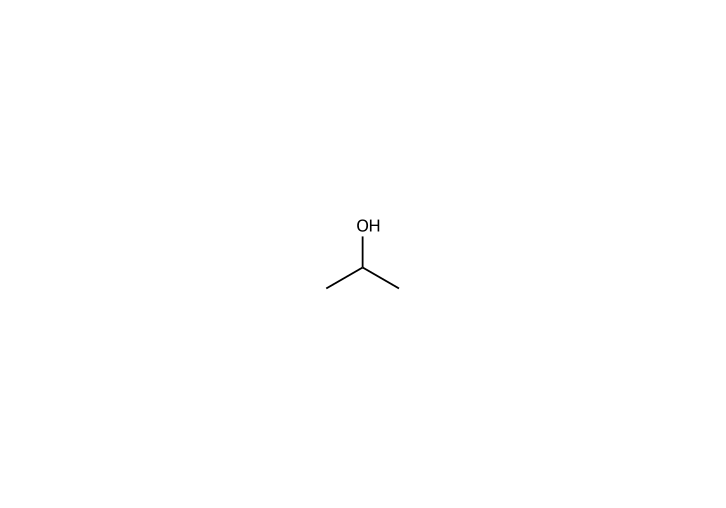
The structure of propan-2-ol is shown below:
Propanone reacts with hydrogen gas to form propan-2-ol according to the following equation: \ceCH3COCH3(g)+H2(g)−>CH3CH(OH)CH3(g)ΔH=−54 kJ mol−1 Using the mean bond enthalpies provided below, what is the mean bond enthalpy of the \ceC=O bond in propanone?
To determine the mean bond enthalpy of the \ceC=O bond, consider the bonds broken and bonds formed during the reaction:
Bonds broken: - In propanone: 6×\ceC−H , 2×\ceC−C , 1×\ceC=O - In \ceH2 : 1×\ceH−HBonds formed: - In propan-2-ol: 7×\ceC−H ( 6 on methyl groups and 1 on the central \ceCH ), 2×\ceC−C , 1×\ceC−O , 1×\ceO−H Cancelling bonds that remain unchanged on both sides leaves the net changes: - Net bonds broken:1×\ceC=O+1×\ceH−H=E(\ceC=O)+436 kJ mol−1 - Net bonds formed:1×\ceC−H+1×\ceC−O+1×\ceO−H=413+358+464=1235 kJ mol−1 Using ΔH=∑(bonds broken)−∑(bonds formed) : −54=[E(\ceC=O)+436]−1235−54=E(\ceC=O)−799E(\ceC=O)=799−54=745 kJ mol−1 Therefore, the correct option is C.
▸Question 25
A chemical equation that represents the reaction of copper(I) phosphide with dilute nitric acid is: \ce3Cu3P+wHNO3−>xCu(NO3)2+3H3PO4+yNO+zH2O where w,x,y, and z are integers.
What is the value of the sum w+x+y+z ?
A.
49
B.
53
C.
57
D.
59
E.
63
Answer and solution
Answer: D
To balance the equation, we equate the number of atoms of each element on both sides of the reaction:
1. **Copper ( \ceCu ):** LHS=3×3=9RHS=x⟹x=9 2. **Phosphorus ( \ceP ):** LHS=3×1=3RHS=3×1=3(already balanced) 3. **Nitrogen ( \ceN ):** LHS=wRHS=2x+y=2(9)+y=18+yy=w−18 4. **Hydrogen ( \ceH ):** LHS=wRHS=3(3)+2z=9+2zz=2w−9 5. **Oxygen ( \ceO ):** LHS=3wRHS=6x+3(4)+y+z=6(9)+12+y+z=66+y+z Substitute the expressions for y and z into the oxygen balance equation: 3w=66+(w−18)+2w−93w=48+w+2w−92w−48=2w−94w−96=w−93w=87⟹w=29 Now calculate y and z : y=29−18=11z=229−9=10 Thus, the coefficients are: w=29,x=9,y=11,z=10 The sum is: w+x+y+z=29+9+11+10=59
▸Question 26
When white phosphorus, \ceP4 , reacts with warm aqueous sodium hydroxide, it undergoes a disproportionation reaction to produce phosphine gas, \cePH3 , and hypophosphite ions, \ceH2PO2− .
The unbalanced ionic equation for this reaction is: a\ceP4+b\ceOH−+c\ceH2O→d\cePH3+e\ceH2PO2− What is the simplest whole-number ratio of e:d in the balanced equation?
A.
1 : 1
B.
1 : 2
C.
2 : 1
D.
1 : 3
E.
3 : 1
F.
1 : 4
G.
4 : 1
H.
3 : 4
Answer and solution
Answer: E
1. Determine the oxidation state of phosphorus in each species: - In \ceP4 , the oxidation state of P is 0 . - In \cePH3 , hydrogen has an oxidation state of +1 , so P has an oxidation state of −3 (reduction: gain of 3 e− per P atom). - In \ceH2PO2− , hydrogen is +1 and oxygen is −2 . Let x be the oxidation state of P : x+2(+1)+2(−2)=−1⟹x−2=−1⟹x=+1 (oxidation: loss of 1 e− per P atom).
2. Balance electron transfer: - Reduction to \cePH3 requires 3 e− . - Oxidation to \ceH2PO2− releases 1 e− . - To balance electrons, 3 phosphorus atoms must be oxidized to \ceH2PO2− for every 1 phosphorus atom reduced to \cePH3 .
Therefore, the stoichiometric ratio of hypophosphite to phosphine produced is e:d=3:1 .
(The fully balanced equation is \ceP4+3OH−+3H2O−>PH3+3H2PO2− , giving a=1,b=3,c=3,d=1,e=3 .)
▸Question 27
The apparatus is used to coat a metal spoon with silver. Which of the following statements is/are correct?
1. The spoon should be connected to the negative terminal so that \ceAg+ ions are reduced on its surface. 2. A silver anode can replace \ceAg+ ions removed from the electrolyte during plating. 3. Alternating current is preferred because regularly reversing the electrode polarity increases the thickness of the coating.
A.
none of them
B.
1 only
C.
2 only
D.
3 only
E.
1 and 2 only
F.
1 and 3 only
G.
2 and 3 only
H.
1, 2 and 3
Answer and solution
Answer: E
The object being plated is the cathode; a silver anode can replenish \ceAg+ . Direct current is required so the electrode roles do not keep reversing, so statement 3 is incorrect.